Uttarakhand UCC Imposes Hindu Code on Other Communities — Maulana Khalid Saifullah Rahmani
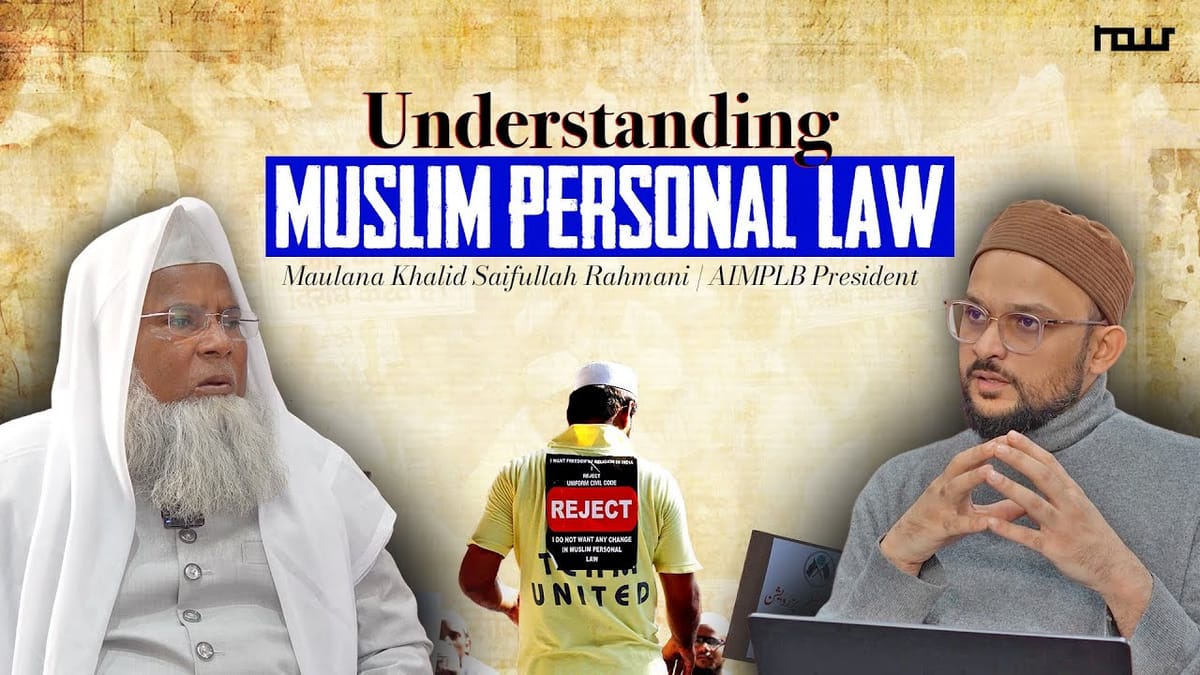
A conversation with Maulana Khalid Saifullah Rahmani on Muslim Personal Law, the role of the AIMPLB, Islamic approaches to reform, women’s rights, and the Uniform Civil Code—set within the framework of India’s constitutional order and religious diversity.
Justice Over Uniformity: Rethinking Muslim Personal Law and the Uniform Civil Code
Few questions in contemporary India generate as much political heat—and as little genuine understanding—as the debate over Muslim Personal Law and the Uniform Civil Code (UCC). Often framed as a struggle between tradition and modernity, or faith and constitutionalism, the discussion is typically reduced to slogans rather than examined through law, history, or lived reality.
In a wide-ranging conversation in this podcast, Maulana Khalid Saifullah Rahmani—Islamic jurist and President of the All India Muslim Personal Law Board (AIMPLB)—offered a rare and detailed articulation of how Muslim Personal Law actually functions, what the Personal Law Board exists to do, and why the push for a Uniform Civil Code raises fundamental constitutional and social questions. Moving beyond political rhetoric, the discussion unpacked the deeper legal, ethical, and civilizational issues at stake.
Why the Personal Law Board Exists
The All India Muslim Personal Law Board was established in 1973, not as a political organisation, but as a constitutional watchdog. Its purpose was to ensure that laws passed by Parliament did not infringe upon the religious freedoms guaranteed by Articles 25 and 26 of the Indian Constitution.
Maulana Rahmani explained that the immediate trigger was the Adoption Bill introduced by the Indira Gandhi government in 1972. The bill proposed granting adopted children the same legal status as biological children, including full inheritance rights. While this framework aligns with Hindu and Western legal traditions, it conflicts with Islamic jurisprudence, which places special emphasis on lineage (nasab).
Islam strongly encourages the care of orphans through kafala—a form of guardianship that is considered highly virtuous and spiritually rewarded. However, it prohibits altering a child’s lineage or legal identity. This distinction protects the inheritance rights of biological relatives and preserves family structures that Islamic law regards as divinely ordained.
The Board was therefore created to monitor legislative developments that might unintentionally—or deliberately—override constitutionally protected religious practices. Its role, Maulana Rahmani stressed, is not to govern Muslims but to defend their right to live according to their faith within the constitutional framework of India.
The Uniform Civil Code and the Question of Neutrality
At the heart of the current debate lies the Uniform Civil Code. While often presented as a neutral instrument of equality, Maulana Rahmani challenged this assumption. In practice, he argued, uniformity frequently means imposing the social norms of the majority upon minorities.
Recent UCC-style legislation, such as the code adopted in Uttarakhand, illustrates this tension. Although framed as “uniform,” these laws largely reflect the structure of the Hindu Code Bill and are extended to other communities without regard for their distinct traditions.
Several examples make this clear:
- Marriage rules: Islamic law permits marriage between cousins—a practice common across large parts of the Muslim world and seen as socially functional. Many proposed “uniform” laws adopt Hindu prohibitions on marriage within certain ancestral lines, thereby restricting Muslim marital choices.
- Adoption versus guardianship: UCC frameworks enforce a Western-style adoption model that erases biological lineage, contradicting Islamic principles that protect family identity while still encouraging the care of orphans.
- Selective uniformity: Tribal communities are often exempted from UCC provisions in the name of cultural preservation. This raises an obvious question: if diversity deserves protection for some, why not for religious minorities?
For Maulana Rahmani, the UCC does not address India’s real social crises—unemployment, poverty, or inequality. Instead, it deepens social distance and fuels mistrust. In his words, it creates “uniformity without harmony.”
Reframing Women’s Rights: Justice, Not Simplistic Equality
One of the most contested areas of Muslim Personal Law concerns women’s rights. Public discourse frequently portrays Islamic law as inherently discriminatory, particularly in matters of divorce and inheritance. Maulana Rahmani argued that this critique rests on a misunderstanding of how Islamic law defines justice.
Islamic jurisprudence distinguishes between musawat (formal equality) and adl (justice or fairness). Justice, in this framework, is not about treating everyone identically, but about distributing rights and responsibilities in a way that produces balance.
Divorce and the Shah Bano Case
The Shah Bano case is often cited as evidence that Islam leaves divorced women economically vulnerable. Maulana Rahmani rejected this portrayal. Under Islamic law, marriage is a contractual relationship. Once it ends, financial responsibility shifts not to the former husband indefinitely, but to the woman’s family—her father, her adult children, or her relatives.
This system, he argued, ensures that a woman is supported by those with enduring kinship ties, rather than by a former spouse with whom the marital bond has ended. Islam, he stressed, does not abandon women after divorce; it redistributes responsibility within the family network.
Inheritance and Economic Responsibility
Similarly, the rule that men receive a larger share of inheritance in certain situations is tied to financial obligations. In Islamic law, men are legally required to provide for their wives, children, and in many cases extended family members. Women, by contrast, retain full control over their wealth.
Where financial responsibility is greater, inheritance shares are adjusted accordingly. In many other cases, women and men inherit equal amounts. The objective is not hierarchy, but economic equilibrium.
Modernity, the West, and the Question of Human Nature
The conversation also addressed the broader philosophical clash between Islamic moral frameworks and contemporary Western culture. Maulana Rahmani drew a distinction between technological progress—which Islam fully embraces—and social changes driven by unchecked desire rather than human nature (fitrah).
He argued that modernity becomes problematic when it undermines the family, erases biological realities, or treats all social limits as oppression. Islam, he said, seeks not to freeze society in the past, but to anchor progress in moral and natural order.
A Vision of Pluralism, Not Separation
Ultimately, Maulana Rahmani framed the defence of Muslim Personal Law not as an act of isolation but as a commitment to India’s pluralistic spirit. Even historically, Islamic legal systems allowed non-Muslims to follow their own personal laws. Diversity in law was seen as a strength, not a threat.
For the Personal Law Board, preserving legal pluralism is essential to genuine secularism. A truly secular state does not impose one cultural model on all; it creates space for communities to live according to their beliefs while sharing equal citizenship.
As Maulana Rahmani concluded, India’s unity does not lie in making everyone the same, but in allowing all to live with dignity under a shared constitutional roof.
Support Independent Media That Matters
Nous is committed to producing bold, research-driven content that challenges dominant narratives and sparks critical thinking. Our work is powered by a small, dedicated team — and by people like you.
If you value independent storytelling and fresh perspectives, consider supporting us.
Contribute monthly or make a one-time donation.
Your support makes this work possible.