The Map of Medina: Why Fiqh is a Blueprint for Society | Dr. Sohail Hanif
This episode explores Fiqh as a social vision rooted in the prophetic model of Medina. It examines how Islamic law shaped institutions of justice, with zakat and waqf functioning as mechanisms for wealth circulation, social welfare, and building a responsible and equitable community.

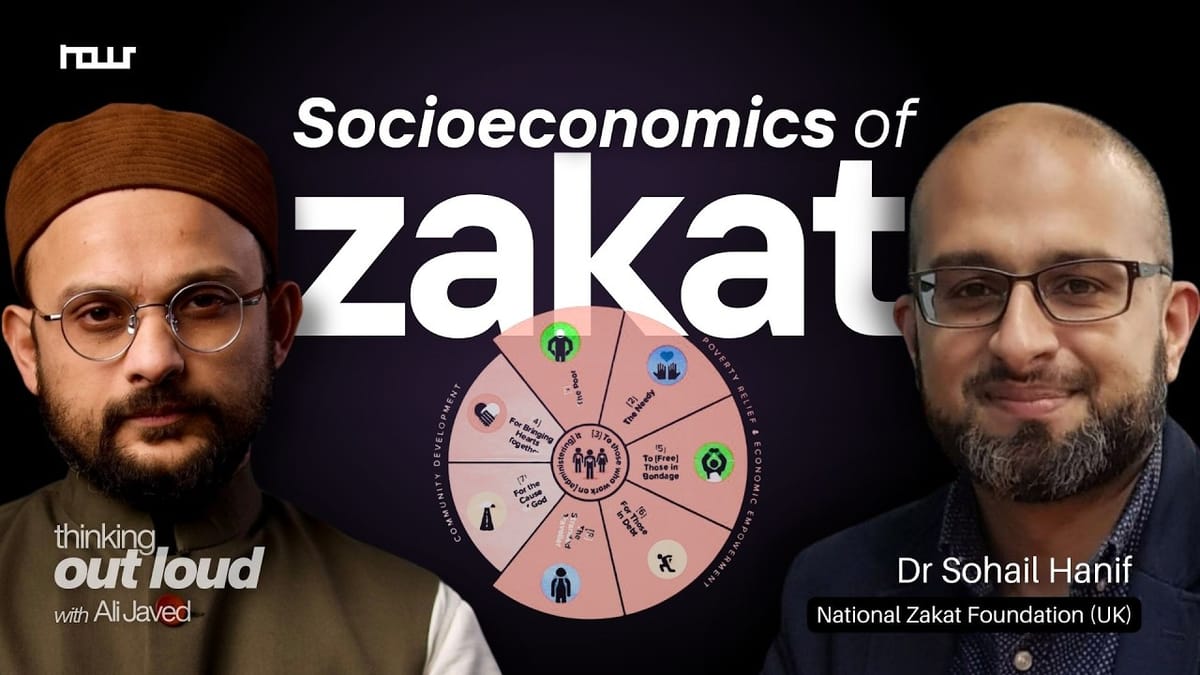
In this episode, the discussion explores Fiqh not merely as a personal legal code but as a comprehensive social vision rooted in the prophetic experience of Madinah. The conversation examines how Islamic law was historically meant to organize society—shaping economic justice, social responsibility, and community institutions.
From the moment the Prophet received revelation to the establishment of the Madinan community, the teachings of Islam evolved into living social systems. A central focus of the discussion is zakat, understood not only as charity but as a structured economic mechanism that circulates wealth, reduces inequality, and builds a responsible community.
The episode also reflects on the broader civilizational impact of these institutions. Beyond zakat, practices like waqf historically expanded welfare, education, and social care across Muslim societies.
By revisiting the prophetic model of Madinah, this conversation invites viewers to rethink the purpose of Islamic law—not simply as personal rules, but as a framework for building a just and compassionate society.
The Map of Medina: Rethinking Fiqh, Sharia, and Zakat as Foundations of Ethical Society
In contemporary discourse, few concepts are as misunderstood as Sharia. Public debates often reduce Islamic law to a narrow set of personal restrictions—rules governing what individuals may or may not do in private life. In both popular media and political rhetoric, Sharia is frequently framed as a rigid system of legalism or an instrument of authoritarian control.
Yet this characterization represents only a fragment of a much richer intellectual tradition.
In a thoughtful and wide-ranging discussion, Dr. Sohail Hanif, Chief Executive Officer of the National Zakat Foundation (UK) and a scholar of Islamic legal theory, offers a different perspective. Drawing on classical jurisprudence as well as historical experience, he argues that fiqh and Sharia were never intended to function merely as a list of personal rulings. They were conceived as a framework for building societies.
From this vantage point, Islamic law appears not as a collection of prohibitions but as a map for constructing ethical communities—structures capable of balancing spiritual values, social justice, and economic responsibility.
Understanding this vision requires returning to one of the most formative moments in Islamic history: the establishment of the Prophet Muhammad’s (PBUH) community in Medina.
Medina as a Civilizational Model
The migration of the Prophet Muhammad (PBUH) from Mecca to Medina—the Hijra—is often remembered primarily as a historical turning point. But its significance goes far beyond geography or chronology.
For Dr. Hanif, the Hijra represents the moment when spiritual ideals were translated into institutional reality.
During the Meccan period, the emphasis lay on shaping the moral and spiritual character of believers. The revelations addressed questions of faith, ethics, and personal transformation. The Medinan period, however, introduced a new dimension: the construction of a functioning social order.
In Medina, a diverse city composed of Muslim migrants, local Arab tribes, and Jewish communities, the Prophet established a political and social framework capable of organizing plural communities under shared principles of justice and mutual responsibility.
In this sense, Sharia can be understood as the constitutional architecture of the Medinan community—a system designed not merely to regulate individual behavior but to guide governance, economic exchange, social welfare, and conflict resolution.
When classical jurists later developed detailed legal frameworks covering family life, trade, charity, criminal law, and dispute mediation, they were essentially elaborating on this foundational blueprint.
If the spirit of Sharia were to be condensed into a single idea, Dr. Hanif suggests, it would be this: “Build Medina wherever you are.”
Fiqh as a Social Map
To understand this vision more clearly, it is important to distinguish between Sharia and fiqh.
Sharia, in Islamic thought, represents the overarching moral and legal path derived from divine revelation. Fiqh, by contrast, is the human effort to interpret and apply that path to concrete social realities.
Over centuries, scholars developed fiqh not as an abstract legal exercise but as a practical tool for organizing communities. Legal rulings on marriage, inheritance, business transactions, charitable obligations, and dispute resolution all formed part of a larger attempt to structure society in a manner consistent with ethical and spiritual values.
Viewed this way, fiqh resembles a social map—a guide that helps communities navigate questions of justice, cooperation, and responsibility.
Such a perspective challenges the widespread notion that Islamic law is purely punitive or authoritarian. Instead, it highlights the extent to which classical jurists were concerned with maintaining social balance and protecting human dignity.
Pluralism and the Limits of State Power
One of the most striking features of the Medinan model was its commitment to legal pluralism.
The early Islamic community did not attempt to erase religious diversity. Jewish tribes living in Medina, for instance, were permitted to govern many aspects of their communal life according to their own legal traditions. Disputes within these communities could be addressed by their own scholars and judges.
This arrangement reflects a broader principle within Islamic legal theory: different communities may coexist within a shared political framework while maintaining distinct religious practices and legal traditions.
In contrast to modern assumptions that centralized authority must dominate every aspect of social life, classical Islamic governance often relied on a distributed structure of authority.
Families, guilds, religious institutions, and local communities all played roles in regulating social life. This diffusion of power limited the reach of the central state and prevented excessive concentration of authority.
In modern political systems—where bureaucratic states frequently absorb responsibilities once carried by local communities—this historical model offers an intriguing alternative.
It suggests that stable societies may depend not only on strong governments but also on robust networks of community responsibility.
Zakat: An Economic System, Not Just Charity
At the heart of this social architecture lies zakat, one of the five pillars of Islam.
In many contemporary discussions, zakat is treated primarily as an individual act of charity. Yet in the classical Islamic framework, zakat functioned as a systemic economic institution.
Its purpose was not simply to encourage generosity but to ensure the circulation of wealth and the protection of vulnerable members of society.
The mechanism is straightforward yet powerful. A portion of accumulated wealth—typically 2.5 percent annually—is redistributed to designated categories of recipients, including the poor, the indebted, and those struggling to meet basic needs.
This practice creates several transformative effects.
First, it discourages the hoarding of idle wealth. Resources are either invested productively in the real economy or redistributed to those who require support.
Second, zakat strengthens local solidarity. Historically, zakat was collected and distributed within the same community where it originated. This localization fostered a sense of shared responsibility among neighbors.
Third, zakat reframes the relationship between wealth and poverty. Rather than viewing the poor as passive recipients of charity, Islamic ethics regards them as essential participants in maintaining the moral balance of society. Through their presence, wealth is purified and redistributed.
In this way, zakat becomes not merely a charitable gesture but an institutional mechanism for economic justice.
Relevance in the Modern World
The question naturally arises: what relevance does the Medinan model hold in contemporary societies, particularly for Muslim minorities living within modern nation-states?
Dr. Hanif argues that the principles underlying fiqh and zakat remain profoundly relevant.
Many modern states face widening inequality, strained welfare systems, and growing social fragmentation. Public institutions often struggle to address the needs of vulnerable populations, leaving communities searching for alternative forms of support.
In this context, organized zakat initiatives offer a practical means of strengthening community resilience.
The National Zakat Foundation in the United Kingdom, under Dr. Hanif’s leadership, provides one example of how classical principles can be adapted to contemporary conditions. By combining traditional obligations with modern financial transparency, digital infrastructure, and community partnerships, the organization seeks to rebuild a culture of localized welfare and mutual care.
Such initiatives demonstrate that religious traditions can function not only as sources of personal spirituality but also as frameworks for civic engagement.
Building Communities in Minority Contexts
For Muslims living as minorities in plural societies, the Medinan model also offers guidance on navigating civic participation.
Rather than withdrawing from broader society, the classical Islamic tradition encourages collaboration and coalition-building. Communities are urged to contribute positively to the public good while maintaining their ethical commitments.
Local zakat networks, community welfare programs, and partnerships with civil institutions can therefore serve both religious and civic purposes.
In this sense, the call to “build Medina wherever you are” does not imply creating parallel societies. Instead, it invites communities to cultivate ethical institutions capable of serving both their own members and the wider public.
The Vision of Cross-Generational Responsibility
Ultimately, the intellectual tradition surrounding fiqh and zakat reflects a long-term civilizational vision.
Islamic law was never intended to function merely as a mechanism for regulating individual conduct. It was designed to nurture communities capable of sustaining justice, compassion, and cooperation across generations.
Dr. Hanif describes this responsibility as a form of civilizational stewardship. Each generation inherits ethical principles and institutional frameworks from the past, adapts them to present circumstances, and passes them forward to the future.
The example of Medina illustrates how spiritual ideals can be translated into durable social structures.
Conclusion: Recovering the Broader Meaning of Sharia
In contemporary debates, discussions of Sharia often become trapped in narrow legal controversies or political anxieties. Such debates overlook the broader intellectual and ethical ambitions of the Islamic legal tradition.
The Medinan model reveals a different story—one in which law, morality, economics, and community life are interwoven into a comprehensive vision of social order.
Fiqh serves as the interpretive map guiding this vision. Zakat functions as one of its central economic institutions. Together, they reflect an attempt to build societies where wealth circulates responsibly, communities care for their vulnerable members, and diverse groups coexist under shared principles of justice.
For modern readers, the lesson of Medina may not lie in replicating its historical circumstances. Rather, it lies in recognizing that ethical societies require structures of responsibility—institutions capable of translating moral values into practical action.
The challenge today, as in the past, is to imagine how those principles can be realized within the complexities of contemporary life.
Support Independent Media That Matters
Nous is committed to producing bold, research-driven content that challenges dominant narratives and sparks critical thinking. Our work is powered by a small, dedicated team — and by people like you.
If you value independent storytelling and fresh perspectives, consider supporting us.
Contribute monthly or make a one-time donation.
Your support makes this work possible.