How Shaheen Bagh Redefined Indian Muslim Political Agency
This roundtable reexamines Shaheen Bagh as a decisive moment of Muslim political assertion during the CAA–NRC crisis. It explores protest, policing, media narratives, and the unresolved questions Shaheen Bagh left for Muslim political futures in India.
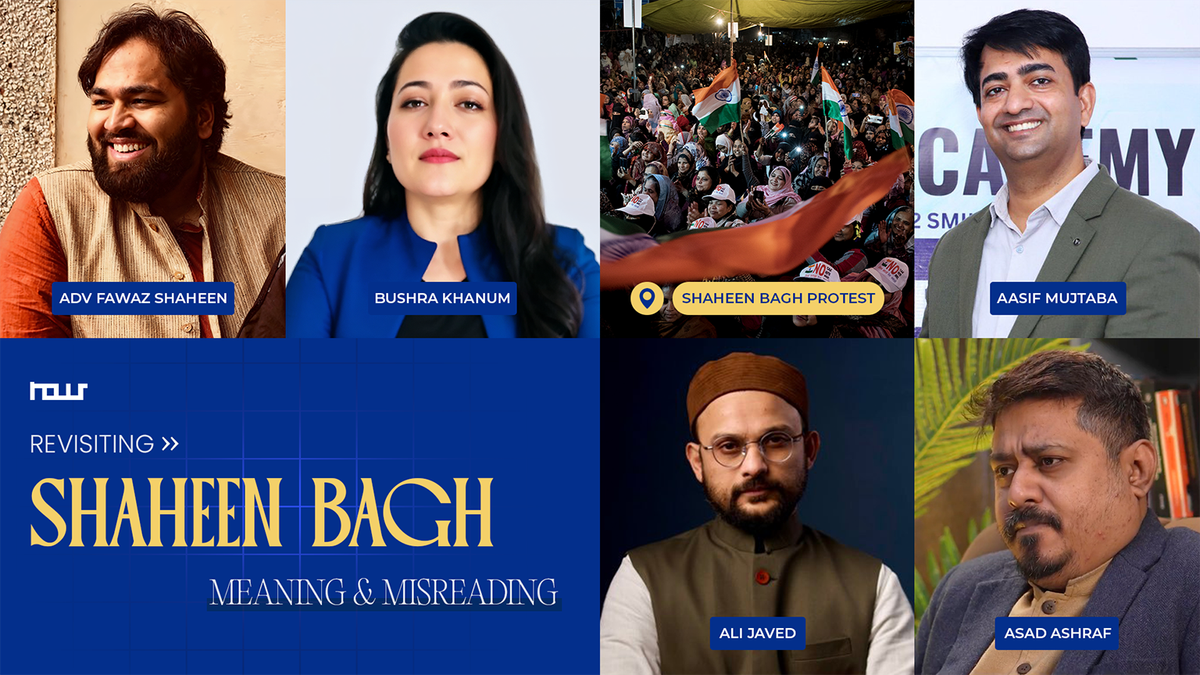
Six Years After Shaheen Bagh: Muslim Political Assertion, Citizenship, and the Battle Against Forgetting
Six years have passed since a modest stretch of road in South Delhi became the unlikely centre of one of the most consequential political moments in contemporary India. Shaheen Bagh was not simply a protest site; it was a rupture—one that unsettled the state, disrupted established modes of dissent, and redefined Muslim political presence in the public sphere.
A recent roundtable discussion brought together voices from law, media, activism, and student movements to revisit Shaheen Bagh not through the lens of nostalgia, but as a moment of Muslim political assertion whose implications remain deeply unfinished. The conversation situated the anti-CAA–NRC movement as a historical interruption that transformed citizenship from an abstract legal status into a lived experience of precarity, fear, and resistance.
As India today confronts new administrative and bureaucratic mechanisms of exclusion, the need to critically revisit Shaheen Bagh—its meanings, limits, and legacies—has become urgent.
Beyond the CAA: The Deeper Crisis of Citizenship
While the Citizenship Amendment Act (CAA) served as the immediate trigger for the protests, panelists emphasised that the anxiety fueling Shaheen Bagh ran far deeper. The turning point was not merely the passage of a law, but the articulation of a “chronology”—a public linkage made by the Home Minister between the CAA, the National Population Register (NPR), and the National Register of Citizens (NRC).
This linkage introduced, for the first time in independent India, the possibility that citizenship—particularly Muslim citizenship—could be subjected to documentary tests in a deeply unequal society where millions lack formal papers. The threat was existential rather than symbolic: a future where belonging itself could be bureaucratically withdrawn.
This fear did not emerge in isolation. The panel situated Shaheen Bagh within a continuum of institutional betrayals: the Babri Masjid verdict, the criminalisation of Triple Talaq, the normalisation of lynching, and the steady erosion of Muslim grievances within legislative, judicial, and executive spaces. Together, these moments produced a profound political realisation—that formal democratic avenues were no longer responsive.
As one of the early organisers, Aasif Mujtaba, noted during the discussion: when representation collapses across institutions, peaceful disruption becomes the only remaining democratic language. The road blockade, or chakka jam, was not an innovation but a historically legitimate form of civil disobedience—used during the freedom struggle and labour movements—yet in 2019 it was aggressively delegitimised to frame Muslim protest as inherently unlawful.
Women at the Centre: Disrupting Power and Stereotypes
The most transformative aspect of Shaheen Bagh was the unprecedented leadership of Muslim women. From elderly grandmothers to young students, women emerged not as symbolic participants but as the political backbone of the movement.
Their presence shattered two dominant and opposing narratives. On the one hand, Hindutva discourse portrays Muslim women as oppressed subjects in need of rescue—invoked selectively during debates on Triple Talaq. On the other, liberal-secular frameworks often recognise Muslim women only when they disassociate from visible religious identity.
At Shaheen Bagh, women refused both roles. They spoke openly as Muslims, as mothers, as grandmothers, and as citizens confronting an uncertain future for their families. Their protest was rooted not in abstraction but in intimate fear: whether their children and grandchildren would continue to belong to the nation.
This assertion unsettled the state and sections of civil society alike. It demonstrated that Muslim women were not passive recipients of politics but its authors—capable of sustained leadership, articulation, and moral authority.
From Compromised to Common Solidarity
A critical conceptual shift articulated during the panel was the movement away from what participants termed “compromised solidarity.” Historically, Muslims have often been expected to dilute or erase religious identity to secure secular support—avoiding Islamic symbols, slogans, or theological language to appear politically acceptable.
Shaheen Bagh disrupted this expectation. Protesters read the Constitution alongside the Qur’an. Islamic expressions coexisted with constitutional values. This was not a contradiction but a political statement: that Muslim identity and democratic citizenship are not mutually exclusive.
Drawing on political theorist Hannah Arendt, a panelist observed that when a community is attacked on the basis of identity, resistance cannot be effective if that identity is denied. The insistence on common solidarity—support without preconditions—exposed discomfort among segments of the liberal intelligentsia, particularly when Muslim leadership appeared assertive, articulate, and autonomous.
This discomfort revealed the limits of liberal allyship, especially when Muslims refused to perform victimhood or conform to secular caricatures.
Policing, Media, and the Criminalisation of Dissent
The discussion also foregrounded how state power responded once the protests gained national momentum. Police violence, selective arrests, and media framing played a decisive role in delegitimising the movement. Peaceful dissent was recast as conspiracy; protestors were transformed into suspects.
In the aftermath, the state extended its response from repression to criminalisation. Student leaders and activists associated with the movement—such as Sharjeel Imam, Umar Khalid, and Gulfisha Fatima—were incarcerated under stringent anti-terror and sedition laws. The message was unambiguous: dissent would be punished retrospectively.
As one panelist noted, the objective was not only to dismantle the protest but to rewrite its memory.
From NRC to SIR: The Evolving Architecture of Exclusion
Crucially, the panel warned against viewing Shaheen Bagh as a closed chapter. While the NRC may no longer dominate headlines, exclusionary practices have mutated into quieter, bureaucratic forms. Mechanisms such as Special Intensive Revisions (SIRs) and “intensive revision” of electoral rolls were described as a backdoor NRC.
Unlike earlier voter list revisions, recent processes invert the burden of proof—placing responsibility on citizens to establish eligibility, often at short notice and through opaque procedures. Failure to comply risks deletion from electoral rolls, effectively disenfranchising populations already rendered vulnerable.
Provisions allowing officials to flag “doubtful” citizens echo the Assam NRC experience, where nearly two million people were excluded, many of them Muslims. The panel characterised this strategy as bureaucratic violence: exclusion without spectacle, implemented through paperwork rather than proclamation.
Accompanying this is what was described as shock politics—a rapid succession of contentious interventions, from Uniform Civil Code debates to Waqf amendments and demolitions, designed to sustain perpetual anxiety and prevent organised political consolidation.
Memory Versus Power
Six years on, Shaheen Bagh no longer exists as a physical occupation, but its symbolic terrain remains contested. The state’s attempt to criminalise the movement is ultimately an attempt to erase its democratic legitimacy.
Quoting Milan Kundera, a panelist remarked: “The struggle of man against power is the struggle of memory against forgetting.” To forget Shaheen Bagh as a peaceful, women-led, constitutional resistance is to surrender the narrative to those who benefit from erasure.
Yet the panel also turned inward. It acknowledged that while the spirit of Shaheen Bagh endures—particularly among younger Muslims—there has been a failure to institutionalise its political energy. Independent think tanks, media platforms, legal collectives, and research institutions capable of sustaining counter-narratives remain underdeveloped. Performative activism has too often substituted for durable organisation.
Conclusion: An Unfinished Political Moment
Shaheen Bagh was not an endpoint; it was an interruption. It exposed the fragility of Muslim citizenship, challenged conditional solidarity, and demonstrated the transformative power of unapologetic political presence—especially by women.
As the instruments of exclusion become more procedural and less visible, the lessons of Shaheen Bagh acquire renewed relevance. Its legacy lies not only in what it achieved, but in the questions it left behind: about leadership, institutional memory, political autonomy, and the future of Muslim citizenship in India.
The road at Shaheen Bagh was eventually cleared. The task now is to ensure that the history of resistance it hosted is not.
Support Independent Media That Matters
Nous is committed to producing bold, research-driven content that challenges dominant narratives and sparks critical thinking. Our work is powered by a small, dedicated team — and by people like you.
If you value independent storytelling and fresh perspectives, consider supporting us.
Contribute monthly or make a one-time donation.
Your support makes this work possible.