Did British Colonial Rule Reshape Hindu–Muslim Relations? | Prof. SherAli Tareen
Prof. SherAli Tareen explores the limits of Hindu–Muslim coexistence in South Asia, drawing on Perilous Intimacies. The discussion examines how Muslim scholars debated pluralism, theology, and political power during colonial rule and the rise of modern identities.

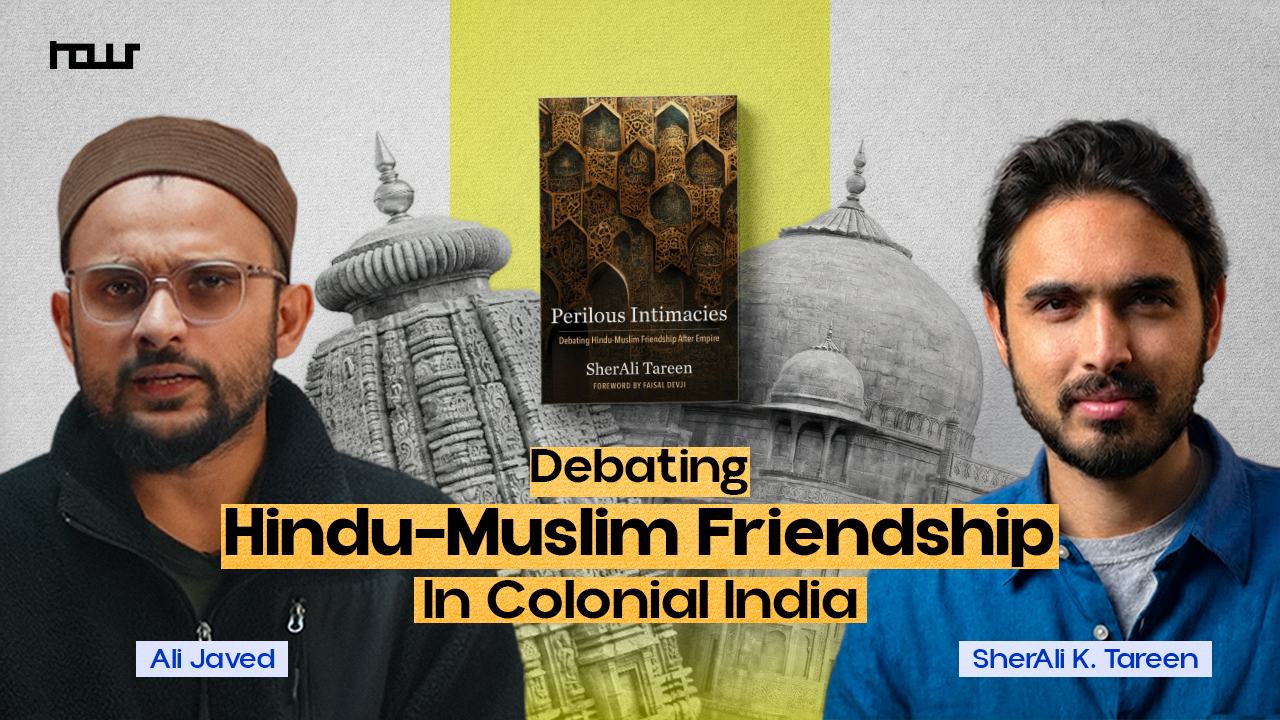
What were the limits of Hindu–Muslim friendship and coexistence in South Asian history?
In this latest podcast with SherAli Tareen, we explore his work Perilous Intimacies: Debating Hindu-Muslim Friendship After Empire, which examines how Muslim scholars (ulama) debated questions of pluralism, difference, and coexistence between the mid-18th and mid-20th centuries, a period marked by colonial transformation and the emergence of modern political identities.
Rather than viewing Hindu–Muslim relations through simplistic communal narratives, this discussion explores how theological, legal, and intellectual debates shaped Muslim responses to empire, nationalism, and shifting structures of political power.
Shadows of Empire: Colonial Rule, Lost Sovereignty, and the Remaking of Hindu–Muslim Relations
The story of Hindu–Muslim relations in South Asia is often told through tired binaries—coexistence or conflict, syncretism or separatism, tolerance or communalism. Yet such frames flatten a far more intricate history. In a rich conversation based on his book Perilous Intimacies: Debating Hindu–Muslim Friendship After Empire, SherAli Tareen invites us to reconsider the 19th and early 20th centuries not as a prelude to inevitable partition, but as a period of intense theological creativity, moral anxiety, and political reimagination.
At the heart of this transformation lies a single, shattering event: 1857.
1857 and the End of Imperial Muslim Political Theology
The revolt of 1857 was not merely a failed uprising against the British. For many Muslim scholars, it marked the end of an entire political imagination. For centuries, Islamic legal and theological traditions in South Asia had operated within what we might call an “imperial Muslim political theology”—an assumption that religious authority and political sovereignty ultimately converged. Even when Muslim power waned, the hope of its restoration lingered.
After 1857, that hope collapsed.
This was not simply the loss of a dynasty; it was the loss of the plausibility of Muslim sovereignty in the subcontinent. The question that haunted Muslim intellectuals was existential: How does one live Islam fully in a world where political power is permanently absent?
Paradoxically, this crisis did not produce stagnation. It generated one of the most vibrant periods of Islamic debate in South Asian history. Movements such as the Deobandis, Barelvis, and Ahl-i Hadith emerged not as rigid monoliths but as rival answers to the same pressing dilemma: how to preserve moral authority without a state.
The anxiety of minority-hood—numerical and political—became intellectually productive.
The Colonial Public Sphere and the Illusion of Neutral Governance
British rule introduced more than foreign domination. It introduced a new grammar of governance. Through instruments like the census, law codes, and print culture, the colonial state reclassified populations into sharply defined religious communities: Hindu, Muslim, Sikh, and so on.
This bureaucratic taxonomy was revolutionary.
The colonial state promised neutrality: it would manage the political sphere while leaving religion untouched, provided public order remained intact. But in separating “religion” from “politics,” the British did not depoliticize religion—they intensified it. Religion became a competitive public identity, numerically measured and legally regulated.
Public debates such as the 1876 Shahjahanpur confrontation between Maulana Muhammad Qasim Nanautavi and Arya Samaj founder Dayanand Saraswati were emblematic of this new world. Interreligious polemics became staged spectacles, supervised by colonial authority, conducted in print, and framed by the logic of majority and minority.
Modern communal consciousness was not a medieval inheritance; it was, in crucial ways, a colonial production.
Muwalat: Friendship, Sovereignty, and the Limits of Coexistence
One of the most illuminating contributions of Prof. Tareen’s work is his attention to the theological concept of muwalat—friendship or intimacy with non-Muslims. This was not a sentimental term. It indexed questions of loyalty, sovereignty, and power.
In the absence of a Muslim state, could political alliance with Hindus be justified? Could ritual markers be compromised for strategic unity?
These questions became especially urgent during the Khilafat Movement. Leaders such as Maulana Abul Kalam Azad allied with Gandhi and the Congress to defend the Ottoman Caliphate. For them, global Muslim sovereignty symbolized by the Caliphate gave meaning to everyday ritual practice. Strategic friendship with Hindus was a temporary necessity for a higher political goal.
Opposing this approach were scholars like Ahmad Raza Khan. Often mischaracterized as merely traditionalist or reactionary, he argued that compromising visible Islamic practices—cow sacrifice, ritual distinctions, devotional forms—would hollow out Muslim sovereignty at its core. In a world without Muslim rule, ritual life itself became the site of sovereignty.
Thus emerged two competing visions:
- Sovereignty through political alliance.
- Sovereignty through ritual distinction.
Both were attempts to answer the same question: how does a community retain dignity without state power?
Shattering Simplistic Binaries
Modern narratives often sanitize history into moral caricatures: Sufis as tolerant mystics, jurists as rigid legalists; modernists as progressive heroes, traditionalists as obscurantists.
Prof. Tareen dismantles these categories.
Imam Ahmad Raza Khan was not only a strict jurist but also a Qadiri Sufi master. His insistence on Muslim distinction coexisted with deep devotional spirituality. Likewise, Sir Syed Ahmad Khan—celebrated as a modernist—held views on imitation (tashabbuh) and communal boundaries that complicate any easy liberal reading of his legacy.
The past was not divided into “good Muslims” and “bad Muslims.” It was animated by serious moral disagreement over how to inhabit modernity faithfully.
This insight is crucial. When we reduce historical actors to ideological mascots, we lose sight of the intellectual seriousness with which they wrestled with power, loss, and survival.
From Empire to Nation-State: The Expansion of Coercive Power
If colonial rule destabilized older political theologies, the modern nation-state has intensified the problem.
Unlike premodern empires, today’s nation-states possess unparalleled coercive capacity. They regulate populations through demographics, surveillance, and the language of public order. Law becomes the ultimate arbiter of legitimacy.
In such a framework, majoritarian sensibilities often become normalized as “national interest.” Whether in India, Pakistan, or Bangladesh, minority difference is tolerated only insofar as it does not disrupt dominant narratives.
The anxiety that began in 1857 thus persists—transformed but unresolved. The loss of sovereignty has been replaced by the challenge of living under states that define belonging numerically and enforce unity legally.
The Liberal Trap and the Politics of Respectability
One of the most provocative elements of the discussion is its critique of liberal-secular expectations. Contemporary solidarity often hinges on whether Muslims articulate their grievances in a language palatable to secular norms.
Muslim political expression that appears assertive, theological, or unapologetically distinct is frequently met with discomfort. The demand is subtle but clear: translate your politics into secular idiom, or risk isolation.
This dynamic mirrors the colonial moment, where religion was tolerated only within carefully bounded limits.
The deeper issue is not simply representation; it is sovereignty over moral vocabulary. Who decides which expressions of faith are legitimate? Who defines the acceptable boundaries of dissent?
Rethinking Coexistence
What, then, were the limits of Hindu–Muslim friendship?
The historical record suggests that coexistence was never merely about social harmony. It was entangled with questions of power, hierarchy, ritual practice, and political aspiration. Friendship could empower—but it could also dilute. Distinction could preserve dignity—but it could also entrench division.
The tragedy of colonial modernity was not that it created difference. Difference had always existed. Its tragedy lay in reconfiguring difference into competitive, bureaucratically managed identities within an unforgiving political order.
Lessons for the Present
The intellectual heritage of 19th- and early 20th-century Muslim scholars in South Asia is not one of blind traditionalism or inevitable communalism. It is a tradition of rigorous debate under conditions of profound loss.
Their arguments remind us that:
- Religious traditions are dynamic responses to historical rupture.
- Political theology does not disappear with empire; it mutates.
- Sovereignty can migrate—from the state to ritual, from empire to community.
Most importantly, they urge us to resist reductive frameworks. The colonial gaze divided communities into static categories. The modern nation-state often perpetuates those divisions in new forms.
To move forward requires intellectual honesty: acknowledging that Hindu–Muslim relations have always involved negotiation, tension, and moral risk. Coexistence is not a sentimental ideal; it is a contested practice shaped by power.
If there is hope, it lies in recovering the depth of these earlier debates—where disagreement was sharp but serious, and where the struggle to live ethically in a fractured world was taken as a sacred responsibility.
The shadows of empire remain long. But so too does the legacy of critical thought it provoked.
Support Independent Media That Matters
Nous is committed to producing bold, research-driven content that challenges dominant narratives and sparks critical thinking. Our work is powered by a small, dedicated team — and by people like you.
If you value independent storytelling and fresh perspectives, consider supporting us.
Contribute monthly or make a one-time donation.
Your support makes this work possible.