What Economic Growth Stories Neglect in India | Dr. Amir Ullah Khan
India’s growth story is often told through markets and income—but who is left out? In this Nous podcast, Dr. Amir Ullah Khan unpacks how exclusion is shaped by policy, institutions, and labour markets, showing why development without justice deepens inequality and demands urgent course correction.
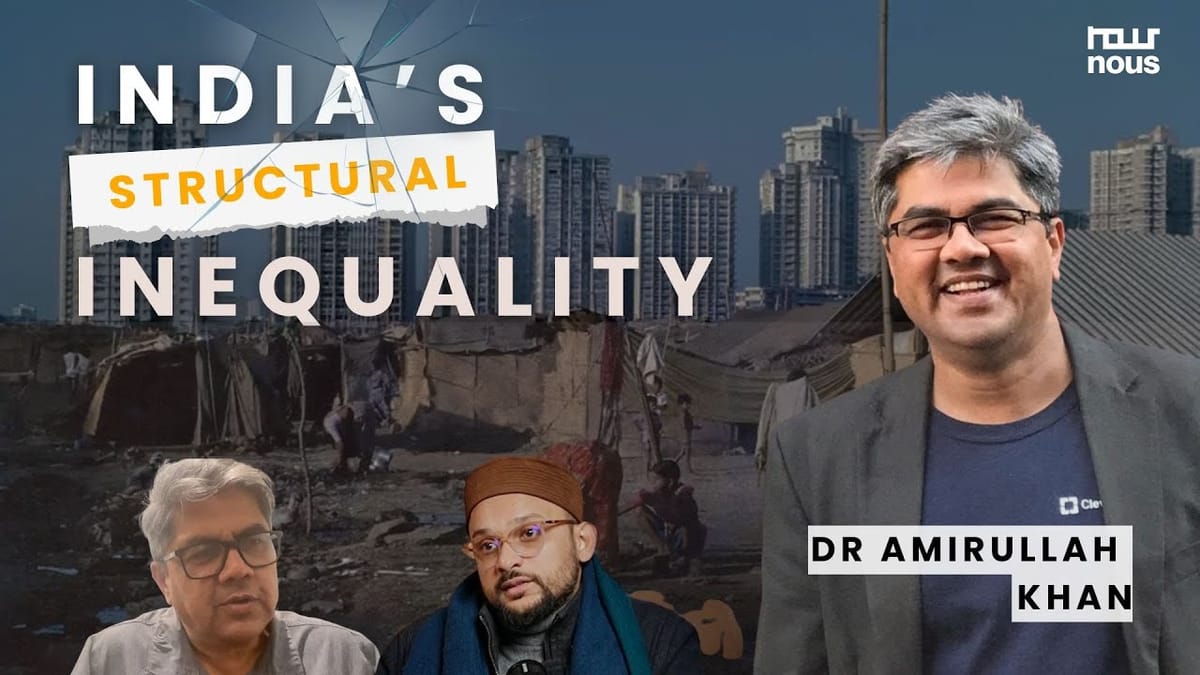
India today is routinely showcased as one of the world’s fastest-growing economies. Rising GDP figures, expanding markets, and global investor interest are cited as evidence of national progress. Yet behind these headline numbers lies a deeper, more unsettling question: growth for whom, and at what cost? In a wide-ranging conversation on the Nous podcast, development economist Dr. Amir Ullah Khan urges us to look beyond the celebratory narrative of economic growth and confront the realities of exclusion, institutional failure, and structural inequality that continue to shape everyday life for millions of Indians.
Growth Is Not Development
At the heart of Dr. Khan’s argument is a critical distinction that is often blurred in public discourse—the difference between economic growth and human development. Growth, he explains, is largely automatic. When capital, labour, and land are available, economic activity expands. Development, however, is neither automatic nor accidental. It requires deliberate, sustained state intervention to ensure access to health, education, infrastructure, and dignity.
For decades, Indian policymakers subscribed to the logic of trickle-down economics: that rapid growth would eventually lift all sections of society. The evidence suggests otherwise. While India’s economy has expanded, development indicators remain deeply uneven. Nearly half the population still lacks access to safe drinking water, and modern healthcare remains out of reach for millions. Disease, poverty, and vulnerability persist not because growth has failed, but because development has been systematically deprioritised.
In functioning welfare states, the division of responsibility is clear: markets drive growth, while the state guarantees development. In India, this balance has been inverted. Governments have focused on growth metrics, while individuals are left to fend for themselves for education, healthcare, and basic services. The consequences are visible everywhere—from polluted cities and collapsing public infrastructure to widening inequalities that cut across social and religious lines.
The Muslim Question: Deprivation or Discrimination?
While governance failures affect all Indians, Dr. Khan draws attention to a disturbing and distinct trajectory in the case of Indian Muslims. The central question, he argues, is whether Muslims are merely deprived due to poverty, or actively discriminated against through policy and practice.
Long-term data reveals a troubling pattern. Over successive generations, Scheduled Castes and Scheduled Tribes have experienced gradual upward mobility. Muslims, however, are the only major community in India where the current generation is, on average, worse off than the previous one. This reversal cannot be explained by economics alone.
Dr. Khan identifies two broad phases behind this decline. In the decades following Independence, Muslim marginalisation was shaped largely by historical and structural factors. The migration of educated and elite Muslims during Partition, followed by later waves of emigration to West Asia and the West, hollowed out leadership within the community. The decline of Urdu as an administrative and educational language further restricted access to state institutions and higher education.
In recent years, however, Dr. Khan argues that marginalisation has taken on a more explicit and institutionalised form. Policies and political rhetoric around housing segregation, the withdrawal of scholarships, and campaigns such as those framed around so-called “Love Jihad” have normalised exclusion. What was once neglect has increasingly begun to resemble discrimination sanctioned by the state.
Labour Markets and Everyday Exclusion
The effects of this discrimination are most visible in urban labour markets. While rural economies often mask bias due to informality and community-based work, cities expose it starkly. Studies cited by Dr. Khan show that equally qualified candidates with Muslim names routinely receive lower wage offers or fewer job opportunities than their non-Muslim counterparts. This is not only a moral failure but an economic one—it distorts markets, reduces efficiency, and violates the constitutional principle of equal pay for equal work.
Such exclusion underscores a broader truth: inequality in India is not simply about income levels. It is structured through institutions, labour markets, and policy choices that determine who belongs and who does not.
The Myth of Meritocracy
One of the most persistent defences of inequality is the idea of meritocracy—the belief that education alone can overcome disadvantage. Dr. Khan dismantles this argument by exposing the vastly unequal conditions under which “merit” is produced.
Education in India, he argues, overwhelmingly serves the privileged. A child who travels to a well-resourced private school, supported by tutors and stable infrastructure, competes in the same examination system as a child studying in a dilapidated government school with teacher shortages and missing textbooks. To describe this as meritocracy is to ignore reality.
Worse still, the promise that education guarantees employment is rapidly eroding. India’s growth has been largely jobless. A vast majority of engineering and management graduates struggle to find work, revealing a sharp decline in the economic returns to education. In this context, education must be valued not merely as a pathway to employment, but as a public good that builds critical thinking, citizenship, and social understanding—especially when jobs themselves are scarce.
Healthcare and the Cost of Illness
Nowhere is the state’s abdication more evident than in healthcare. Dr. Khan notes that a single episode of illness is the most common trigger pushing Indian families into chronic poverty. Government data shows that tens of millions fall below the poverty line every year due to medical expenses alone.
This crisis stems from three interconnected failures. First, responsibility for health has been shifted from the state to individuals. Second, health policymaking is increasingly centralised, ignoring vast differences between states and regions. Third, relentless privatisation has created a two-tier system: world-class hospitals for the wealthy and medical tourists, and crumbling public facilities for everyone else.
Marginalised communities, particularly Muslims who are more dependent on public healthcare, bear the brunt of this collapse. When public systems fail, there is no safety net to fall back on.
Identity Over Profession
Beyond economics, Dr. Khan warns of a deeper sociological shift underway in India—the replacement of professional identity with religious identity. In stable economies, people primarily see themselves as workers, professionals, or citizens. Increasingly, however, public life is organised around religious labels.
This shift has serious economic consequences. Social polarisation distracts from urgent issues like unemployment and urban decay, while creating instability that deters investment. Capital does not flow into societies marked by constant social friction and calls for exclusion or boycott. The politics of identity, Dr. Khan argues, ultimately undermines the very growth it claims to defend.
Reclaiming the Developmental State
Despite the gravity of his critique, Dr. Khan does not advocate despair or reactionary responses. He is sceptical of economic boycotts and symbolic gestures, noting that they are often ineffective and legally questionable. Instead, he calls for a renewed commitment to democratic, evidence-based engagement.
History shows that sustained, data-driven protest can work. Just as the farm laws were repealed after prolonged democratic pressure, India’s development trajectory can be corrected through constitutional means—by demanding accountability, transparency, and policy grounded in evidence rather than ideology.
As India aspires to become a developed nation by 2047, the choice is stark. A country cannot call itself developed while leaving 15–20 percent of its population behind. Development without justice merely reproduces inequality. True progress will require the state to reclaim responsibility for health and education, and society to reject the politics of discrimination in favour of a shared, inclusive economic future.
Support Independent Media That Matters
Nous is committed to producing bold, research-driven content that challenges dominant narratives and sparks critical thinking. Our work is powered by a small, dedicated team — and by people like you.
If you value independent storytelling and fresh perspectives, consider supporting us.
Contribute monthly or make a one-time donation.
Your support makes this work possible.