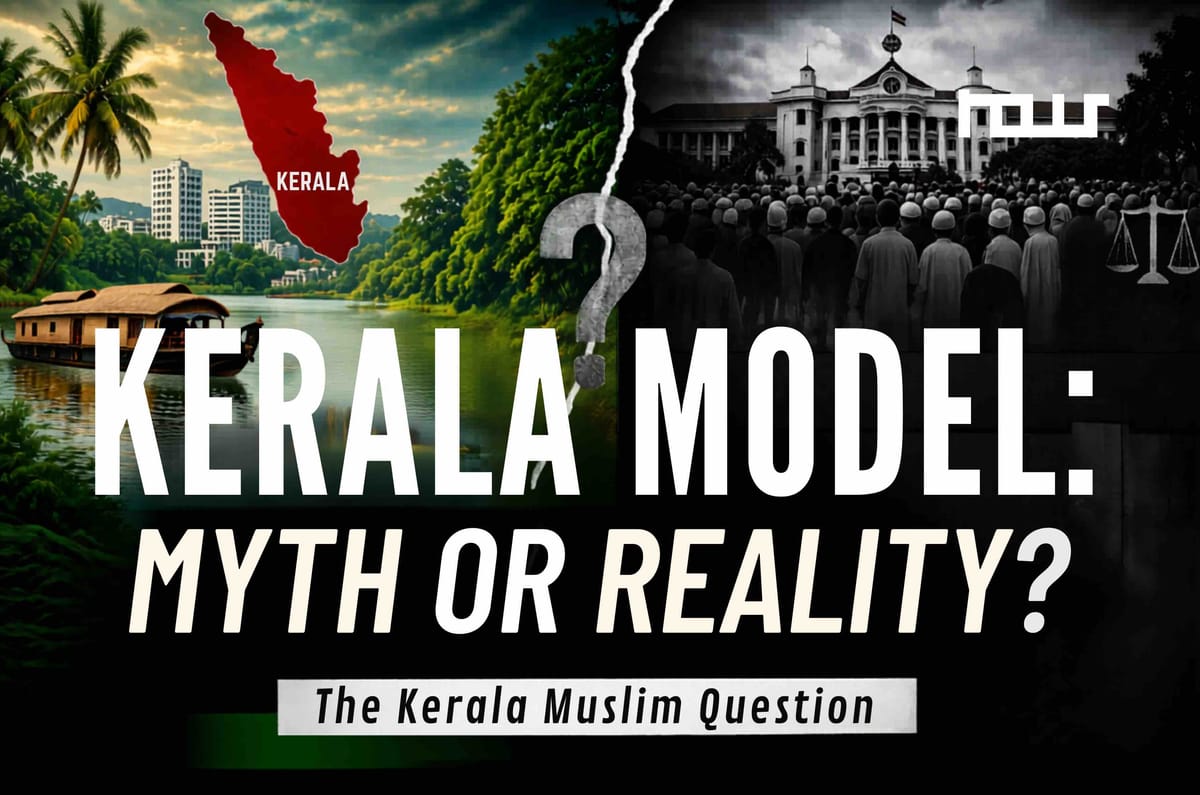
The Kerala Muslim Question
Kerala is held up as a state where Muslims fare better. This piece tests that claim - with data on representation, employment, and education. The gains are real. So are the gaps. Kerala is different. The question is: different enough, and for whom?
On April 9, voters across Kerala are expected to cast their ballots. For many years, the state has been celebrated for its sustainable development indicators comparable to developed countries, and as a relatively better solace for minority communities — a proof, many argue, that the Indian secular model can work.
Every election cycle, the journalists and analysts parachuted from mainland India arrive in Kerala with a familiar refrain. "Muslims and other minorities are better off here." "Kerala is different." "The secular model works."
This article tests that claim - not to dismiss it, but to examine what the data actually says about Kerala's Muslims: who they are, how they compare to other communities within the state, and what the numbers reveal about representation, education, employment, and economic mobility.
It relies on data and the political architecture of the southernmost Indian state — the only state in India where the Left party is still in power, and the first state in the world to democratically elect a communist government.
According to the 2011 Census, Kerala's Muslims constitute roughly 27% of the state's population. Hindus, the majority, constitute roughly 55%, and Christians roughly 18%.
Islam's arrival in Kerala dates back to the time of Prophet Muhammad himself, according to legend. It evolved not through conquest but through oceanic trade and cultural exchange. Since ancient times, Kerala maintained strong trade relations with the Arabs, Romans, and Chinese — and it was through these ancient networks that Islam first took root along the Malabar coast, making Kerala's Muslims among the earliest Muslim communities in the subcontinent.
Kerala's Muslims are not a monolith. They currently belong, broadly, to three distinct orientations: the traditionalist Sunni groups, who form the majority; the reformist Salafi-Wahhabi Mujahid movement; and the Jamaat-e-Islami. These are not merely theological differences — they shape political alignments, institutional loyalties, and electoral behaviour across the state.
The evidence does not support the conclusion that Kerala has achieved structural equity for its Muslim population. What it shows, instead, is a community that has advanced significantly — but largely through its own resources, while structural gaps in state provisioning remain comparatively largely intact. And it shows that even here, representation and power are not the same thing.
Understanding this distinction matters not just before polling day — it matters for what we expect from democratic inclusion at all.
The Assumption: Muslims Are Better Off in Kerala
The claim has surface plausibility. Kerala ranks highest in India on the Human Development Index. Literacy stands at 98.9%, life expectancy is around 74 years, and rural poverty declined from 59% in the 1970s to approximately 12% by 2010, according to the Kerala Human Development Report and Planning Commission data.
Within this, Muslim incomes are among the highest relative to other states. Data from the Indian Human Development Survey, analysed by political scientist Christophe Jaffrelot, shows Muslims in Kerala earning approximately 75% of Hindu incomes — still unequal, but significantly closer than in West Bengal or Gujarat (around 63%) or Haryana (approximately 33%).
In 2021, 33 of Kerala's 140 MLAs were Muslim — approximately 22.86% — against a community population share of 26–27%. Following Shafi Parambil's resignation from his Palakkad seat to contest the Vadakara parliamentary constituency, that number stands at 32.
Kerala's political landscape is defined by two dominant coalitions. The United Democratic Front (UDF), led by the Indian National Congress, draws its Muslim representation primarily from the Indian Union Muslim League (IUML) — its most vital ally — which holds 15 seats, alongside 3 Muslim MLAs from the Congress itself. The Left Democratic Front (LDF), led by the Communist Party of India (Marxist), takes a more distributed approach: 9 Muslim MLAs from the CPI(M), 1 from the CPI, and 1 each from splinter factions of the League — the Indian National League (INL) and the National Secular Conference (NSC) — plus 2 independents. Together, these numbers reflect a competitive dual-front system in which both coalitions actively contest the community's political allegiance.
The national picture is strikingly different. Muslim representation in the Lok Sabha has fallen from around 48–49 MPs in 1980 to just 24 out of 545 seats today — a drop from roughly 9% to under 4.5% — even as the community's share of the national population has grown. An analysis published in The India Forum documents this widening gap between demographic presence and parliamentary representation across successive Lok Sabhas.
The decline is visible not just in outcomes but in nominations. Congress fielded 31 Muslim candidates in 2014; by 2024, that figure had fallen to 19. Across major opposition parties combined, only 43 Muslim candidates were fielded in 2024, according to Election Commission data. Entire states — Rajasthan, Madhya Pradesh, Gujarat, Uttarakhand — saw no Muslim candidates on any major party ticket.
Against this national backdrop, Kerala's numbers are genuinely notable. Whether they tell the full story is another question
Representation: The Geography of Selective Accommodation
Kerala's reputation as a global outlier in human development rests on an aggregate that conceals as much as it reveals. The state's celebrated progress was never uniformly distributed. It was built, in large part, on foundations laid in the southern princely states of Travancore and Cochin, under the aegis of British colonisers, where reformist rulers had invested in education and public health well before independence. Malabar, the northern region governed directly by the British Crown, inherited no such foundation.
Under colonial administration, Malabar was subject to a predatory land revenue system designed for extraction rather than welfare. The consequences were not merely economic — they were cultural. Western education, arriving as an instrument of colonial administration, was met with deep suspicion, producing a long tradition of resistance that inadvertently widened the gap in institutional participation. The Malabar rebellions were, among other things, an expression of this accumulated grievance.
Post-independence Kerala reduced rural poverty from 59% in the 1970s to 12% by 2010 — a genuine achievement. But the governments that drove that transformation largely treated the state as a single unit of development, allowing the south to compound its existing advantages while the north continued to recover from decades of colonial extraction. The historical deficit was never formally acknowledged, and so it was never systematically addressed. The result is a state whose headline numbers are extraordinary and whose internal geography tells a quieter, more complicated story.
In the current assembly , 28 of the 32 Muslim MLAs came from Malabar — concentrated in Malappuram, then Kozhikode, Palakkad, Kannur, Wayanad, Kasaragod and parts of Thrissur . Only four came from the Thiru-Kochi region
This concentration is not accidental — it reflects a consistent political calculation. Parties nominate Muslim candidates in constituencies where Muslims already form a large share of voters, avoiding seats where such nominations might trigger majority backlash.
This pattern holds nationally: research on recent parliamentary elections shows that most Muslim MPs come from constituencies where Muslims constitute at least 40% of the electorate .Representation exists — but within boundaries. This is not broad inclusion. It is selective accommodation.
Seats Without Power: Who Actually Controls Kerala?
Even within the seats held, a deeper question almost never gets asked: who controls the levers of executive power?
Since Kerala's formation as a state, a Muslim Chief Minister has governed for just 50 days. Upper-caste Hindus — Nair and Brahmin communities combined, roughly 15–17% of the population — have held the office for more than 12,500 days. Ezhavas and Thiyyas, the largest OBC group at 23–25%, for more than 6,000. Christians, at 18–19%, for nearly 4,600. The Chief Minister's office has functioned, across governments of both coalitions, as a space with a remarkably stable ceiling.
The pattern holds within cabinets. In the Congress-led UDF, the Indian Union Muslim League — despite decades of consistent alliance — has historically received portfolios in education, industries, local self-government, and social welfare. Finance and Home have almost invariably remained with the Congress or its dominant-caste allies. The League is admitted into governance, but kept at a reliable distance from where decisions of consequence are made.
How Kerala responds when that distance is challenged is equally instructive. In 2012, the Muslim League, holding 20 MLAs, sought a fifth ministerial berth — one that had been promised to them. A routine matter of coalition arithmetic. The berth was eventually granted. But the response was not routine. The BJP called a hartal. Commentators warned of threats to Kerala's secular balance. A negotiation became a communal provocation simply by being conducted in public.
The contrast with 2021 is worth sitting with. The LDF cabinet — led by a party that foregrounds class over caste — allocated 7 of 21 ministerial berths to Nairs: roughly 33% representation for a community that comprises 15–17% of the population. This overrepresentation produced no hartals, no warnings about secular imbalance. It was received as the ordinary texture of governance.
The historical record extends the pattern further back. In the 1960s, when C.H. Mohammed Koya of the Muslim League was to be sworn in as Speaker of the Kerala Assembly, the Congress — then a coalition partner — insisted he resign from the party before taking the chair. In 2024, during Rahul Gandhi's campaign, the IUML was informally advised to avoid displaying its green flag, on the grounds that it could be framed as Pakistani. Party workers switched to green balloons. Even symbolic presence had to be made less visible, and the terms of that visibility were set by others.
The Development Data: What the Indicators Actually Show
Following the Sachar Committee report, the LDF government appointed a committee chaired by Paloli Muhammed Kutty to examine how its recommendations could be implemented in Kerala. What it found was unambiguous.
Muslims in the state lagged across social, economic, and educational indicators. 37.8% were landless. Only 14.3% of those aged 18 to 25 were enrolled in higher education. Employment participation stood at 23.25%. The poverty rate was 28.7%. These were not marginal gaps — they were structural ones, visible across every indicator the committee examined.
The recommendations were specific: expand educational institutions, increase aided colleges under Muslim management, create employment opportunities in underserved regions. They were also largely unfulfilled. The report was submitted. The gap persisted.
Recent data confirms it has not closed. According to Kerala Studies 2.0, published by the Kerala Shastra Sahitya Parishat in June 2025, Muslims constitute 27.3% of Kerala's population but hold just 13.8% of state government jobs. In central government employment, their share falls to 1.8%.
Research by Ajmal Khan on Gulf migration and development in Malabar disaggregates this further by department. In education, Muslims make up approximately 12.3% of employees — less than half their population share. In the home department, 10.7%. In health, 10.5%. Across every sector where the state directly controls hiring, the same pattern holds: presence well below proportion, and no meaningful trend toward correction.
- Education: The Malabar Deficit
The Mappila Muslims of Malabar — nearly 72% of Kerala's Muslim population — were historically among the most educationally disadvantaged communities in the state, lagging well behind their counterparts in Travancore and Cochin. That began to change through a combination of state intervention, community initiative, and the economic mobility unlocked by Gulf migration.
The Indian Union Muslim League, which has held the education portfolio across multiple coalition governments since 1967, played a measurable role in this shift. Its tenure saw the steady expansion of institutions across Malabar, including the establishment of Calicut University in 1968 under Education Minister C.H. Mohammed Koya. Literacy among Muslims in the region improved over the following decades. Whether that progress was proportionate to the League's long stewardship of the portfolio is a harder question — one the data does not fully resolve in its favour.
In the aided sector, the gaps remain visible. Muslims account for 19.38% of aided schools and 18.63% of aided colleges statewide — well below their population share. Hindus hold 41.41% of aided schools and 30.88% of aided colleges. Christians, though a smaller share of the population, dominate aided colleges at 46.57%. The regional picture complicates this further. In Malabar, Muslim ownership of aided schools stands at 16.44% against 26.13% for Hindus; in aided colleges, Muslims hold 14.22% compared to 7.35% for Hindus. In the Thiru-Kochi region, Muslim presence drops sharply — to 2.84% in schools and 4.4% in colleges.
What these numbers suggest is that educational expansion in Malabar has depended less on state provision and more on community self-organisation, underwritten substantially by Gulf remittances. Surplus income circulated widely within Mappila networks — supporting households, religious institutions, and social infrastructure — and increasingly flowed into education. When Kerala opened higher education to private investment in the 2000s, Muslims entered the self-financing sector in significant numbers. A study by Jose Sebastian found that of 890 self-financing institutions, 154 — roughly 17.3% — were under Muslim management, spanning arts and science colleges, engineering, medical, law, and management institutions.
Yet the structural imbalance in public provision has not been corrected. A study by the Malabar Education Movement reveals that in the 2024–25 academic year, Malabar — home to 42% of the state's population — faced a shortage of 66,170 higher secondary seats, while the Thiru-Kochi region carried a surplus of 20,189. Of 238 government and aided arts and science colleges across the state, only 76 are located in Malabar. The region holds just 29% of B.Ed seats, 34% of government MBBS seats, and 20% of medical postgraduate seats.
Institutional control within the aided sector tells the same story at a finer resolution. Of 46 aided colleges affiliated with Kerala University, only 4 are under Muslim management. Under Mahatma Gandhi University, 3 of 62. Of 17 aided B.Ed colleges in the state, 2. The self-financing sector filled a gap that public investment left open — but it did not close it.
- Land Ownership
The most telling comparison — and the one least often made — is not between Muslims in Kerala and Muslims elsewhere in India. It is between Muslims and other communities within Kerala itself.
Across village studies spanning half a century, upper castes make up just 33% of surveyed households yet held nearly four-fifths of all land — 78.45%. Upper-caste Christians alone, barely 22% of the sample, owned the largest single share at 34.5%. For Muslims, the picture sits at the other end of the distribution entirely. At 11% of surveyed households, they held just 4.68% of the land — figures closer to Dalit landholding than to any community above them in the hierarchy.
What makes this more than a static inequality is the trajectory. In 1958, Muslim landholding was roughly proportional to population — close to parity. The land reforms of the 1960s and 70s, which largely failed Dalits and Adivasis, actually extended modest gains to lower and middle-class Muslims. By 1986, Muslims held slightly more land than their numbers alone would predict. By 1992, they were nearer to parity than at any other point in the recorded data.
Then came the reversal. By 2006, the gap had widened beyond anything in the historical record — 4.68% of the land against 11.29% of the population. Not a gradual drift. A collapse within a decade and a half.
Part of this was deliberate. Many Muslim families liquidated agricultural holdings to finance Gulf migration, moving capital out of land and into trade, remittances, and small businesses. Ancestral plots fragmented as nuclear family structures replaced joint households. And as Kerala's economy shifted toward real estate and services, land ceased to function as a primary asset and became instead something to be sold. The community's footprint in physical land shrank — not only because of dispossession, but because capital itself changed form.
The Income Illusion: Gulf Remittances vs. State Development
The relative economic position of Kerala's Muslims raises a foundational question: how much of it is a product of state policy, and how much is built on migration?
According to Kerala MIgration Survey report 2023, Muslims constitute approximately 26–27% of Kerala's population but account for an estimated 51% of emigrants. Remittances now constitute 23.2% of Kerala's Net State Domestic Product — up from 13.5% in 2018 — amounting to 1.7 times the state's total revenue receipts.
Malappuram — with a nearly 70% Muslim population and long considered the IUML's political heartland — recorded the lowest per capita income in Kerala in 2022–23. There has been improvement: from about 68% of the state average in 2005–06 to over 74% today. But the trajectory is remittance-driven, not state-driven.
This pipeline is now narrowing. The migration study further suggest that the share of Kerala migrants going to GCC countries declined from 89.2% in 2018 to 80.5% in 2023. Return migration rose sharply — from 1.2 million to 1.8 million — often driven by job losses and visa restrictions tied to nationalisation policies like Saudi Arabia's Nitaqat programme. Unemployment in Kerala rose from 9% to 12.5% over the same period.
Community-Built Progress: When the State Didn't Build It
Much of Kerala's Muslim educational progress was not driven by state action. It was built, incrementally and over generations, by sustained community initiative — particularly in Malabar.
The foundations were laid before independence. Organisations like the South Indian Mohammedan Education Association and the All Travancore Muslim Mahajana Sabha expanded access to modern education, while reformers like K.M. Moulavi and Vakkam Maulavi pushed systematically for organised educational advancement within the community.
After independence, this translated into institution-building at scale. The Rouzathul Uloom Association established Farook College in 1948. The Muslim Educational Society, founded by Dr. P.K. Abdul Gafoor in 1964, opened its first college at Mannarkkad in 1967 and has since grown to approximately 150 institutions — over 70 English-medium schools, 35 arts and science colleges, and 10 professional institutions.
Religious organisations built parallel networks of comparable reach. Jamaat-e-Islami runs over 600 madrasas serving around 50,000 students, approximately 100 CBSE schools with over 70,000 students, and 25 Arabic colleges — with more than 60% female enrolment across its institutions. Samastha, through its Vidhyabhyasa Board, operates over 8,000 madrasas and several Arabic colleges, including Jamiya Nooriyya, forming one of the largest religious education networks in the state. Kerala Nadwathul Mujahideen has contributed through a network of madrasas, schools, and higher educational institutions.
The conclusion this history points to cuts against a familiar narrative. What is celebrated as the "Kerala model" of educational progress was, in Malabar, substantially the product of organised community action filling gaps that public provision left open — not a story of state delivery, but of communities building around its limits.
Islamophobia: Quiet Normalisation
Kerala is often held up as an exception — free from the overt, violent Islamophobia visible elsewhere in India. Recent data suggests a more complicated reality.
The Islamophobia Research Collective, which tracks incidents across Kerala's social, political, and cultural spheres, recorded 92 Islamophobic incidents and 13 hate statements in February 2026 alone. January saw 78 incidents and 29 hate statements; December 2025, 45. Across 2024, 260 incidents were documented — roughly one every 36 hours.
What the data reveals is not just volume but distribution. Statements have come from leaders across the UDF and LDF, from BJP functionaries, from rationalist groups, and from sections of the Church hierarchy. Islamophobia in Kerala is not the property of one political tendency. It is cross-cutting — and that breadth is precisely what makes it difficult to isolate, attribute, and confront.
Figures like Vellappally Natesan — general secretary of the SNDP Yogam, the socio-cultural organisation representing the Ezhava community and founded by Sree Narayana Guru, one of the central figures of Kerala's modern social renaissance — delivered over 60 Islamophobic statements between April and December 2025 without meaningful political consequence from either coalition. This is not incidental. Natesan is not a fringe figure tolerated at a distance. He shares stages with the Chief Minister, appears at coalition functions, and has continued his rhetoric casually and openly — in formal speeches, in passing remarks, in the ordinary texture of public life — without prompting so much as a recorded objection from his political allies.
What distinguishes Kerala's Islamophobia is not its absence but its register. It is rarely loud or explicit. It circulates through selectively framed social media content, edited clips, and decontextualised narratives that construct Muslims as a latent threat. It enters mainstream discourse through the language of "concerns," "questions," and "security debates" — coded idioms that carry the structure of prejudice while maintaining the appearance of reasonableness. As journalist Jisha M has observed, the form is mediated and normalised rather than openly hostile.
The MEC 7 episode in 2024 illustrates how this works in practice. A community fitness initiative from Malappuram was rapidly recast as suspect following political allegations, with media coverage shifting from activity to intent — without evidence. Suspicion itself became the story. The same logic applies to geography: Muslim-majority regions like Malappuram, Eerattupetta, and Kasaragod are routinely framed in public discourse as spaces of inherent risk.
A longer pattern underlies all of this. As one researcher associated with the Islamophobia Collective has noted, Kerala's secular common sense has historically required a Muslim villain — someone against whom the distinction between the acceptable and the threatening can be drawn. Until the 1990s, that critical function was performed largely by the progressive left and liberal Muslims themselves, operating within a framework that sought to empower the community while remaining largely unconcerned with the casteist and patriarchal tendencies embedded in Kerala society more broadly. After the 1990s, the villain role migrated. It was assigned successively to Abdunasar Madani's PDP, then to the Popular Front, and now to Jamaat-e-Islami — an organisation the Chief Minister has himself described as equivalent to the RSS.
The point is not that Kerala mirrors North India. It does not. The point is that Islamophobia here has adapted to its surroundings. It is quieter, more respectable, and harder to confront precisely because it presents itself not as hatred but as common sense.
Political Architecture
- The Muslim League
The Indian Union Muslim League was born in 1948 from the remnants of the All India Muslim League — and from the wreckage of Partition. It inherited not just an organisation but a burden: the weight of history that had been placed, disproportionately, on Muslim shoulders. The party's founding impulse was to prove that it belonged. To moderate. To accommodate. To stay quiet. That impulse has never left.
For over seven decades, the IUML has remained Kerala's largest Muslim political formation, almost entirely bound to the Congress-led UDF. It cultivated what it called a "moderate Muslim" image — emphasising communal harmony, distancing itself from more assertive Muslim formations, positioning itself as the responsible voice of a community that could not afford to appear otherwise. The question its critics have always asked is: moderate for whom?
The pattern of silence is difficult to ignore. On Islamophobia. On the weaponisation of UAPA. On custodial excesses and the alleged fabrication of terror cases. The League's caution on these questions has been most pronounced precisely when the perpetrator was its own coalition partner — the Congress. When confrontation became unavoidable, it confronted. When it didn't, it didn't.
Despite its mass base among lower and middle-class Muslims, the party is routinely described as elitist and pro-capital. Its neoliberal orientation sits uneasily alongside the economic principles it invokes in religious registers. The portfolios it has historically controlled — education, commerce, industries — have produced institutional expansion without structural redistribution. The League has been inside governance long enough to be responsible for some of what it claims to be addressing.
Religious authority has been central to how the party sustains itself where ideology cannot. Hadrami Syed families — locally known as Thangals, claiming lineage from the Prophet and tracing their roots to Yemen — have lent the party a moral legitimacy no manifesto can manufacture. The elevation of a Thangal at the helm transforms political allegiance into something closer to spiritual obligation.
The party formally distances itself from the liberation theology of Islam. It has not hesitated, however, to brand its electoral symbol — the ladder — as a stairway to heaven, to invoke religious sentiment at electoral intervals, and to maintain its cadre base through a structure in which clerical endorsement functions as political authentication. The implicit claim is that the League is not merely a party representing Muslims — it is the legitimate vessel of the community itself, certified from above.
The Babri Masjid demolition in 1992 briefly cracked the surface. Leaders like Ibrahim Sulaiman Sait broke away, accusing the party of political compromise at the moment it mattered most. The party absorbed the rupture and continued. It has always continued — because for a community navigating a coalition system that rewards moderation and punishes assertion, the League remains the only vehicle on offer. That captivity is the party's greatest source of power, and its most damning indictment.
- The Left
The CPI(M)-led Left in Kerala has long projected itself as the natural defender of minorities. The projection comes with a condition: Muslim politics is acceptable only when it remains within Left control. Independent mobilisation — by the Muslim League, Jamaat-e-Islami, or the SDPI — is routinely branded communal. Muslim assertion is treated not as a democratic claim but as a management problem.
In practice, this critique frequently slips into something harder to distinguish from the language it claims to oppose. Political attacks on Muslim organisations often mirror Sangh Parivar framing — casting community organisation as infiltration, religious identity as suspicion, and assertion as extremism. The vocabulary differs. The structure does not.
The electoral arithmetic has always made this legible. Muslims have never been the Left's primary base. The LDF secures roughly 35–39% of Muslim votes; the UDF holds a dominant 58%. The Left's real foundation is OBC Hindu communities — particularly Ezhavas — and Scheduled Castes. It has governed not as the party of minorities but as the party that manages minority support while consolidating elsewhere.
That elsewhere is now shifting. Sections of Ezhava voters have begun moving toward the BJP. The Left's response has not been to deepen secular politics. It has been to chase the voters leaving — by accommodating majoritarian sentiment rather than contesting it. Vellappally Natesan, whose Islamophobic record is extensive and documented, has been embraced rather than isolated. Rhetoric against Muslim organisations has sharpened. At different moments, Left leaders have portrayed the UDF as a Muslim-Christian dominated front, warned of Islamist influence, and — most starkly — the Chief Minister himself has equated Jamaat-e-Islami with the RSS. These are not slips. They are signals, directed at a specific audience.
Governance follows the same logic. Under recent Left governments, the police and home department have faced repeated allegations of targeting Muslim activists — during anti-CAA protests, during pro-Palestine mobilisations, and in cases where social media posts critical of Sangh Parivar figures attracted police action framed as threats to communal harmony. The category of communal harmony, in this usage, functions to protect the majority's comfort rather than the minority's safety.
The contradiction at the centre of all this is not subtle. In attempting to contain the BJP, the Left has begun internalising its language — casting Muslim political presence as a problem to be managed, and Hindu consolidation as an electorate to be courted. The result is not resistance to Hindutva. It is a respectable variant of it: one that may hold seats in the short term while quietly preparing the ground it claims to be defending against.
- Congress
For Congress, the Kerala Muslim is a high-yield, low-maintenance asset. The votes are delivered through the League and through traditional religious networks. Muslim leaders within the party are assigned a different function: performing visible secularism — a generic, unthreatening Muslim identity that can be displayed for the cameras without unsettling the party's other constituencies.
It was not always this arrangement. Pre-independence Congress in Kerala had assertive Muslim leadership with genuine mass roots — Muhammad Abdurahiman Sahib, Khilafat figures like Moidu Moulavi, an organic base across Malabar. What replaced that, over the decades following independence, was elite, managed engagement: Muslim support mediated through intermediaries, community demands filtered through the League, and Congress itself increasingly anchored among upper-caste Hindus and Christians.
The governance record makes the logic visible. Under successive Congress governments, the pattern is consistent and documented. The Oommen Chandy government allegedly ran an email surveillance operation monitoring hundreds of accounts — overwhelmingly belonging to Muslims: journalists, students, community leaders. The Marad violence and its aftermath raised questions of a different order. The police opened fire on the crowd. Sirajunnisa, eleven years old, was shot dead. The FIR that followed alleged she had been leading a mob of 300 people to attack a Brahmin settlement — a charge that has never been seriously examined for what it reveals about how the state constructs its narratives around Muslim victims. The DIG Raman Srivastava who allegedly ordered his officers to shoot at "Muslim bastards" over the walkie-talkie was never held accountable. He was later elevated to DGP during Oommen Chandy's tenure in 2005. Fabricated terror cases — several still unresolved — have kept Muslim youth in detention for years, their lives suspended while the cases against them quietly collapsed or dragged on without accountability.
The party that depends on Muslim votes placed Muslim citizens under suspicion, under surveillance, and under fire — and ensured that those responsible faced no consequences.
Whenever in power, Congress in Kerala has not diverged from its national pattern — othering Muslims, amplifying threats, treating the community as a variable to be managed rather than a constituency to be served. The difference is that in Kerala, it has always had the League to absorb the anger.Taken together, the evidence resists both familiar conclusions. Kerala has not failed its Muslims in the way that Uttar Pradesh or Assam has. But it has not delivered equity either.
The gains are real. Higher relative incomes than most Indian states. Closer-to-proportional legislative representation. Visible political presence. A less openly hostile public environment. These are not trivial achievements, and they should not be dismissed.
But the data is consistent on what those gains are not. They are concentrated, conditional, and in significant part community-generated rather than state-delivered. Representation has not translated into control of executive power. Economic mobility has been sustained more by Gulf remittances than by state institutions. Structural gaps in employment, education, and institutional ownership persist — documented not by critics but in the state's own commissioned reports, and still unaddressed.
The intra-Kerala comparison is the sharpest test — and the most rarely applied. Against forward-caste Hindu and dominant Christian communities within the state, Muslims trail substantially on land ownership, institutional presence, and measured income. The claim that Muslims have achieved equity within Kerala is not supported by the evidence the state itself has produced.
The broader pattern this fits into is not unique to Kerala. For decades, the deal offered to Indian Muslims has been consistent: vote for secular parties, receive protection, but not structural change. Votes without power. Representation without transformation.
Kerala refines that deal. It does not break it. The Islamophobia has learned to speak more quietly. The representation stops reliably short of executive control. The economic mobility is real but built on remittances, not state investment — which means it is always one migration cycle away from reversal. It is a more comfortable arrangement than what exists elsewhere. It is still an arrangement — one that serves the parties that benefit from Muslim political dependence more than it serves the community itself.
- Hindutva
In 1942, a 22-year-old law graduate arrived in Kozhikode carrying a mission from M.S. Golwalkar himself — to seed the RSS in Kerala. His name was Dattopant Thengadi, who would go on to become one of the Sangh Parivar's key intellectuals, shaping its economic and labour thinking for decades. He carried a letter from Rajagopalachari, addressed to a local lawyer. The lawyer's verdict was firm: there is no need for the RSS here.
Thengadi did not leave. He turned to the Zamorin royal family, won them over, and in March 1942 the first shakha opened at Chalappuram in Kozhikode. Today there are over 5,100 shakhas across Kerala, supported by at least 212 affiliated organisations. What began with a single rejection has become the most extensive political infrastructure project in the state's modern history.
Elections were never the only goal — and the numbers reflect that distinction. BJP support among upper-caste Hindus rose from 11% in 2016 to 32% in 2021. Ezhava support shifted from 18% to 23%, aided by the Sangh's deliberate cultivation of Bharath Dharma Jana Sena, its political formation linked to the SNDP Yogam. Dalit voters moved in the opposite direction — from 23% to 7%. Muslim support remains between 1% and 3%. The Sangh has not won Kerala. It has been reorganising it.
The method has always been institutional before it is electoral. Temples, festivals, education, martial training, local community networks — the RSS embeds itself slowly, quietly, and deliberately, building presence that outlasts electoral cycles. The strategic objective is not a BJP majority. It is the transformation of a bipolar political system into a three-cornered contest — one in which Muslim votes lose their decisive weight and both mainstream coalitions are pulled toward majoritarian accommodation.
The outreach to Christians — particularly Syrian Christians — follows the same logic. Shared caste anxieties and social conservatism have been cultivated as common ground. Narratives like "love jihad," widely criticised as a manufactured conspiracy, have been deployed to build ideological alignment with sections of the clergy and community organisations. Electoral returns from this outreach have been limited. The ideological space it has opened has not.
And now a more direct instrument has entered the picture: central investigative agencies. In May 2025, Twenty20 Kizhakkambalam, a corporate backed political leader Sabu M. Jacob received an ED notice over alleged FEMA violations. By January 2026, his party had formally joined the NDA. The sequence prompted allegations that the alliance was not political conviction but engineered compliance — legal pressure converted into electoral realignment. Ahead of the 2026 elections, Twenty20 flooded its candidate list with celebrities and influencers. Political commentators described it as a backdoor for the Sangh Parivar, dressed in the language of anti-establishment politics.
The broader realignment extends further. The Nair Service Society and the SNDP — traditional Hindu organisations that once maintained studied distance from the BJP — have grown increasingly accommodative. Reports suggest Congress and Left leaders are crossing over as well, drawn by calculations that would have been unthinkable a decade ago.
What has made all of this possible is not only Sangh strategy. The mainstream parties have contributed too.Hindutva in Kerala is no longer marginal. It is embedding itself socially, culturally, and politically — not despite the secular parties, but in part through the space they have chosen to vacate.
- Alternative Muslim Politics
Post-Babri, new formations emerged with a more assertive political language — ones that refused both Hindutva and the accommodationist politics of the Muslim League.
The most instructive figure in this history is Abdunasar Madani. His People's Democratic Party was built around a genuinely expansive vision: a Dalit-Muslim alliance that reimagined development from the margins rather than toward them. It was a politics that refused the terms on offer from both coalitions. The state's response was systematic. Following the 1998 Coimbatore blasts, Madani became a target of successive governments — UDF and LDF alike — through prolonged detention, contested prosecutions, and years of legal attrition that effectively removed him from political life. The PDP did not survive his absence intact. Stripped of its founder and its radical imagination, it retreated into strategic accommodation with the Left — the very model it had originally set itself against.
The Popular Front of India took a different route to the same destination. It accused the League of chronic failure, adopted a confrontational stance, and at points issued explicit calls for resistance. It was banned in 2022. What it represented — the demand for a politics that did not require perpetual moderation as the price of inclusion — did not disappear with the organisation.
Jamaat-e-Islami traces the most revealing trajectory of all. It began aligned with the Left, pivoted to the Congress-led UDF after 2014, and launched the Welfare Party of India in 2011 — abandoning its long-held position against electoral participation. The party advocates a Dalit-OBC-Muslim-Adivasi alliance against Hindutva. In practice, its ground politics has repeatedly aligned with the forces it once opposed. Cadres and affiliated media that spent years criticising the Congress and the League for soft Hindutva and opportunism began defending — and endorsing — the same formations. The criticism was not retracted. It was quietly retired when the electoral calculus changed.
Conclusion: What the Data Actually Says
Taken together, the evidence resists both familiar conclusions. Kerala has not failed its Muslims in the way that Uttar Pradesh or Assam has. But it has not delivered equity either.
The gains are real. Higher relative incomes than most Indian states. Closer-to-proportional legislative representation. Visible political presence. A less openly hostile public environment. These are not trivial achievements, and they should not be dismissed.
But the data is consistent on what those gains are not. They are concentrated, conditional, and in significant part community-generated rather than state-delivered. Representation has not translated into control of executive power. Economic mobility has been sustained more by Gulf remittances than by state institutions. Structural gaps in employment, education, and institutional ownership persist — documented not by critics but in the state's own commissioned reports, and still unaddressed. Against forward-caste Hindu and dominant Christian communities within the state, Muslims trail substantially on land ownership, institutional presence, and measured income. The claim that Muslims have achieved equity within Kerala is not supported by the evidence the state itself has produced.
The broader pattern this fits into is not unique to Kerala. For decades, the deal offered to Indian Muslims has been consistent: vote for secular parties, receive protection, but not structural change. Votes without power. Representation without transformation.
Kerala refines that deal. It does not break it. The Islamophobia has learned to speak more quietly. The representation stops reliably short of executive control. The economic mobility is real but built on remittances, not state investment — which means it is always one migration cycle away from reversal. It is a more comfortable arrangement than what exists elsewhere.
Support Independent Media That Matters
nous is committed to producing bold, research-driven content that challenges dominant narratives and sparks critical thinking. Our work is powered by a small, dedicated team — and by people like you.
If you value independent storytelling and fresh perspectives, consider supporting us.
Contribute monthly or make a one-time donation.
Your support makes this work possible.