
School Education in a Muslim-Concentrated Urban Neighbourhood: Evidence from a Large-Scale Household Survey in Jamia Nagar, Delhi
Based on a large-scale household survey in Jamia Nagar, Delhi, this report examines school access, educational costs, and learning outcomes among children in a Muslim-concentrated urban neighbourhood, highlighting the structural factors shaping educational inequality.
Overview
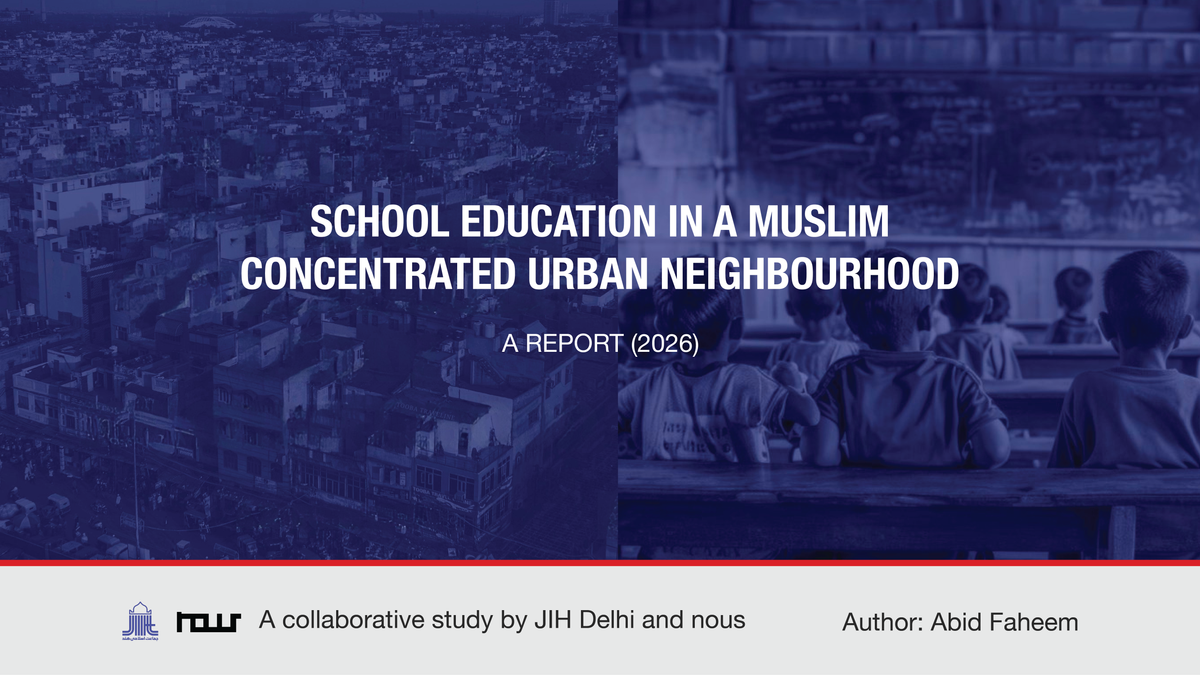
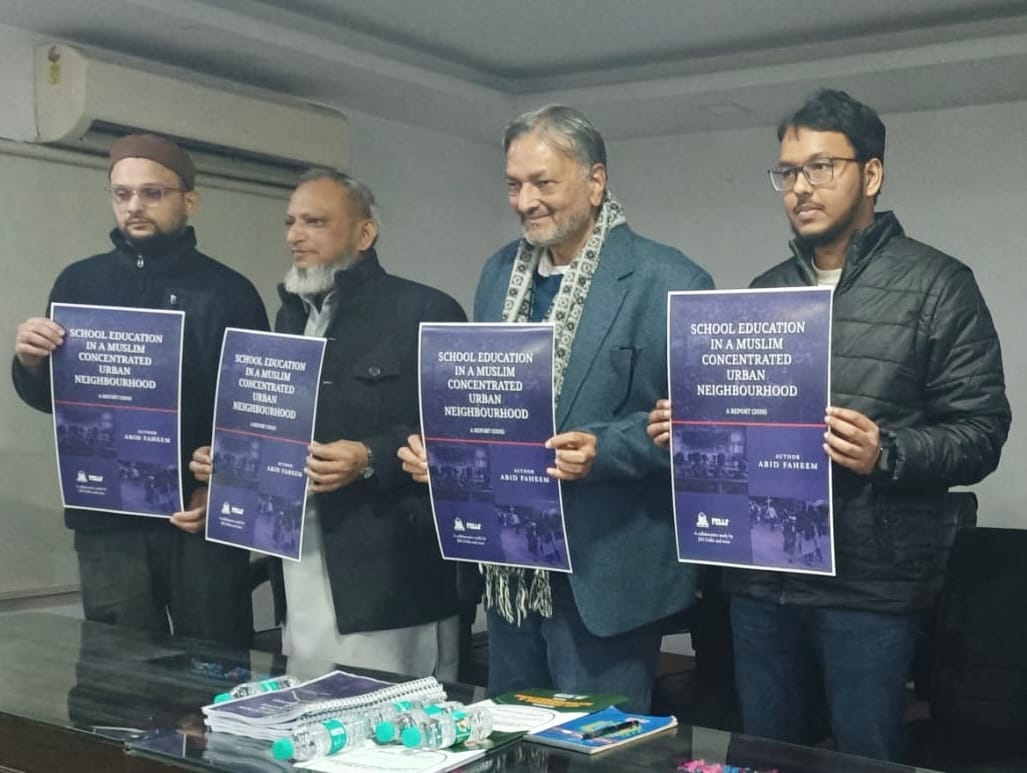
nous, in collaboration with JIH Delhi, has released a new research report titled
“School Education in a Muslim-Concentrated Urban Neighbourhood: A Case Study of Jamia Nagar, South-East Delhi.”
The report is based on a large-scale household-level survey covering 2,700 households and over 3,800 children aged 3–18 years across twelve localities of Jamia Nagar. It provides one of the most detailed neighbourhood-level empirical accounts of school education in an urban Muslim-concentrated area in India.
At a time when discussions on Muslim education are often driven by assumptions, aggregate statistics, or cultural explanations, this study offers granular, evidence-based insights into enrolment patterns, institutional availability, education-related expenditure, and learning outcomes.
Why This Study Matters
National and state-level datasets often fail to capture the intra-urban and neighbourhood-level realities of education, particularly in minority-concentrated urban settlements. As a result, policy responses tend to focus narrowly on enrolment, overlooking deeper structural issues related to school availability, quality, and learning.
Jamia Nagar—despite being located in the national capital and in proximity to major educational institutions—continues to face:
- Uneven public provisioning of schools
- Heavy reliance on private schooling
- High out-of-pocket educational expenditure
- Weak foundational learning outcomes
This study was designed to address these gaps by linking household socio-economic conditions with children’s educational trajectories and learning outcomes.
Study Design and Methodology
- Survey coverage: 2,700 households (2,648 Muslim households analysed)
- Children covered: 3,872 children aged above 3 and up to 18 years
- Study area: 12 localities in Jamia Nagar, South-East Delhi
- Methodology:
- Cross-sectional household survey
- School mapping across localities
- Basic learning assessments in Urdu, English, and Mathematics
- Analysis: Disaggregation by gender, caste, wealth status, and migration background
The study was led and authored by Dr. Abid Faheem, who oversaw the research design, fieldwork supervision, data analysis, and report writing.
Key Findings
Some of the central findings of the report include:
1. High Enrolment and Strong Educational Aspirations
- 94 percent of children were currently enrolled in school.
- Over 97 percent of children expressed aspirations to pursue higher education.
- Gender gaps in enrolment were minimal.
2. Structural Constraints Beyond Enrolment
- Government secondary and senior secondary schools are severely limited.
- Entire localities, such as Shaheen Bagh, have no government schools.
- As a result, households are compelled to rely on private institutions.
3. Growing Dependence on Private Schooling and Coaching
- Nearly 57 percent of children attend private schools.
- About 21 percent of children receive paid private coaching.
- Coaching participation rises sharply with household wealth, reinforcing inequality.
4. Learning Outcomes Remain Fragile
- Learning levels in Urdu, English, and Mathematics lag behind national ASER benchmarks at most grades.
- Even at higher grades, many students struggle with basic reading comprehension and numeracy.
- English-medium dominance has not translated into stronger learning outcomes.
5. Inequality Within the Community
- Wealth and caste-based stratification strongly shape school type, coaching access, and educational expenditure.
- Migrant households account for a disproportionate share of school dropouts, particularly at higher grades.
Key Insight
The study demonstrates that educational disadvantage in Jamia Nagar is not rooted in culture or lack of aspiration, but is produced through institutional bottlenecks, uneven public provisioning, and the financial burden placed on households.
Focusing only on enrolment figures risks masking where inequality is actually being generated - within school systems, institutional access, and learning processes.
Policy and Programmatic Relevance
The report provides actionable insights for:
- Government agencies working on school infrastructure and learning outcomes
- Civil society organisations designing remedial education and mentoring programmes
- Community institutions supporting scholarships, coaching, and guidance
- Researchers and donors interested in urban education and minority schooling
Detailed recommendations are provided for government authorities, NGOs, community organisations, and scholars.
About the Collaboration
This study is a collaborative initiative by JIH Delhi and nous, reflecting a shared commitment to grounding public discourse and policy engagement in rigorous, community-level evidence.
At nous, we believe that sustainable social change requires data-driven understanding of lived realities. This report is part of our broader effort to generate credible evidence on education, inequality, and marginalisation in India.
Accessing the Report
The full report is available for download below.
How to cite this report
Please use the following citation when referencing this report in academic work, policy documents, or media articles.
Faheem, A. (2026). School Education in a Muslim-Concentrated Urban Neighbourhood: A Case Study of Jamia Nagar, South-East Delhi. nous & JIH Delhi.
Nous is committed to producing bold, research-driven content that challenges dominant narratives and sparks critical thinking. Our work is powered by a small, dedicated team — and by people like you.
If you value independent storytelling and fresh perspectives, consider supporting us.
Contribute monthly or make a one-time donation.
Your support makes this work possible.