Rethinking the Partition of Bengal, 1905
The 1905 Partition of Bengal was not simply an administrative act or a communal divide. It's making and responses reveal how regional inequalities and competing political visions rather than religion defined one of the most consequential moments in India’s history.


Introduction
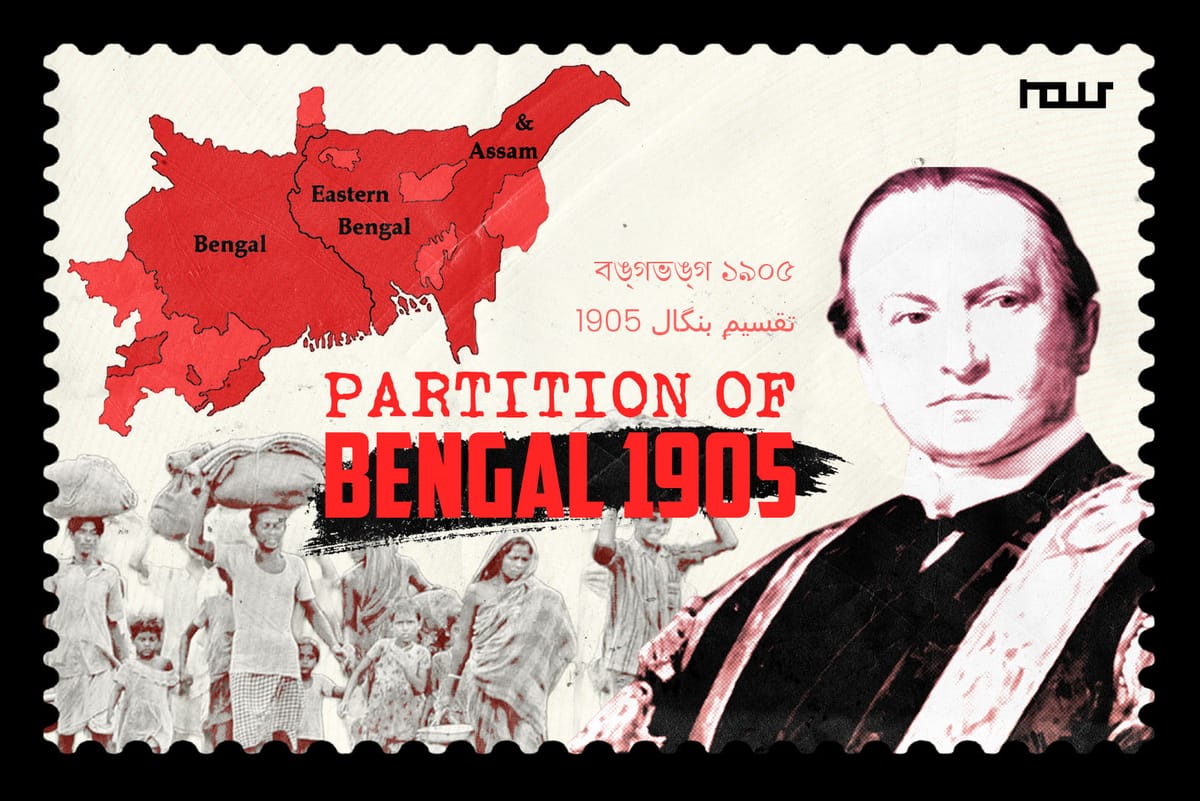
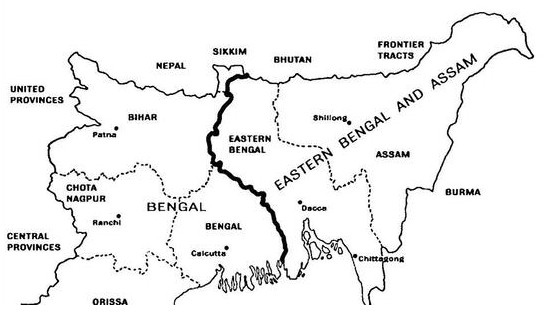
On 16 October 1905, the British colonial government partitioned Bengal - the largest administrative unit in India—into two provinces. The western half, centred on Calcutta, retained a Hindu majority, while the eastern half, with its capital at Dhaka, had a Muslim majority. The move was justified as an administrative necessity, with officials arguing that a population of nearly eighty million was too large to govern from a single centre.
Historians widely refer to this decision as the Partition of Bengal. However, it differed significantly from what the term “partition” later came to mean in South Asian history. The 1905 measure did not involve the creation of new sovereign states or the drawing of an international border. It was an internal administrative reorganisation carried out within the British Empire. Yet despite its administrative character, the decision had far-reaching political consequences, reshaping debates about nationalism, representation, and communal politics across the subcontinent.
At the same time, dominant narrative interpret the move as a classic instance of colonial “divide and rule” and an attempt to weaken a growing nationalist movement in Bengal. The policy did draw sections of Muslim support and opposition from the Hindu nationalist. But this interpretation is not sufficient on its own. It collapses a complex political moment into a binary of Hindu versus Muslim, obscuring the material and structural forces at play such as questions of class power, regional imbalance, language, and access to representation that cannot be reduced to communal identity.
This article therefore is an attempt to examine the wider historical dynamics that shaped the Partition of Bengal in 1905.
Bengal Before the Company: Mughal Prosperity and Provincial Autonomy
To understand the politics surrounding the 1905 division, it is necessary to first examine what Bengal had become by the early twentieth century under colonial rule.
During the Mughal period, Bengal was one of the most prosperous regions of the empire. The province, known as the Bengal Subah, was a major centre of agricultural production and global trade, particularly renowned for its muslin textiles and other fine manufactures. Its wealth made it one of the richest provinces in the Mughal Empire. The Bengal being referred to here was far larger than the present-day state: it included what is now Bangladesh and West Bengal, as well as parts of Assam, Odisha, Jharkhand, and Bihar.
However, the political structure of Bengal began to change following the decline of Mughal central authority after the death of Emperor Aurangzeb in 1707. Wars of succession, weakening imperial institutions, financial strain, and foreign invasions gradually eroded the power of the Mughal centre. In this context, Bengal came under the effective control of powerful provincial rulers who increasingly ruled as autonomous nawabs during the early eighteenth century.
Yet this autonomy did not represent a break from the Mughal political and cultural order. The nawabs largely preserved the administrative structures and courtly culture of the Mughal state. Their capitals in Dhaka and later Murshidabad became important centres of governance and commerce. The political structure of the province was characterised by a Muslim ruling aristocracy working alongside a powerful class of predominantly Hindu zamindars who managed land revenue and local administration. This arrangement created a political economy in which influential groups from both communities were integrated into the governing order of the province.
Meanwhile, European trading companies had begun to establish a presence in Bengal. The British East India Company, founded in 1600 as a chartered trading corporation, gradually expanded its commercial activities along the Indian Ocean littoral. By the late seventeenth century it had established trading factories in Bengal, most notably at Hooghly and later at Calcutta, where Fort William became an important centre of Company operations.
From Trading Company to Colonial State: Plassey, Buxar, and the Diwani
The balance of power shifted dramatically in 1757 with the Battle of Plassey, when the East India Company, led by Robert Clive, defeated the Nawab Siraj-ud-Daulah. The victory was made possible in part by the defection of influential elites, including Mir Jafar and powerful banking interests such as the Jagat Seths, who conspired against the Nawab. The Company subsequently installed Mir Jafar as a puppet ruler. However, this did not immediately amount to full political control over Bengal. The Company’s initial objective was economic dominance rather than direct governance. Following Plassey, it secured control over the rich district of the Twenty-Four Parganas and gained significant commercial privileges, including expanded rights of trade.
Nevertheless, these developments marked the beginning of a profound transformation. The decisive shift came after the Battle of Buxar in 1764, when the East India Company defeated the forces of Mir Qasim, the Nawab whom the British had earlier installed after replacing Mir Jafar. Mir Qasim eventually turned against the Company as tensions escalated over its growing interference in Bengal’s administration and its abuse of trading privileges. Company officials widely misused dastaks, that is, tax-exempt trade permits originally granted to the East India Company by a Mughal Emperor Farrukhsiyar in 1717 to conduct private inland trade without paying customs duties. The practice severely undermined the authority of the Nawab and reduced the revenues of the Bengal state.
Subsequently, the Company’s victory at Buxar paved the way for a more direct form of control. In 1765, the Mughal emperor Shah Alam II granted the East India Company the Diwani rights, giving it the authority to collect land revenue from Bengal, Bihar, and Orissa. In effect, while the Nawab continued to exist as a nominal ruler responsible for administration and law and order, the Company now controlled the province’s finances under the diarchy system introduced by Robert Clive in 1765.
With control over revenue, the East India Company gained the means to reshape Bengal’s economy and administration. From the mid-eighteenth century onward, the economic and administrative structures of the province increasingly came under Company influence, laying the foundations for the deeper colonial restructuring that would transform Bengal over the following century and a half.
The Bhadralok and Rise of Early Hindu Nationalism
By the turn of the twentieth century, Bengal existed as a single administrative province centred on Calcutta. Socially and politically, however, power within the province was increasingly concentrated in the hands of an English-educated upper-caste Hindu professional class known as the bhadralok.
The rise of this class was closely tied to Calcutta’s position as the colonial capital of British India and a centre of education, print culture, and administrative employment. Institutions such as the University of Calcutta, founded in 1857, and a growing network of schools and colleges produced a generation of educated professionals who found employment as lawyers, teachers, journalists, and civil servants within the colonial system.
Through their engagement with Western education and liberal thought, sections of the bhadralok participated in what historians have often described as the Bengal Renaissance. Reformers such as Raja Rammohan Roy and movements like the Brahmo Samaj advocated selective reform within Hindu society, challenging practices such as sati and promoting new forms of religious and social thought.
Yet these reform movements were shaped by the social position of their proponents. Their focus remained largely on reforming upper-caste Hindu society rather than addressing the deeper inequalities that structured colonial Bengal. Many within this intelligentsia also initially viewed British rule not simply as domination but as a vehicle for modernisation, law, and education.
Alongside these reformist currents, however, another intellectual tendency gradually emerged within sections of the bhadralok: Hindu revivalism. While earlier reformers had attempted to reinterpret Hindu traditions through the language of rationalism and universalism, revivalist thinkers increasingly emphasised the recovery of a glorious Hindu past believed to have declined under centuries of Muslim and later British rule. What began as a cultural response to Western domination gradually acquired political overtones, merging over time with early forms of Hindu nationalism.
It was during this period that the term Hindutva itself first appeared in print, in Chandranath Basu’s 1892 book Hindutva, where it was used to describe a distinctive Hindu national character.
Bankim Chandra Chattopadhyay’s novel Anandamath (1882) provides a particularly revealing example of this emerging imagination. Set during the late eighteenth-century Bengal famine, the novel depicts a band of ascetic rebels who call themselves the “children of the motherland.” Their struggle is portrayed as both political and civilisational, and the narrative frames Muslims collectively as the adversary. In several passages the rebels attack Muslim settlements, burning villages and killing their inhabitants.
These developments unfolded within broader colonial knowledge systems that had already begun to interpret Indian history through communal categories. In his influential work History of British India (1817), James Mill divided the subcontinent’s past into three periods: Hindu, Muslim, and British. This framework implicitly portrayed Muslim rule as an era of decline between an ancient Hindu civilisation and the supposedly civilising intervention of British rule. Administrative practices reinforced these distinctions. The colonial census of 1871, for instance, systematically classified populations according to religious identity, encouraging communities to imagine themselves as politically distinct demographic groups.
By the late nineteenth century, these ideas had begun to circulate more widely within public debate. In 1909, Lt. Col. U. N. Mukerji published a series of letters titled Hindu: A Dying Race in the newspaper The Bengalee, arguing that Hindus were under demographic and political threat and needed to organise collectively to secure their future.
Taken together, these intellectual and political developments contributed to a nationalist discourse that increasingly drew upon Hindu cultural symbols and historical narratives. This was particularly significant because many figures associated with this milieu were also becoming influential within the Indian National Congress in Bengal.
Contextualising Muslim Responses to the 1905 Partition
At the same time, large sections of Bengal’s Muslim population were experiencing a markedly different trajectory under colonial rule.
The restructuring of Bengal’s economy and administration following the establishment of Company rule gradually eroded the social and economic position of many Muslim elites. The replacement of Persian and the rise of English and vernacular administration reduced the access of Persian-educated Muslims to official employment, while colonial policies also disrupted the land and endowment base that had supported many Islamic institutions.
Company rule shifted Bengal’s economic center decisively toward Calcutta, weakening Murshidabad’s court-based economy. Dhaka, once a major Mughal textile hub, entered a steep decline after the late eighteenth century as Company monopoly, loss of patronage, and competition from British machine-made textiles undermined the muslin industry, reshaping eastern Bengal’s economy
For the largely Muslim peasantry of eastern Bengal, these transformations were compounded by agrarian exploitation under the Permanent Settlement of 1793. By granting hereditary property rights to zamindars and fixing revenue obligations, the colonial state created a class of absentee landlords, many of whom resided in Calcutta and helped channel agrarian surplus toward the colonial metropolis, deepening regional inequalities.
These cumulative pressures were noted by the colonial administrator W. W. Hunter in his 1871 study The Indian Musalmans. Hunter famously asked whether Indian Muslims had become “irreconcilable enemies” of British rule, but what he encountered was a community grappling with the collapse of an older political and social order.
By the turn of the twentieth century, the consequences of these long-term processes were stark. In 1901, only 22 out of every 10,000 Muslims in Bengal had received an English education, compared with 114 out of every 10,000 Hindus. This disparity was reflected in government employment: Muslims held just 41 high appointments in the colonial administration, while Hindus held 1,235.
It was within this structure that was defined by regional inequality, unequal access to education and employment, and the dominance of the Calcutta-based bhadralok that responses to the 1905 Partition took shape.
For many Muslims in eastern Bengal, the creation of the new province of Eastern Bengal and Assam, with its capital at Dhaka, appeared not merely as administrative rearrangement but as a promise to bring a marginalised and neglected region closer to the centre of governance.
Conclusion
The Partition of Bengal in 1905 was not just a neutral administrative reform but also a calculated intervention by the colonial state to reorganise power weakening Calcutta’s dominance while building support among sections of Muslim elites in eastern Bengal who had been structurally marginalised.
Similarly, the opposition to the partition, led largely by the Hindu bhadralok, was not only anti-colonial but also shaped by the threat of losing economic and political influence centred in Calcutta. The Swadeshi movement marked a significant moment of mass mobilisation, but it also reflected a nationalism increasingly articulated through upper-caste Hindu social and cultural frameworks.
The “divide and rule” interpretation is not incorrect. Colonial governance did make strategic use of communal categories, and the 1905 partition aligned with that logic. But it is insufficient.
By the early twentieth century, structural inequalities across education, region, and access to state power had already produced competing claims over representation. In this context, political mobilisation increasingly took shape through communal categories.
In this light, Muslim support for the new province cannot be reduced to separatism or collaboration. It reflected a response to an existing structure of exclusion. Likewise, nationalist opposition cannot be read only as a unified anti-colonial struggle; it was also embedded in the social location and interests of the bhadralok elite.
To understand 1905, then, is to move beyond a single explanatory frame. It requires recognising how colonial policy, regional inequality, and the internal dynamics of emerging nationalism intersected shaping not just the partition itself, but the political trajectories that followed in the region.
References
Bhattacharya, Snigdhendu. 'Hindutva and the Idea that Hindus Are in Danger Were Born in Bengal.' The Print, 30 September 2020.
Chatterji, Joya. Bengal Divided: Hindu Communalism and Partition, 1932–1947. Cambridge: Cambridge University Press, 1994.
Ray, Anil Baran. 'Communal Attitudes to British Policy: The Case of the Partition of Bengal 1905.' Indian Economic and Social History Review 6, no. 2 (1969).
Sarkar, Sumit. The Swadeshi Movement in Bengal, 1903–1908. New Delhi: People's Publishing House, 1973.
Saxena, Vinod Kumar. Partition of Bengal 1905–1911. Delhi: Trimurti Publications, 1987.
Support Independent Media That Matters
nous is committed to producing bold, research-driven content that challenges dominant narratives and sparks critical thinking. Our work is powered by a small, dedicated team — and by people like you.
If you value independent storytelling and fresh perspectives, consider supporting us.
Contribute monthly or make a one-time donation.
Your support makes this work possible.