Madrasas & its Contribution in Shaping Knowledge & Learning
Watch Episode 1 of our Madrasa Series: The History and Evolution of Madrasas. Moving beyond media stereotypes, this explainer traces the madrasa’s origins as a place of learning and its historic role as a centre of education and scholarship across the Islamic world and India.

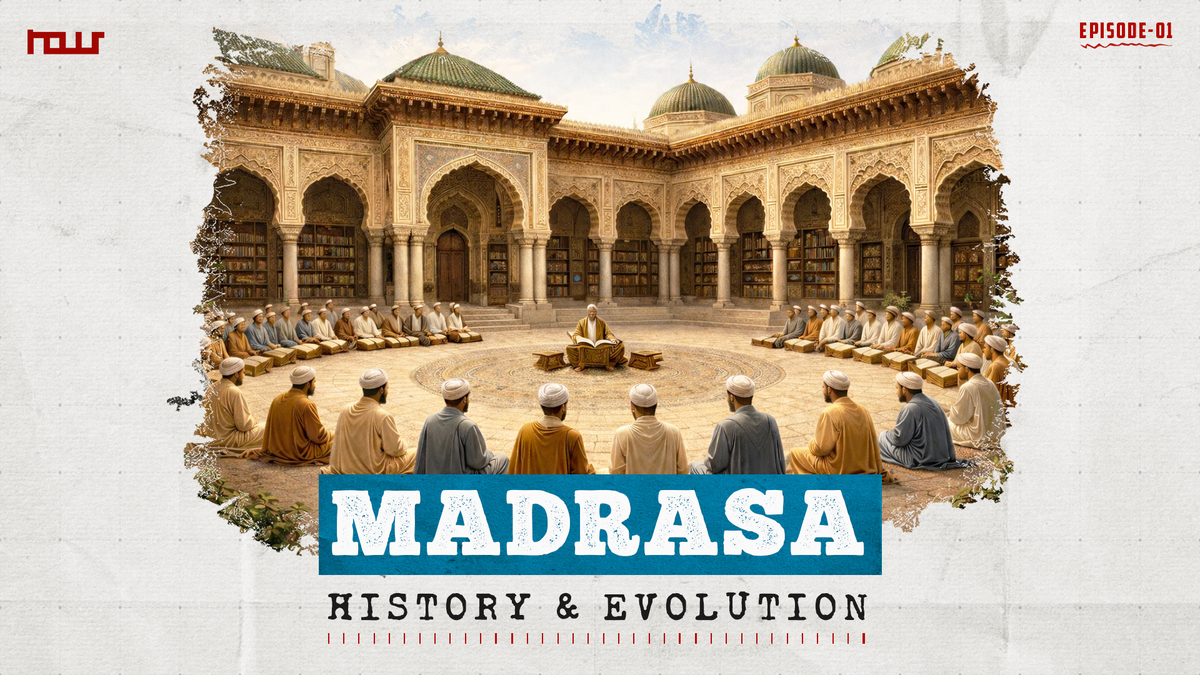
Beyond the Stereotypes: Uncovering the True History and Evolution of the Madrasa
Madrasa. When you hear this word, what is the first image that comes to your mind?
Do you see children reciting the Quran? Do you visualize a place of learning and knowledge? Or does your mind jump to the negative images and stereotypes that media narratives and propaganda have deeply embedded in the public consciousness?
It is to answer these questions that we are beginning this new series—to bring the true picture of Madrasas to light. In this series, we will explore the history and evolution of Madrasas, the syllabus taught within their walls, and the stories of some of the most prominent institutions. We will also examine the role Madrasas have played in education and society, the propaganda spread against them, and how current government policies are targeting them today.
In this first episode, we go back to the very beginning to understand what a Madrasa actually is and how it has transformed over the last few centuries.
What Does "Madrasa" Actually Mean?
In the South Asian context, a Madrasa is generally understood as a place reserved for religious education and the preservation of Islamic tradition. However, the meaning of the word is far deeper than that.
The word Madrasa comes from the Arabic root letters d-r-s (dars), which means to read or to learn. In simple terms, a Madrasa is simply "a place of learning"-a location where knowledge is acquired.
In fact, in many parts of the Muslim world, the definition is quite broad. In cities like Cairo, Egypt, everything from a primary school for small children to a high school is referred to as a Madrasa. In the Middle East and many Muslim-majority countries, the term is used for all types of educational institutions-whether government or private, and whether they offer religious or modern secular education.
The Four Tiers of Traditional Learning
In the traditional Islamic education system, institutions known as Madrasas are generally divided into four key categories:
Maktab: This is where primary education takes place. Children learn to read and write for the first time, often starting with the Quran.
Darul Qur’an: These institutions are dedicated specifically to the memorization (Hifz) and recitation (Qira'at) of the Quran.
Madrasa: Here, education continues up to the secondary and senior-secondary levels. Along with religious studies, subjects like logic, philosophy, language, and literature are emphasized.
Jamia: These are equivalent to universities. They offer higher-level education in religious sciences alongside modern education.
The Origins: From "Iqra" to Formal Institutions
Knowledge holds a special significance in Islam. The very first revelation - the first verse of the Quran revealed to Prophet Muhammad (PBUH) in 610 CE - began with the word "Iqra," meaning "Read." The Quran emphasizes knowledge and contemplation approximately 800 times, making education a mandatory pursuit.
In Mecca, when Prophet Muhammad (PBUH) presented the message of Islam based on justice and equality, the chieftains of the Quraysh felt their power threatened. As oppression increased, teaching Islam openly became impossible. Consequently, the Prophet gathered his companions at the house of Arqam bin Abi Arqam—known as Dar al-Arqam—where they were taught faith, ethics, and patience.
When life in Mecca became untenable, Muslims migrated to Medina. Here, for the first time, there was an opportunity to spread Islamic education openly. Mosques became centers of knowledge. The first of these was ‘Suffa,’ attached to the Prophet’s Mosque. Here, the companions learned the Quran, Hadith, and social principles, laying the foundation for the Islamic educational system.
The Golden Age: A Holistic Approach
By the 10th century, Madrasas had emerged as independent centers of learning. They were not limited to religious instruction; they taught philosophy, mathematics, astronomy, medicine, literature, law, and administration, creating a foundation for holistic education.
The World's First University: The University of Al-Qarawiyyin in Fez, Morocco, founded in 859 CE by a visionary woman named Fatima al-Fihri, is recognized by UNESCO and Guinness World Records as the oldest existing, and continually operating educational institution in the world.
The House of Wisdom: Between the 9th and 13th centuries, the Bayt al-Hikma (House of Wisdom) in Baghdad became a global center for arts and sciences. Established during the time of Caliph Harun al-Rashid, it housed the largest collection of books in the world, attracting philosophers, doctors, astronomers, and mathematicians. It became a hub for translating Greek, Persian, and Indian texts.
Around 1005 CE, the Fatimid Caliph Al-Hakim established the Darul-Ilm in Cairo-a state-supported institution teaching science, mathematics, and philosophy alongside religion.
The Systemization of Education
Around 1100 CE, Nizam al-Mulk, the vizier of the Seljuk Empire, established the Nizamiya Madrasas. Nizam al-Mulk is counted among the greatest administrators in Islamic history after Caliph Umar (RA) due to his visionary reforms.
The curriculum developed there, known as the ‘Nizamiya Syllabus,’ set a standard for education across the Islamic world. The faculty included giants like Imam al-Ghazali, who synthesized reason and revelation. His work, particularly The Revival of Religious Sciences (Iḥyā’ ʿUlūm al-Dīn), gave a new direction to both religious education and spiritual thought. Alongside theology and jurisprudence (Fiqh), students studied history, mathematics, astronomy, and physical sciences.
For centuries, Madrasas performed the role that European universities would later take on producing scholars, judges, doctors, bureaucrats, poets, and thinkers.
Fueling the Renaissance
Through this robust network of institutions, the Islamic Golden Age reached its zenith.
Al-Khwarizmi laid the foundations of algebra and the concept of algorithms.
Ibn Sina and Al-Razi made groundbreaking discoveries in medicine; their texts were taught in European universities for centuries.
Ibn al-Haytham, the "Father of Modern Optics," explained the principles of the camera.
Al-Biruni calculated the earth’s circumference with remarkable accuracy.
Al-Jazari created engineering designs and water clocks.
Al-Farabi and Ibn Rushd revolutionized philosophy.
These works eventually reached Europe, fueling the Renaissance. Even historian Bernard Lewis, often a critic of Islam, acknowledged this reality: "In most of the arts and sciences of civilization, medieval Europe was a pupil and in a sense a dependent of the Islamic world." Similarly, historian George Saliba notes that the scientific institutions of the Islamic world laid the groundwork for the European Renaissance.
The Madrasa in India
The tradition of the Madrasa traveled from Morocco and Baghdad to India with the spread of Islam.
It is believed that the first Maktabs (primary schools) in India began in the Malabar region of the South, where Islam first arrived via Arab traders. During the Arab rule in Sindh (8th–10th century), Madrasas began to emerge in a more organized form, offering both religious and worldly education.
By the 13th century, under the Delhi Sultanate, Madrasas were integral to the social and administrative structure. The state placed high importance on education; by the Tughlaq era in the 14th century, it is said that Delhi alone had nearly 1,000 functioning Madrasas.
· Qutbuddin Aibak initiated the tradition of mosques that served as both places of worship and education.
· Iltutmish expanded this by founding the Nasiriya College in Delhi and the Firoziya Madrasa in Multan.
· The Mughals, particularly under Akbar, integrated the Madrasa curriculum with Persian administrative and literary training, preparing students for government service alongside religious leadership.
The Legacy of Farangi Mahal and Shah Waliullah
Two institutions profoundly shaped Islamic education in India:
1. Darul Uloom Farangi Mahal (Lucknow): Established in 1693 by Mulla Nizamuddin Sihalvi, this institution is famous for developing the ‘Dars-i-Nizami’ curriculum. This syllabus created a balance between religious studies, philosophy, and logic. It became the foundation of the Islamic education system in the subcontinent. Shibli Nomani even referred to Farangi Mahal as the "Cambridge University of India."
2. Madrasa Rahimiya (Delhi): Founded by Maulana Shah Abdur Rahim and carried forward by his son, Shah Waliullah Dehlavi. Shah Waliullah was a master of Quran, Hadith, metaphysics, logic, and medicine. His intellectual contributions left a deep impact on the educational system of the region.
By the 18th century, these Madrasas had created a powerful intellectual ecosystem, producing individuals who not only advanced religious knowledge but played a pivotal role in shaping the modern world.
What Comes Next?
This history reminds us that Madrasas were not just religious enclaves but vibrant centers of holistic learning that laid the groundwork for modern academia.
However, the system we see today looks different. In the next episode, we have looked at the Colonial and Post-Colonial periods. We will explore the historical shifts that occurred under British rule and how the holistic model-where religious and worldly knowledge walked hand in hand-began to fracture.
Support Independent Media That Matters
Nous is committed to producing bold, research-driven content that challenges dominant narratives and sparks critical thinking. Our work is powered by a small, dedicated team — and by people like you.
If you value independent storytelling and fresh perspectives, consider supporting us.
Contribute monthly or make a one-time donation.
Your support makes this work possible.