Is Dalit Politics Losing Its Radical Edge? | UGC, Universities & More | Dr. Rahul Sonpimple
Dr. Rahul Sonpimple challenges the progressive image of elite universities, examining caste hierarchies, Ambedkar’s marginalisation, the limits of campus Dalit politics, reservation, and the need for broader Bahujan unity grounded in collective power rather than symbolism.

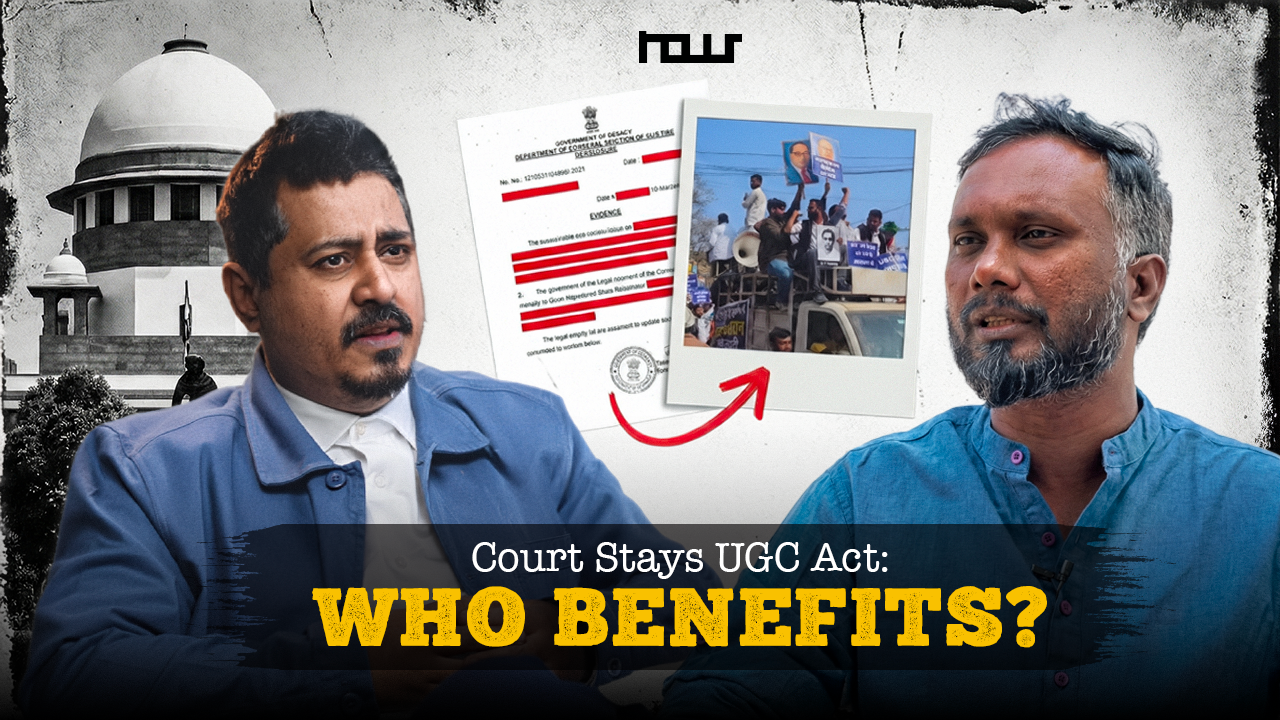
This episode features a wide-ranging and critical conversation with Dr. Rahul Sonpimple, Founder President of the All India Independent Scheduled Castes Association (AIISCA) and former leader of the Birsa Ambedkar Phule Student Association (JNU), in discussion with Asad Ashraf. The podcast challenges the assumption that premier universities are inherently progressive, arguing instead that many were historically conceived as elite, upper-caste spaces—and continue to reproduce those hierarchies.
Drawing on campus experiences, the conversation highlights how Babasaheb Ambedkar has been marginalised in academic life, remembered largely through symbolism rather than sustained intellectual engagement, while figures like Nehru dominate classroom narratives. It raises sharp questions about whether Dalit politics on campuses has lost its radical edge and become confined to symbolic assertion.
The discussion also examines reservation in its current form, the caste character of institutions like the UGC, and the persistence of discrimination despite legal safeguards such as the SC/ST Act. Engaging Kanshi Ram’s Bahujan framework, the episode argues for broader political unity—especially between Dalits and Muslims—grounded in collective power rather than fragmented identities or welfarist politics.
Beyond Political Correctness: Radical Dalit Politics, Institutional Power, and the Question of Solidarity
In a searching and often unsparing conversation on the nous network, Dr. Rahul Sonpimple—Founder President of the All India Independent Scheduled Castes Association and former leader of the Birsa Ambedkar Phule Students' Association—joins Asad Ashraf to interrogate the present condition of Dalit politics. What emerges is not merely a critique of policy or party, but a structural analysis of caste power embedded in India’s universities, judiciary, and electoral strategies.
This is not a conversation about political correctness. It is about power.
The University as a Caste Institution
The immediate provocation for the discussion is the University Grants Commission’s anti-discrimination guidelines, framed in the aftermath of institutional tragedies such as Rohith Vemula and Payal Tadvi. On paper, these guidelines appear progressive. In practice, Dr. Sonpimple argues, they are structurally hollow.
When anti-discrimination committees are chaired by institutional heads who overwhelmingly belong to upper-caste backgrounds, the promise of justice becomes self-defeating. Institutions do not float above society; they reproduce its hierarchies. If caste prejudice remains normalized in social life, why expect its disappearance in academic administration?
This is a larger point about elite campuses. Universities such as Jawaharlal Nehru University are widely imagined as progressive spaces. Yet, historically, they were conceived as elite enclaves—producing bureaucrats, intellectuals, and policymakers from socially dominant backgrounds. The celebration of figures like Nehru or Gandhi long overshadowed sustained engagement with B. R. Ambedkar. Ambedkar appeared symbolically—on anniversaries, in portraits—but not structurally in syllabi or institutional imagination.
Dr. Sonpimple’s critique cuts deeper: elite campuses have replaced radical transformation with the language of “political correctness.” Gender and sexuality discourses are fluently adopted, yet caste is often addressed in abstract moral tones rather than as a lived hierarchy of power. Political correctness, in this framing, becomes a shield against structural critique.
The Supreme Court and the Myth of Neutrality
The discussion turns toward the Supreme Court of India, especially in light of its decision to stay the UGC guidelines. Dr. Sonpimple challenges the comforting belief that the judiciary stands outside political currents. He describes the Court as historically shaped by upper-caste dominance, often aligning—directly or indirectly—with prevailing state power.
This critique resonates with earlier controversies, particularly around the dilution of the Scheduled Castes and Scheduled Tribes (Prevention of Atrocities) Act, 1989. For many Dalit activists, such judicial interventions signal not neutrality but a pattern: the Constitution promises equality, yet its guardians are drawn disproportionately from socially dominant groups.
Ambedkar himself warned that a constitution, however well-crafted, is only as effective as the people who administer it. The gap between constitutional morality and social morality remains the central fault line of Indian democracy.
Electoral Strategy and Managed Contradictions
If the ruling establishment is widely perceived as skeptical of affirmative action politics, why introduce such guidelines at all?
Dr. Sonpimple situates this within electoral calculus—especially in politically decisive states like Uttar Pradesh. Bahujan politics has long shaped the state’s political imagination. To secure non-Yadav OBC and Dalit constituencies, gestures toward social justice become tactically necessary.
The result is a managed contradiction: introduce reformist optics, allow upper-caste anxieties to be publicly expressed, and rely on judicial or procedural routes to blunt the reform. In this reading, governance becomes a chessboard where symbolic concession and structural rollback coexist.
Kanshiram, Ambedkar, and the Radical Imagination
A striking moment in the conversation is Dr. Sonpimple’s invocation of Kanshi Ram. Unlike sections of the Indian Left, he argues, Kanshi Ram recognized that caste—not merely class—structures Indian society. The “Bahujan” framework identified the oppressed majority not as a vague proletariat but as a caste-marked demographic reality.
This insight re-centers B. R. Ambedkar as not simply a constitutionalist but a radical theorist of social democracy. Ambedkar’s critique of Brahminism was not rhetorical; it was institutional. He understood that without representation in state structures, democracy becomes numerical but not substantive.
Dr. Sonpimple resists the liberal claim that caste can be intellectually transcended through declarations of being “de-casted.” Brahminism, in his framing, is not merely an attitude but a material structure. Like capitalism requires capitalists, caste hierarchy requires its beneficiaries.
Reservation as Political Settlement, Not Charity
One of the most forceful arguments concerns reservation. Critics often describe it as a welfare mechanism that perpetuates caste identity. Dr. Sonpimple reframes it as a political settlement—a negotiated assurance that the marginalized majority retains a stake in the democratic system.
Without reservation, representation in bureaucracy, academia, and judiciary would shrink dramatically. More crucially, the democratic compact itself would fray. Reservation is not benevolence; it is stability.
This interpretation echoes Ambedkar’s insistence that political democracy must be anchored in social democracy. When social hierarchies remain intact, affirmative action becomes not an exception to equality but a prerequisite for it.
Dalits, Muslims, and the Arithmetic of Solidarity
Perhaps the most politically sensitive part of the conversation concerns Dalit–Muslim solidarity. Dr. Sonpimple argues that Dalits, Adivasis, and marginalized Muslims constitute the working class of India in material terms—laborers, vendors, factory workers, informal economy participants.
He contends that together, Dalits and Muslims represent a demographic capable of reshaping political equations. Yet, such unity faces deliberate fragmentation. The invocation of “Pasmanda” politics by ruling actors, he suggests, operates as both recognition and division—addressing welfare questions while preventing broader political consolidation.
The warning is sharp: identity recognition without structural alliance can weaken collective bargaining power. Solidarity, in this view, must transcend symbolic gestures and move toward shared political negotiation.
Beyond Correctness: Reclaiming Radicalism
What does it mean to say Dalit politics may be losing its radical edge?
Dr. Sonpimple suggests that institutional incorporation—positions in academia, bureaucracy, party structures—can soften oppositional energy. Representation is necessary, but it can also become co-optation. Radicalism is not loudness; it is structural clarity.
Elite discourse often rewards civility over confrontation. Yet caste hierarchy is not polite. It is violent, persistent, and adaptive. A politics that merely seeks inclusion without transformation risks becoming decorative.
A Larger Reflection: The Future of Democratic Power
Listening to Dr. Sonpimple’s arguments raises uncomfortable but necessary questions. Can institutions built within caste society transcend it without structural redesign? Can the judiciary embody constitutional morality if its social composition remains narrow? Can solidarity emerge across communities historically divided by both prejudice and political engineering?
The answers are not simple. But the conversation insists on one foundational principle: democracy without social equality is unstable.
If universities are to become genuinely emancipatory, their curricula, faculty composition, and administrative cultures must change—not cosmetically but structurally. If the Constitution is to remain meaningful, its promises must be defended not only in courtrooms but in streets, classrooms, and political coalitions.
Dr. Sonpimple’s intervention is less about despair than about recalibration. It calls for moving beyond the comfort of political correctness toward the discomfort of structural critique. It asks marginalized communities to see through symbolic inclusion and to imagine power not as access to elite spaces alone, but as the capacity to redefine those spaces.
In the end, the question is not whether Dalit politics has lost its radical edge. The question is whether India’s democracy can afford for it to.
Support Independent Media That Matters
Nous is committed to producing bold, research-driven content that challenges dominant narratives and sparks critical thinking. Our work is powered by a small, dedicated team — and by people like you.
If you value independent storytelling and fresh perspectives, consider supporting us.
Contribute monthly or make a one-time donation.
Your support makes this work possible.