Budget 2026 Explained: What Did India’s Minorities Really Get?
This video analyses the Ministry of Minority Affairs’ Budget 2026 allocation beyond headline figures, examining real spending, inflation-adjusted trends, and shifting priorities to understand what the numbers truly mean for minority welfare in India.
Budgetary Optics vs. Fiscal Reality: Decoding the Ministry of Minority Affairs Allocation for 2026–27
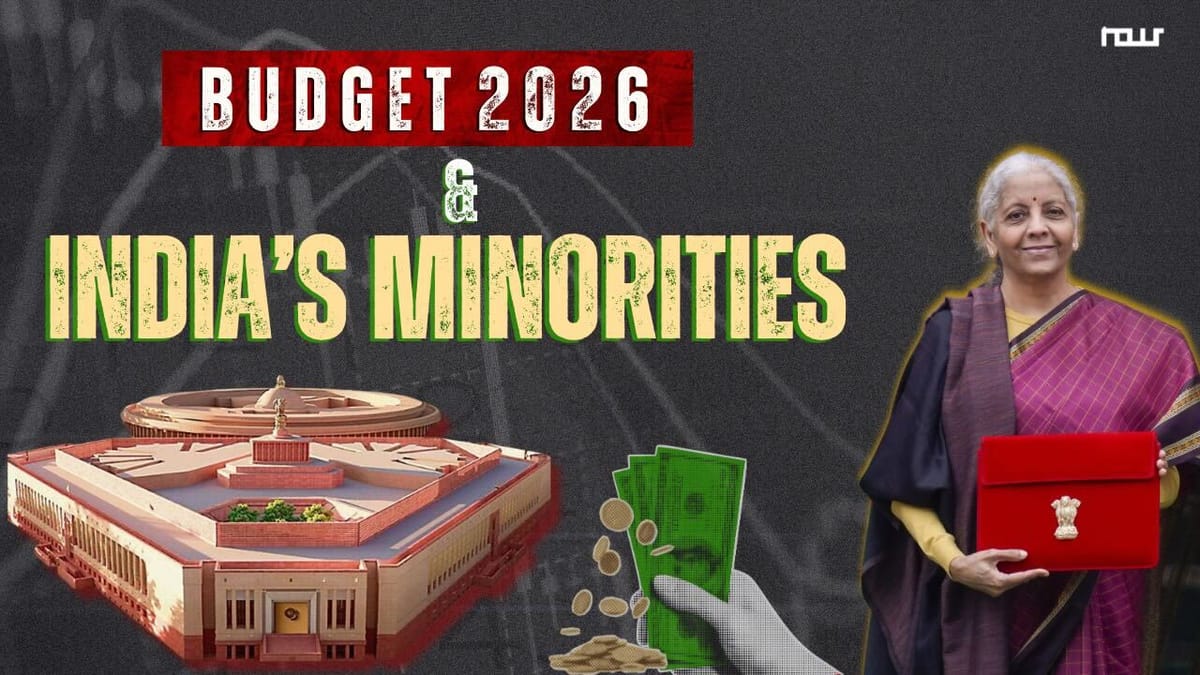
In the Union Budget for 2026–27, the central government announced an allocation of ₹3,400 crore for the Ministry of Minority Affairs. On the surface, this represents a marginal increase from the previous year’s budget estimate (BE) of ₹3,350 crore. This uptick of ₹50 crore has fueled a media narrative suggesting "fiscal generosity" or a "treasure" for minority communities.
However, a granular analysis of the fiscal data - looking beyond the headline numbers to inflation, relative budget share, and historical expenditure trends—reveals a starkly different picture. The narrative of increase dissolves when subjected to the scrutiny of real-term economics and implementation history.
The Illusion of an Increase: Nominal vs. Real Terms
While the absolute number has risen by ₹50 crore, the allocation must be viewed in the context of the total Union Budget and prevailing economic conditions.
In the fiscal year 2025–26, the allocation of ₹3,350 crore represented 0.066% of the total budget. In 2026–27, despite the nominal hike, the Ministry’s share of the total budget has shrunk to 0.064%. This reduction in proportional allocation occurs against the backdrop of a demographic reality where religious minorities constitute approximately 19.3% of India’s population.
Furthermore, the "increase" fails to account for inflation. According to the Economic Survey, the average CPI inflation for 2025–26 stood at approximately 2.8%. To merely maintain the purchasing power of the previous year’s allocation, the 2026–27 budget for the Ministry should have been at least ₹3,443 crore.
If we apply the Reserve Bank of India’s inflation-targeting benchmark of 4%, the erosion of value becomes even more pronounced. Consequently, the allocation of ₹3,400 crore is not an increase; in real economic terms, it is a budget cut.
The Implementation Gap: Promise vs. Performance
Perhaps the most critical aspect of the Ministry’s finances is the widening gap between what is announced in the Budget Speech and what is actually spent.
The fiscal cycle of the Ministry of Minority Affairs follows a concerning pattern:
- Announcement: A headline allocation is made.
- Revision: The budget is drastically slashed in the Revised Estimates (RE) mid-year.
- Expenditure: The actual spending falls even below the reduced revised estimate.
For instance, in 2025–26, the government announced ₹3,350 crore. However, during the course of the year, this was revised downward to ₹2,160 crore - a slash of nearly ₹1,190 crore (approx. 35%).
Looking back at 2024–25, the data is even more telling regarding actual utilization:
- Budget Estimate: ₹3,183 crore
- Revised Estimate: ₹1,868 crore
- Actual Expenditure: ₹714.98 crore
In 2024–25, the Ministry utilized less than a quarter of the funds originally promised. This trend suggests that budget allocations have become symbolic figures that do not translate into on-ground welfare.
A Timeline of Structural Dismantling
The 2026–27 budget appears to be the continuation of a decade-long policy shift, moving away from direct financial support and institutional empowerment for minorities. A timeline of key schemes illustrates this trajectory:
- 1989 – Maulana Azad Education Foundation (MAEF): Established to promote education among the educationally backward minorities, this institution was a cornerstone of minority welfare. In 2024, it was completely dissolved.
- 1994 – NMDFC: The National Minorities Development and Finance Corporation was created to provide credit to minority entrepreneurs. In the 2026–27 budget, it has received a mere token allocation of ₹5 crore, signaling a potential phase-out.
- 2007–08 – Scholarship Schemes: The Pre-Matric, Post-Matric, and Merit-cum-Means scholarships were instrumental in bringing thousands of students into the professional fold.
- The Decline: In 2014–15, the Merit-cum-Means scholarship had an allocation of ₹302 crore. In 2026–27, the allocation stands at ₹0.06 crore—effectively zero.
- 2009–10 – Maulana Azad National Fellowship (MANF): A vital lifeline for minority scholars pursuing M.Phil and Ph.D. degrees. This was officially discontinued starting from the 2022–23 academic session.
- 2014–16 – Skill & Culture Schemes: New initiatives like Nai Manzil (skills), USTTAD (traditional crafts), and Hamari Dharohar (culture) were launched with fanfare. By the 2024–25 budget cycle, these were either scrapped, quietly defunded, or merged into oblivion.
- Overseas Education Loans: The Interest Subsidy scheme for overseas education, launched in 2013–14, saw its allocation reduced to ₹0.01 crore in 2024–25, with zero utilization reported.
Conclusion: From Commitment to Optics
The Union Budget 2026–27 confirms a transition in the state’s approach toward minority welfare. What was once a robust framework of scholarships, fellowships, and financial corporations has been eroded through a dual strategy: fiscal strangulation (reducing real allocations) and institutional closure (scrapping schemes like MANF and MAEF).
When schemes are announced but slashed in revisions, and when funds are allocated but left unspent, the Budget becomes an exercise in optics rather than governance. The current allocation offers no roadmap for inclusion; rather, it reflects a gradual but definitive withdrawal of the state from its responsibilities toward the development of its minority citizens.
Support Independent Media That Matters
Nous is committed to producing bold, research-driven content that challenges dominant narratives and sparks critical thinking. Our work is powered by a small, dedicated team — and by people like you.
If you value independent storytelling and fresh perspectives, consider supporting us.
Contribute monthly or make a one-time donation.
Your support makes this work possible.