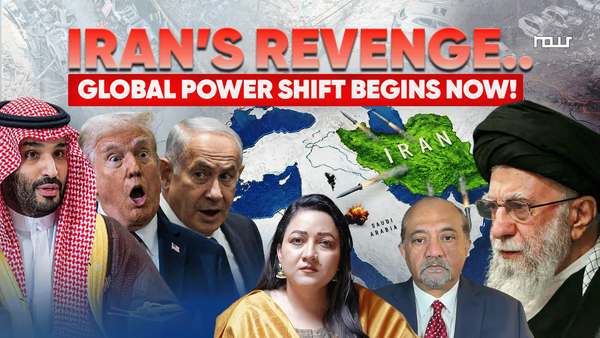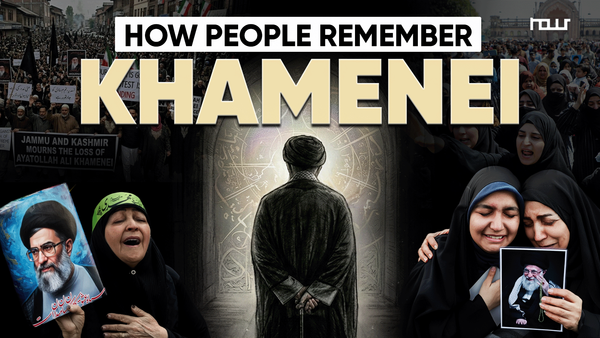
After Khamenei: What’s Next for Iran | Amaresh Misra in Conversation with Bushra Khanum
Bushra Khanum speaks with Amaresh Misra on Iran’s political transition after Ayatollah Ali Khamenei’s martyrdom, examining its domestic impact, regional tensions, and how constitutional and factional dynamics may shape the future of the Islamic Republic.
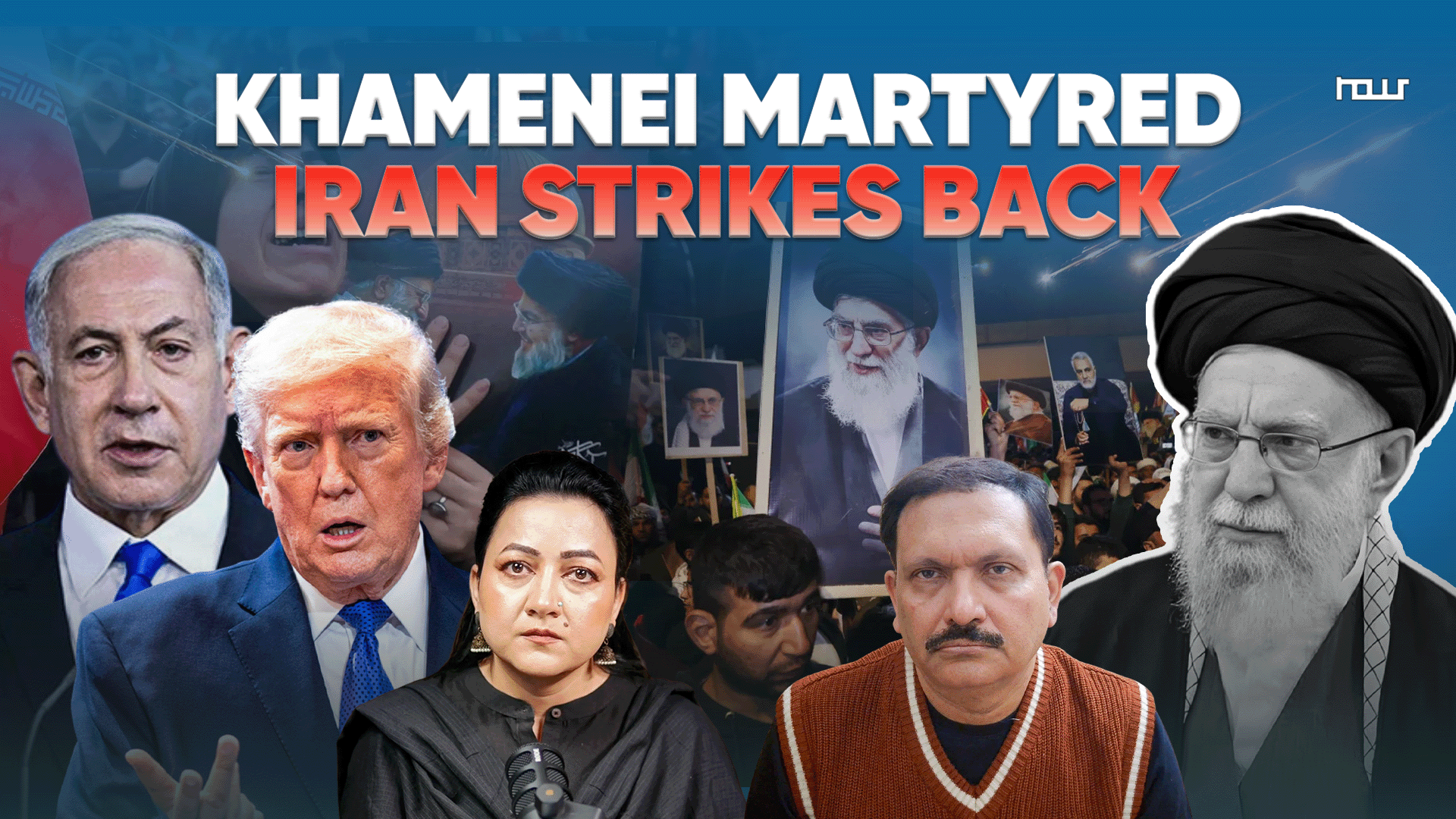
In this incisive conversation, senior journalist Bushra Khanum sits down with author and political commentator Amaresh Misra to unpack the far-reaching shifts in Iranian politics following the death and martyrdom of Ayatollah Ali Khamenei. Against the backdrop of unprecedented upheaval in Iran’s leadership and society, they explore what this moment means for the future of the Islamic Republic - both domestically and internationally. Misra and Khanum analyze the implications of Khamenei’s passing during a period of intense regional tensions, the contested narratives emerging within Iran, and how the nation’s constitutional mechanisms and political factions may shape the transition of power.
After Khamenei: Escalation, Uncertainty, and the Fragile Edges of a New Geopolitical Order
In a recent discussion on the nous, author and geopolitical analyst Amaresh Misra examined a dramatic hypothetical scenario: the assassination of Iran’s Supreme Leader Ayatollah Ali Khamenei in a joint U.S.–Israeli operation, and the cascading consequences that would follow.
While the scenario itself represents an extreme rupture in Middle Eastern politics, the conversation is less about spectacle and more about structure—about deterrence, institutional resilience, asymmetric warfare, and the fragile balance of a rapidly evolving global order.
This article synthesizes the key arguments from that discussion, while situating them within a broader and more cautious geopolitical frame.
Leadership Decapitation and the Logic of Escalation
The targeted killing of a sitting head of state or supreme authority would represent an extraordinary escalation under international law and diplomatic norms. For the Islamic Republic of Iran, whose political system is organized around the authority of the Supreme Leader, such an act would not merely be military—it would be existential.
Historically, leadership decapitation strategies are often justified by their architects as means of deterrence or destabilization. Yet political systems built around ideological institutions frequently prove more resilient than anticipated. The Islamic Republic’s power structure includes not just the Supreme Leader but the Guardian Council, Assembly of Experts, presidency, parliament, and the Islamic Revolutionary Guard Corps (IRGC).
Rather than collapse, such systems may consolidate.
The hypothetical aftermath described in the discussion suggests precisely that: instead of fragmentation, Iran could experience rapid institutional regrouping. Leadership transition mechanisms are embedded within the Iranian constitution. The assumption that removing a single figure guarantees regime change often misunderstands how revolutionary states sustain continuity.
Asymmetric Warfare: Iran’s Strategic Doctrine
Iran’s military doctrine has long emphasized asymmetric deterrence. Facing superior conventional air power from the United States and Israel, Tehran has invested in missile systems, proxy networks, naval disruption capabilities, and cyber operations.
Missile platforms such as the Fateh and Khorramshahr series are frequently cited in strategic analyses for their range and payload capacities. More broadly, Iran’s emphasis on speed, mobility, and decentralization is designed to complicate adversarial response.
In a direct confrontation scenario, escalation would likely unfold across multiple theaters:
- U.S. bases in the Gulf
- Israeli strategic infrastructure
- Maritime routes in the Persian Gulf
- Cyber networks
- Energy chokepoints
Such conflict would not resemble conventional large-scale ground war. It would manifest in layered retaliation, calibrated signaling, and proxy engagements.
The danger lies not only in immediate destruction but in miscalculation.
The Strait of Hormuz: Energy as Leverage
One of Iran’s most potent geopolitical levers remains the Strait of Hormuz. Approximately a fifth of the world’s traded oil passes through this narrow maritime corridor. Any serious disruption—whether through mining, tanker seizures, or naval skirmishes—would reverberate instantly through global energy markets.
Even limited hostilities could:
- Spike oil prices dramatically
- Trigger stock market volatility
- Disrupt supply chains
- Accelerate inflation in import-dependent economies
Energy chokepoints turn regional conflicts into global crises. This is why Gulf tensions historically produce outsized economic consequences.
The Nuclear Question: Deterrence vs. Proliferation
A particularly sensitive dimension of the scenario concerns nuclear policy. Ali Khamenei had publicly referenced a religious decree (fatwa) opposing nuclear weapons. While international observers debate the binding nature of such pronouncements, they have been cited diplomatically as evidence of restraint.
A leadership transition under conditions of external attack could fundamentally alter that calculus.
States often reassess deterrence when conventional vulnerability is exposed. The North Korean precedent—nuclear capability as regime insurance—is frequently invoked in strategic debates. However, nuclearization carries enormous risks:
- Severe economic sanctions
- Regional proliferation (e.g., Saudi or Turkish responses)
- Increased probability of preemptive strikes
- Permanent diplomatic isolation
The move from nuclear ambiguity to weaponization would represent a watershed moment in global non-proliferation politics.
The Role of Major Powers: Russia and China
Any escalation involving Iran would inevitably intersect with broader great-power competition.
Russia and China maintain strategic partnerships with Tehran, though neither is likely to seek direct military confrontation with the United States over Iran. Their support would more plausibly manifest through:
- Intelligence sharing
- Technology transfers
- Diplomatic shielding in international forums
- Economic lifelines
This aligns with the broader shift toward multipolarity. Conflicts are no longer purely bilateral; they are nested within systemic rivalries.
The risk is that a regional war becomes a proxy arena for larger geopolitical competition—further fragmenting global governance structures.
Israel and the Logic of Pre-emption
From Israel’s strategic perspective, preventing hostile regional powers from acquiring advanced weapons capabilities has been a consistent doctrine. Pre-emptive actions—whether in Iraq (1981), Syria (2007), or against Iranian-linked targets in Syria—have been justified as defensive necessities.
Yet a strike on Iran’s top leadership would cross an entirely different threshold.
Escalation control would become extraordinarily difficult. Missile exchanges, cyberattacks, and maritime disruptions could spiral beyond the intentions of any one actor.
South Asia’s Delicate Balancing Act
For countries like India and Pakistan, such a crisis would be deeply destabilizing.
India faces competing interests:
- Energy dependence on Gulf stability
- Strategic ties with Israel
- Civilizational and commercial links with Iran
- A long-standing doctrine of strategic autonomy
Pakistan confronts its own constraints:
- Economic vulnerability
- Complex relations with the U.S.
- Domestic public sentiment strongly reactive to Middle Eastern crises
South Asia’s margin for diplomatic error in such a scenario would be narrow. Neutrality may prove difficult to maintain under pressure.
Public Mobilization and National Consolidation
One of the most unpredictable elements in any crisis is domestic response. External attack often generates internal consolidation. Political factions that might otherwise contest authority may temporarily close ranks.
If mass mobilization occurs, it can:
- Legitimize hardline leadership
- Marginalize reformist voices
- Harden public opinion
- Reduce diplomatic flexibility
In such moments, emotional narratives—martyrdom, sovereignty, resistance—become powerful drivers of state policy.
A World on Edge: Structural Fragility
Beyond immediate military consequences lies a deeper question: are global institutions equipped to manage high-intensity regional wars between technologically advanced actors?
The post–Cold War order assumed that economic interdependence would dampen large-scale conflict. Yet recent crises—from Eastern Europe to the Middle East—suggest otherwise. Economic globalization has not eliminated strategic rivalry; it has complicated it.
A conflict of the magnitude discussed would test:
- The resilience of energy markets
- The authority of international law
- The limits of deterrence theory
- The viability of multilateral diplomacy
It would also accelerate debates about multipolarity and the erosion of Western-led global dominance.
Between Alarm and Analysis
While the scenario discussed is dramatic, serious analysis requires separating rhetorical intensity from structural probability. States—even adversarial ones—often calibrate escalation carefully. The costs of uncontrolled war remain extraordinarily high for all actors involved.
However, the conversation underscores a crucial point: the Middle East remains a central fault line of global politics. Leadership transitions, nuclear calculations, maritime chokepoints, and great-power rivalry intersect there in uniquely combustible ways.
The question is not only what happens “after Khamenei,” but how international actors manage deterrence, restraint, and dialogue in moments of crisis.
If diplomacy fails, the consequences would not be confined to one region. They would reverberate across markets, alliances, and institutions worldwide.
In an era already marked by fragmentation, a conflict of this scale would not merely reshape the Middle East. It could redefine the architecture of global order itself.
Support Independent Media That Matters
Nous is committed to producing bold, research-driven content that challenges dominant narratives and sparks critical thinking. Our work is powered by a small, dedicated team — and by people like you.
If you value independent storytelling and fresh perspectives, consider supporting us.
Contribute monthly or make a one-time donation.
Your support makes this work possible.