This Is Not Strategic Silence, This Is Surrender’ — Yashwant Sinha on India’s Foreign Policy
In this conversation, Yashwant Sinha joins Bushra Khanum to assess India’s foreign policy amid West Asia tensions—examining strategic silence, energy risks around the Strait of Hormuz, and whether India can act as a stabilising force in an increasingly volatile global order.
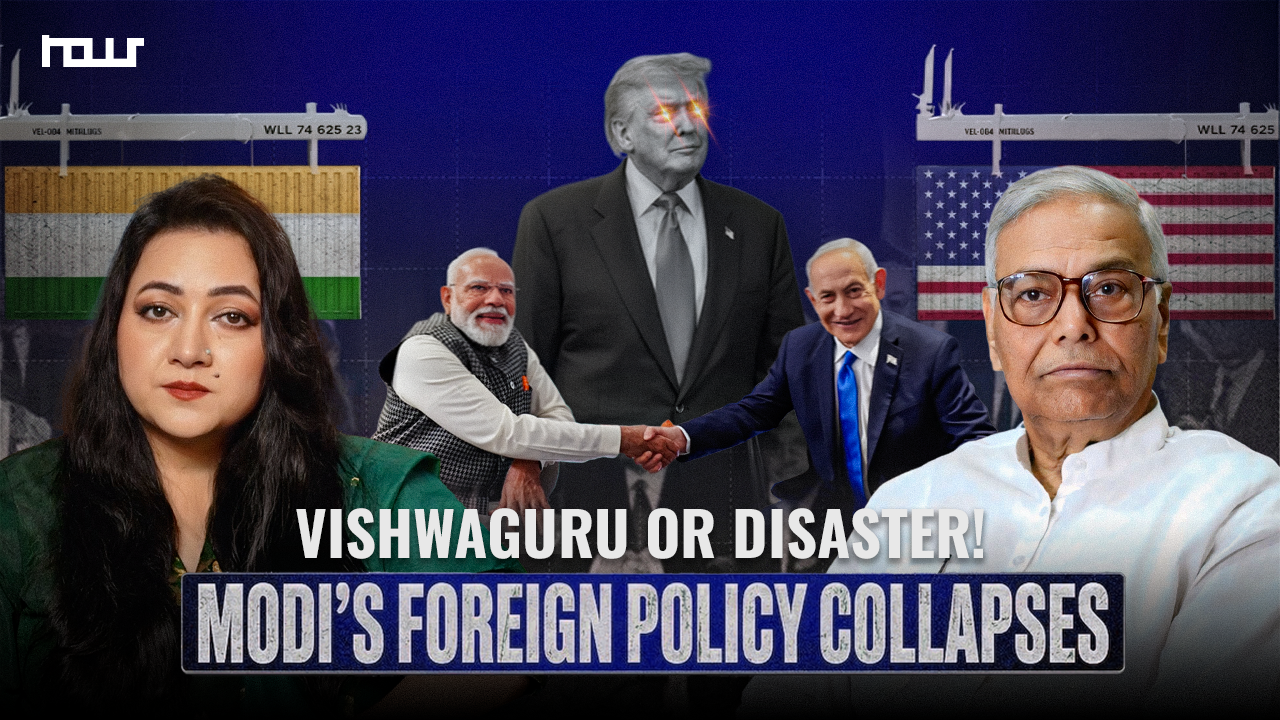
In this sharp and probing conversation, Senior Journalist Bushra Khanum speaks with Yashwant Sinha (Former Finance Minister of India & Former External Affairs Minister) on India’s foreign policy posture amid escalating tensions in West Asia. The discussion examines whether India’s silence reflects strategic restraint or a deeper diplomatic compromise, particularly in the context of US influence and shifting global alignments.
Concerns around energy security take center stage, with a focus on the Strait of Hormuz and the potential consequences of disruption in oil supply routes for India’s economy. The conversation also reflects on the intensifying Iran–Israel conflict, the risks of military escalation—including the possibility of tactical nuclear use—and the broader geopolitical implications involving China.
At its core, the dialogue questions India’s role: Can it act as a stabilizing force, or is it retreating from its responsibility in shaping regional peace?
India’s Foreign Policy Under Strain: Strategic Silence, Economic Vulnerability, and the West Asia Crisis
Rethinking Diplomacy in an Era of Escalating Global Conflict
The intensifying conflict involving Iran, Israel, and the United States has once again placed West Asia at the centre of global geopolitics. For India, however, the implications are not limited to distant strategic calculations. They are immediate, material, and deeply consequential—affecting energy security, economic stability, and diplomatic positioning.
In a detailed discussion, former External Affairs and Finance Minister Yashwant Sinha offered a sharp critique of India’s current approach to the crisis, questioning whether what is often described as “strategic restraint” reflects a calibrated diplomatic choice—or a deeper uncertainty in foreign policy direction.
This moment provides an opportunity to examine not just India’s response to a specific conflict, but the broader evolution of its foreign policy in a rapidly changing global order.
West Asia in Flux: A Region Redefining Global Stakes
West Asia has historically been a theatre of overlapping conflicts—territorial, ideological, and geopolitical. What distinguishes the current phase is the scale and intensity of escalation, alongside its integration with global power dynamics.
The confrontation between Iran and Israel, with the United States as a central actor, is no longer confined to indirect engagements. It increasingly involves direct strategic signalling, targeted strikes, and heightened military preparedness.
For countries like India, which depend heavily on the region for energy imports and diaspora linkages, instability in West Asia translates into immediate economic and strategic risks.
The Idea of “Strategic Silence”
India’s official posture in recent conflicts has often been described as “strategic silence”—a deliberate effort to avoid taking overt sides while maintaining relationships across competing actors.
In principle, such an approach aligns with India’s long-standing doctrine of strategic autonomy, allowing it to engage with multiple partners without formal alignment.
However, as Sinha argues, the effectiveness of such a strategy depends on context. Silence can be interpreted in different ways—either as diplomatic prudence or as reluctance to articulate a clear position.
In situations involving high-intensity conflict and visible violations of international norms, the absence of a clear stance may also affect perceptions of credibility and influence.
Continuity and Departure: India’s Diplomatic Tradition
India’s foreign policy has historically balanced moral positioning with pragmatic engagement.
From the era of non-alignment under Jawaharlal Nehru to later phases of multi-alignment, India sought to maintain relationships across geopolitical divides—engaging the United States, Russia, Iran, and Israel simultaneously.
This balancing act enabled India to safeguard diverse interests:
- Energy imports from West Asia
- Defence cooperation with multiple partners
- Access to global markets and technology
The current geopolitical environment, however, presents new challenges. Intensifying rivalries among major powers reduce the space for ambiguity, making it more difficult to sustain equilibrium without clearer positioning.
Energy Dependence and Economic Exposure
One of the most immediate consequences of instability in West Asia is its impact on energy markets.
India imports a significant portion of its crude oil, much of which passes through the Strait of Hormuz—a critical global chokepoint. Any disruption in this corridor affects supply chains, increases transportation costs, and pushes up domestic fuel prices.
This, in turn, has cascading effects:
- Rising inflation
- Pressure on household consumption
- Increased fiscal strain on subsidies
Currency fluctuations often accompany such shocks. As global uncertainty rises, capital flows shift, affecting exchange rates and financial markets.
These dynamics highlight a key reality: foreign policy decisions are deeply intertwined with domestic economic outcomes.
The Limits of External Alignment
India’s relationships with global powers—particularly the United States—have expanded significantly over the past two decades, encompassing defence cooperation, trade, and strategic dialogue.
At the same time, India continues to maintain ties with Russia and engages with regional actors like Iran.
Navigating these relationships requires constant recalibration. External pressures—whether related to sanctions, trade policies, or geopolitical expectations—can complicate decision-making.
The challenge lies in ensuring that partnerships do not constrain policy independence, especially in areas critical to national interest such as energy security and regional connectivity.
Diplomatic Platforms and Collective Action
In discussing possible responses to the crisis, Sinha highlights the importance of multilateral engagement.
India is part of several international groupings, including BRICS and IBSA (India, Brazil, South Africa). These platforms offer opportunities for coordinated diplomatic initiatives, particularly on issues such as ceasefire negotiations and conflict de-escalation.
However, the effectiveness of such forums depends on political will and consensus among member states. In a fragmented global environment, building that consensus is itself a complex task.
Strategic Autonomy in a Multipolar World
The broader question raised by the current crisis is whether India can sustain its traditional approach of strategic autonomy in an increasingly polarized world.
The emerging global order is not strictly bipolar or unipolar. Instead, it is characterized by multiple centres of power—each with its own interests, alliances, and spheres of influence.
In such a system, autonomy requires more than neutrality. It demands:
- Clarity of priorities
- Consistency in policy articulation
- Capacity to absorb external shocks
Balancing these elements is essential for maintaining both credibility and flexibility.
Beyond Rhetoric: The Need for Policy Coherence
Foreign policy today operates not only through diplomacy, but also through perception.
Narratives of global leadership or civilizational influence can enhance a country’s soft power. However, they must be supported by coherent and consistent policy choices.
When external actions appear misaligned with stated principles, questions arise about the direction and intent of policy.
For India, the challenge is to align its global aspirations with grounded, pragmatic decision-making that reflects both national interests and international responsibilities.
Conclusion: Navigating Uncertainty
The ongoing crisis in West Asia is a reminder of how interconnected the modern world has become. Conflicts in one region can quickly translate into economic, political, and strategic challenges elsewhere.
For India, this moment underscores the importance of recalibrating foreign policy to meet evolving realities. Strategic silence, alignment, or neutrality are not ends in themselves—they are tools that must be deployed carefully, depending on context.
Ultimately, the effectiveness of foreign policy lies in its ability to protect national interests while maintaining credibility on the global stage.
As the international system moves toward a more complex and multipolar structure, the task before India is not merely to respond to crises—but to shape its role within this changing order with clarity, balance, and foresight.
Support Independent Media That Matters
Nous is committed to producing bold, research-driven content that challenges dominant narratives and sparks critical thinking. Our work is powered by a small, dedicated team — and by people like you.
If you value independent storytelling and fresh perspectives, consider supporting us.
Contribute monthly or make a one-time donation.
Your support makes this work possible.