The Muslim Crisis is Philosophical, Before It Is Political: Unraveling the Roots of Modernity with Hassan Spiker
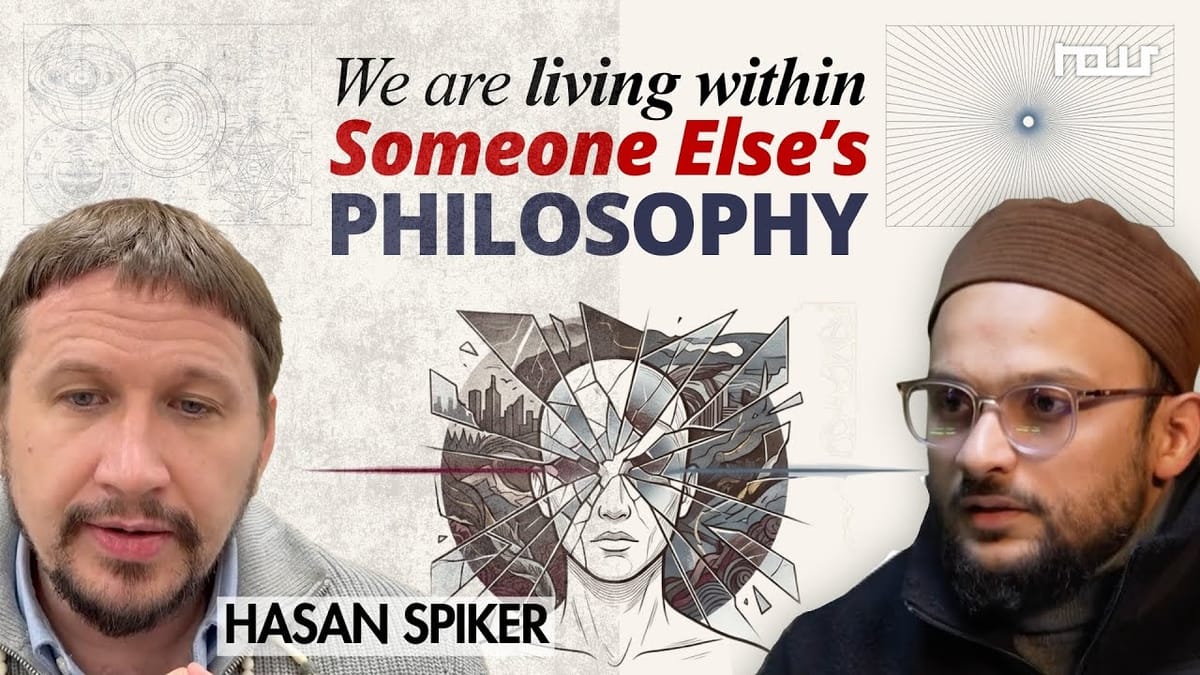
Ali Javed engages philosopher Hasan Spiker to diagnose the "Muslim Crisis." Spiker argues the issue isn't geopolitical, but ontological: Muslims increasingly inhabit a "borrowed philosophy." A deep dive into the metaphysical roots of modern confusion.
When observing the trajectory of the contemporary Muslim world, the diagnosis is almost always geopolitical. Commentators point to a failure of constitutionalism, the fragmentation of the nation-state, or a lack of economic unity. The assumption is that if the political machinery were fixed, the civilization would recover.
However, in a recent and philosophically rigorous conversation, philosopher and comparative scholar Hasan Spiker proposes a far more unsettling diagnosis: these political failures are merely symptoms. The true crisis is ontological. Muslims, Spiker argues, are increasingly inhabiting someone else’s philosophy—living within a "borrowed" metaphysics that quietly reshapes how reality itself is understood.
Spiker, the author of Hierarchy and Freedom and The Unraveling of Intelligibility, suggests that the intellectual and social mechanisms that once transmitted the Islamic worldview have eroded. In their absence, many Muslims have unconsciously absorbed the default setting of modernity: a flattened, materialist lens that is fundamentally at odds with the Revelation they profess to believe.
The Dilemma of "Flatland"
The core of Spiker’s argument rests on a profound cognitive dissonance. The Islamic faith describes a vertical, hierarchical reality—a cosmos populated by Divine essences, spirits, and objective truths that transcend the physical. Yet, the modern Muslim mind is often educated within a "flat" reality defined by positivism and empiricism, where only that which can be measured is deemed objectively real.
Spiker utilizes the analogy of "Flatland"—a two-dimensional world trying to theorize a three-dimensional existence. We attempt to adhere to a faith of infinite depth while utilizing the intellectual tools of a flattened philosophy.
This results in a subtle colonization of the mind. For instance, Spiker notes how easily modern believers adopt liberal secular values, such as John Stuart Mill’s "harm principle," as their primary moral compass. We accept the premise that "freedom" is simply non-interference, assuming this is a neutral stance. However, Spiker warns that this neutrality is a myth; it relies on the specific metaphysical assumption that there is no objective, spiritual Good that binds society together.
The Genealogy of the Crisis
How did we arrive at this point of fragmentation? Spiker traces the "unraveling of intelligibility" not to a simple passage of time, but to a specific philosophical trajectory in Europe—what he terms the "Five Severances."
This decline is rooted in the shift from a world of universals to a world of particulars. Pre-modern thought (both Islamic and Christian) understood that physical things possessed an essence—a "what-ness" that gave them meaning. However, through the rise of nominalism and eventually empiricism, Western philosophy stripped the world of these qualitative properties. Meaning was divorced from matter.
In the pre-modern Islamic worldview, science was subordinate to metaphysics; physics explained how things moved, but metaphysics explained what things were. Today, that order is inverted. We attempt to answer ultimate questions with material sciences, resulting in a bleak existentialism where "existence is prior to essence." In this framework, humans have no inherent nature, only the arbitrary freedom to construct themselves—a view entirely alien to the Islamic conception of the human being (insan).
The Limits of Traditional Kalam
Perhaps the most challenging aspect of Spiker’s thesis is his critique of the traditional response. A common instinct among revivalists is to simply return to classical Kalam (scholastic theology). While Spiker holds deep respect for the tradition, he argues that classical Kalam was designed to address the specific heresies and questions of a different age.
Merely teaching logic or theology in isolation is insufficient because the modern student returns to a world designed by a completely different ontology. As Spiker notes, "We are living within someone else’s worldview." We cannot solve a total crisis of being with a textbook on logic alone, nor can we use "methodological immanentism" to diagnose a world that has rejected the transcendent entirely.
The Remedy: Faculty Holism and the Prophetic Model
If the illness is the fragmentation of reality, Spiker argues that the cure must be integration. He proposes "Faculty Holism"—a reintegration of the spiritual, the rational, and the ethical. We require a metaphysics that connects our intellectual arguments directly to spiritual purification and lived ethics.
This leads to the ultimate ordering principle of Spiker’s thesis: The Haqiqa Muhammadiyya (The Muhammadan Reality).
The crisis of the modern world is, at its heart, a crisis of order. Spiker argues that the Prophet Muhammad (peace be upon him) represents the perfect balance of the Divine attributes of Majesty (Jalal) and Beauty (Jamal). He is the archetype of the Vicegerent (Khalifa)—the being who spans the spiritual and material worlds, ordering the latter toward the Good.
Unlike the fragmented extremes of modernity—which offer either a dry, soulless rationalism or an unanchored, subjective spirituality—the Prophetic model offers a "totalized metaphysical vision." It reminds us that real knowledge is not merely data accumulation; it requires the purification of the soul.
Conclusion
The "Muslim Crisis" will not be solved at the ballot box alone. It requires a profound intellectual unlearning of the positivistic philosophies that have silently colonized our engagement with the world. It demands a return to a worldview where the visible world is anchored in the invisible, and where knowledge is not a means of domination, but a path to the Divine.
As Spiker articulates, the recovery of our civilization depends on recognizing the Prophet (peace be upon him) not just as a historical figure, but as the metaphysical lens through which the fragmentation of the modern world can finally be made whole.
Support Independent Media That Matters
Nous is committed to producing bold, research-driven content that challenges dominant narratives and sparks critical thinking. Our work is powered by a small, dedicated team — and by people like you.
If you value independent storytelling and fresh perspectives, consider supporting us.
Contribute monthly or make a one-time donation.
Your support makes this work possible.