The Entire Middle East Could End up Living Under Israeli Domination I Prof. Muqtedar Khan
Amid escalating tensions around Iran, Bushra Khanum speaks with Prof. Muqtedar Khan on the risks of wider escalation, Russia and China’s strategic calculations, and how the unfolding crisis may reshape regional alignments and the Middle East’s geopolitical balance.
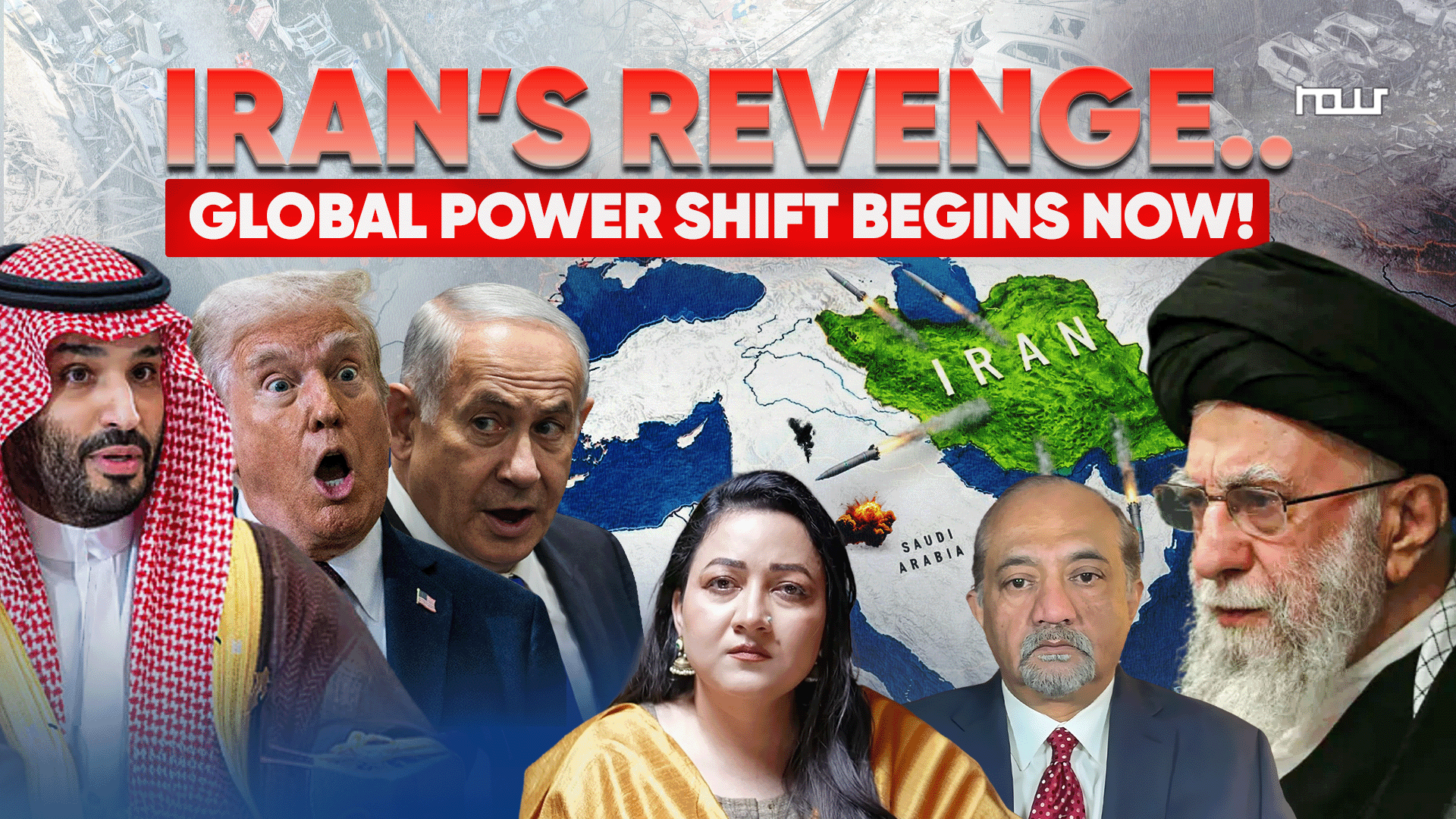
When does a regional conflict turn into a world war? As tensions around Iran rise, what paths might Russia and China take — direct backing, strategic restraint, or something in between? And how could this war reshape the Middle East’s balance of power?
Senior journalist Bushra Khanum speaks with Muqtedar Khan, Professor of Political Science and International Relations at the University of Delaware, on power, strategy, and the region’s uncertain future.
The Expanding Middle East Conflict: Regional Upheaval, Strategic Calculations, and the Limits of Escalation
The Middle East once again finds itself at the center of global anxiety. What began as escalating hostilities between Israel and Iran has widened into a volatile regional confrontation involving multiple state and non-state actors, American military assets, and fragile Gulf monarchies whose economic stability is deeply intertwined with global energy markets.
In a detailed conversation, Prof. Muqtedar Khan, an expert in International Relations at the University of Delaware, offered a sobering analysis of the conflict’s trajectory, strategic miscalculations, economic consequences, and the broader geopolitical implications. While public discourse often swings between alarmism and oversimplification, Professor Khan’s assessment situates the crisis within structural realities—regional power balances, global energy dependency, and the limits of great-power intervention.
The picture that emerges is neither apocalyptic nor reassuring. It is complex, dangerous, and transformative.
From Proxy Confrontation to Regional Conflict
For decades, tensions between Israel and Iran have been managed largely through proxy theatres—Lebanon, Syria, Iraq, and Yemen. The present phase marks a departure from that indirect paradigm. Military actions have become more overt, with strategic assets, command structures, and critical infrastructure under threat.
However, it is important to distinguish between rhetorical escalation and structural war. While the conflict has expanded geographically and operationally, it remains regionally bounded. The involvement of the United States—primarily through air defense systems, intelligence sharing, and strategic deterrence—has intensified the stakes but has not yet transformed the conflict into a direct great-power war.
This distinction is critical in assessing claims that the region is on the brink of a global conflagration.
Economic Shockwaves: Energy Markets and Global Vulnerability
The Middle East’s strategic centrality lies not only in political alliances but in its role as the heart of global energy supply. Any disruption—whether actual or anticipated—reverberates through oil and gas markets worldwide.
Heightened military activity around the Strait of Hormuz, energy infrastructure concerns in Gulf states, and uncertainty surrounding production and shipping routes inevitably push global oil prices upward. Even limited disruptions can trigger speculative volatility in international markets.
Professor Khan highlights that modern conflicts are no longer fought solely with weapons; they are fought through economic leverage. The mere perception of instability in the Gulf undermines investor confidence, disrupts long-term economic planning, and strains economies dependent on energy imports.
In an interconnected global system, regional wars generate global consequences.
Strategic Objectives and Miscalculations
From a military standpoint, Israel and the United States maintain significant technological and aerial superiority in the region. Advanced surveillance capabilities, missile defense systems, and precision-strike technologies give them a clear tactical advantage in direct engagements.
Yet military superiority does not necessarily translate into political success.
One of the enduring lessons of modern conflict—from Iraq to Afghanistan—is that external pressure rarely produces regime collapse in the way strategists anticipate. Professor Khan argues that attempts to weaken a state through sustained military pressure often consolidate domestic unity rather than fracture it. When leadership frames conflict as existential, public dissent frequently gives way to national solidarity.
The expectation that economic or military strain will organically produce regime change has historically proven unreliable. Political systems under external attack tend to harden, not dissolve.
Gulf States and Strategic Vulnerability
Perhaps the most precarious position in the unfolding crisis belongs to the Gulf monarchies. Economically ambitious and globally integrated, cities such as Dubai, Doha, and Riyadh have built reputations as stable hubs for finance, tourism, and investment.
Yet geography cannot be outsourced.
Missile and drone warfare, even if largely intercepted, introduces uncertainty into environments that rely on the perception of safety. Air defense systems such as the Patriot batteries provide substantial protection, but no defensive system guarantees absolute security. The psychological impact of vulnerability can be as destabilizing as physical damage.
Professor Khan notes a subtle but important tension: while Gulf states host American military infrastructure, their long-term economic models depend on regional stability. They walk a careful diplomatic line—maintaining strategic ties with Washington while avoiding open confrontation with Tehran.
This balancing act may define the next phase of Middle Eastern geopolitics.
The “World War III” Narrative: Reality Versus Rhetoric
In times of crisis, public discourse often gravitates toward worst-case scenarios. The phrase “World War III” has surfaced frequently in media commentary. Professor Khan rejects this framing.
A world war requires direct, sustained military confrontation between major global powers. At present, neither China nor Russia shows any willingness to militarily intervene on Iran’s behalf. Their engagement remains primarily economic and diplomatic.
China, in particular, occupies a strategically advantageous position. It continues energy purchases, strengthens regional trade ties, and observes the strategic overextension of Western military resources without direct involvement. Russia, while aligned with Iran in certain theatres, has its own geopolitical priorities and constraints.
Global powers are calculating risk carefully. None appear eager to convert a regional conflict into a global one.
The Nuclear Question
Speculation about nuclear escalation frequently accompanies discussions of Iran. While Iran has advanced nuclear enrichment capabilities, weaponization involves technological, logistical, and political thresholds that extend beyond enrichment percentages.
Professor Khan cautions against alarmist conclusions. The presence of enrichment capacity does not equate to immediate deployable nuclear weapons. Moreover, overt nuclear use would fundamentally alter global alignments and invite overwhelming retaliation.
The nuclear dimension remains a strategic deterrent factor—but not necessarily an imminent operational reality.
The United States: Power and Reputation
The United States retains unmatched military capabilities. However, modern power is measured not only in hardware but in legitimacy.
Sustained regional interventions over the past two decades have affected Washington’s global image. Supporters argue that American presence deters greater instability. Critics contend that repeated involvement deepens entanglement without producing durable political solutions.
Professor Khan suggests that while the United States may preserve its material strength, its diplomatic credibility faces ongoing strain. In a multipolar world, perception matters as much as projection.
Iran: Resilience and Structural Strain
For Iran, the conflict carries both immediate and long-term consequences. Military pressure, economic sanctions, and regional isolation create significant strain. Yet Iran has demonstrated resilience over decades of containment.
Historically, Iranian political identity has intertwined nationalism with sovereignty. External pressure often strengthens narratives of resistance. At the same time, economic hardship compounds domestic dissatisfaction.
The tension between resilience and vulnerability will shape Iran’s trajectory in the coming years.
Cultural Dimensions Often Overlooked
Beyond strategy and economics lies a deeper cultural layer rarely addressed in mainstream analysis. Iran occupies a foundational position in the intellectual and cultural history of the broader Muslim world, including South Asia. Persianate traditions have shaped literature, theology, governance, and artistic expression across centuries.
Regional destabilization therefore carries implications not only for geopolitics but for shared civilizational memory. While states operate through strategic calculation, societies absorb conflict through historical continuity.
Understanding this dimension adds nuance to discussions that too often reduce the region to military chessboards.
The Endgame: No Clear Victory
Modern wars rarely produce decisive triumphs. They produce recalibrations.
Israel may maintain military advantage. The United States may preserve regional dominance. Iran may endure through resilience. Gulf states may adapt through cautious diplomacy.
But the region as a whole bears the cumulative cost: disrupted economies, strained alliances, militarized borders, and generational insecurity.
The likely outcome is not total domination by one actor, nor total collapse of another. It is a reshaped balance—one defined by deterrence, strategic caution, and a lingering undercurrent of instability.
Conclusion: A Region in Transition
The Middle East stands at an inflection point. The present conflict reflects deeper structural shifts: the recalibration of American influence, the cautious ascent of China, the resilience of regional powers, and the fragility of energy-dependent economies.
Alarmist narratives of global war obscure more than they clarify. The greater danger may not be immediate world war, but prolonged regional destabilization.
Prof. Muqtedar Khan’s analysis reminds us that geopolitics is rarely binary. It is shaped by layered interests, calculated risks, and unintended consequences.
The future of the Middle East will likely be determined not by dramatic battlefield moments, but by quiet strategic decisions—alliances formed cautiously, deterrence maintained carefully, and power exercised with awareness of its limits.
The region is being reshaped. Whether it moves toward sustainable equilibrium or recurring cycles of confrontation will depend on the choices made not only in Tehran and Tel Aviv, but in Washington, Beijing, Riyadh, and beyond.
Support Independent Media That Matters
Nous is committed to producing bold, research-driven content that challenges dominant narratives and sparks critical thinking. Our work is powered by a small, dedicated team — and by people like you.
If you value independent storytelling and fresh perspectives, consider supporting us.
Contribute monthly or make a one-time donation.
Your support makes this work possible.