Maharashtra’s 5% Muslim Quota: Administrative Closure or Policy Shift?
Maharashtra has scrapped the 5% Muslim quota, inactive for over a decade. But is this merely administrative clean-up or a signal of shifting priorities in minority welfare? This article revisits the data, legal history, and broader policy context behind the decision.

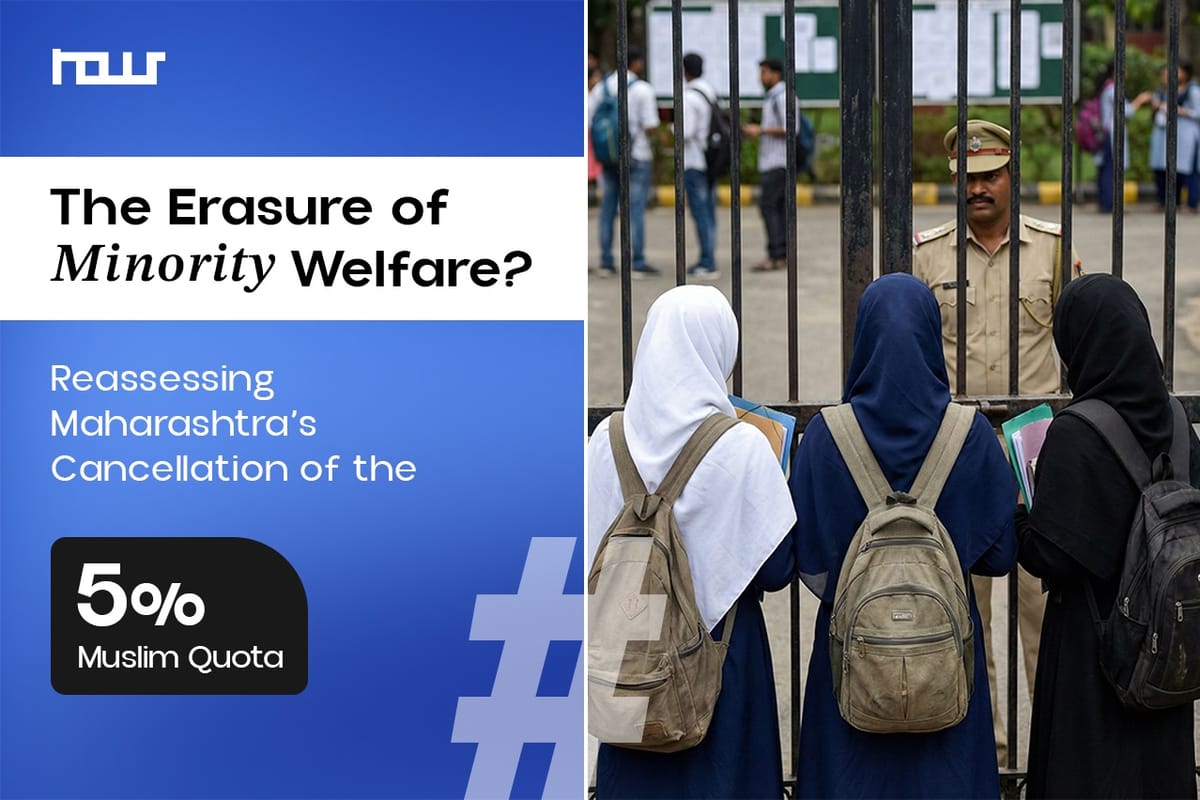
The Maharashtra government recently made headlines by officially scrapping a 5% reservation for Muslims in jobs and education. On paper, the move appears procedural. The quota had not been operational for over a decade. No one was receiving benefits under it.
So why has its cancellation generated such strong reactions?
To answer that, we need to look beyond the technical explanation and situate this decision within a broader conversation about minority welfare and affirmative action in India.
A Legal Dead End: Flashback to 2014
In July 2014, just months before the Maharashtra Assembly elections, the Congress–NCP government issued an ordinance granting 16% reservation to the Maratha community and 5% reservation to Muslims. Importantly, the Muslim quota was not framed as a religion-based reservation. Instead, beneficiaries were classified under a newly created category - Special Backward Class-A (SBC-A), drawing on the findings of the Mahmoodur Rahman Committee, which documented severe socio-economic backwardness within the community.
However, the policy immediately faced legal challenges. By November 2014, the Bombay High Court stayed its implementation, raising concerns about religion-based reservation and the breach of the Supreme Court’s 50% cap on total quotas. The ordinance was never converted into law before its December deadline and subsequently lapsed. For over ten years, the 5% Muslim quota remained legally inoperative.
The current government now describes its cancellation as a simple administrative clean-up - formally removing a provision that had no legal standing.
But policy decisions are rarely neutral. They signal priorities.
The Double Standard: What Happened to the Maratha Quota?
The current government maintains that scrapping the 5% Muslim quota is merely an administrative clean-up, formally removing a quota that had been stayed by the courts years ago and was no longer legally operational. Yet this reasoning becomes harder to sustain when we consider what happened to the 16% Maratha quota introduced in the same 2014 ordinance.
The Maratha quota was also stayed by the Bombay High Court in 2014 for breaching the 50% ceiling. Yet, it met a vastly different fate. Successive governments - across party lines - moved mountains to revive it. In 2018, the state passed a new law to secure the Maratha quota. Even after the Supreme Court struck it down again in 2021, the current government convened a special assembly session in February 2024 to pass a brand-new bill granting Marathas a 10% reservation.
This exposes a deep contradiction. For the Maratha community, the government tirelessly fought court battles, drafted new legislation, and bent over backwards to find legal loopholes. But for the Muslim community? The state simply threw its hands up and cancelled the earlier procedures, using the High Court's interim stay and the lapse of the ordinance as an excuse.
As critics and activists have pointed out: instead of strengthening the process and working out the loopholes, the government took the easiest way out to erase the Muslim quota. On one hand, the leadership speaks of 'Sabka Saath, Sabka Vikas' (development for all), and on the other hand, it actively blocks the path for marginalized minority youth to secure necessary documents for reservation.
Policy, clearly, is not just about legality. It is about political intent and direction.
When you look at the data and zoom out to the national level, a much larger, more troubling picture begins to emerge. The scrapping of this quota isn't an isolated administrative move; it reflects a "new normal" where targeted welfare and affirmative action for India's minority communities are being systematically dismantled.
The Data Ignored: The Mahmoodur Rahman Committee
To understand what was actually lost in Maharashtra, we have to look at why the quota was promised in the first place. It wasn't pulled out of thin air. It was rooted in the findings of the Mahmoodur Rahman Committee, appointed in 2008 by the state government to study the socio-economic conditions of Muslims.
The committee’s findings were devastating. They revealed that urban Muslims in Maharashtra were actually poorer than members of Scheduled Castes and Scheduled Tribes. Laying out this stark reality, the report states:
- Severe Poverty: About 45% of Muslim households in the state survive on a per capita income of less than ₹500 a month.
- Lack of Assets: Only 10% owned land, and a mere 6.8% were able to obtain credit from banks.
- Underrepresentation: While making up 10.6% of Maharashtra’s population, Muslims held just 4.4% of government jobs.
- Absence in Leadership: In 2012, there was not a single Muslim officer in the state's IAS cadre.
- Over-incarceration: Perhaps most alarming, Muslims constituted around 27% of the state’s prison population, pointing to deeper structural vulnerabilities.
The 5% quota was designed as a targeted lifeline for a community in deep socio-economic distress. Striking it down permanently ignores this empirical data.
A National Pattern of Erasure
If we pan out from Maharashtra to the Union Government, we see that the erasure of minority-specific welfare has become standard policy. Over the last few years, several flagship schemes designed to uplift minority students and entrepreneurs have been quietly gutted or entirely scrapped.
Let's look at the facts:
- The Maulana Azad National Fellowship (MANF): This crucial fellowship, which financially supported thousands of minority students pursuing M.Phil and Ph.D. degrees, was abruptly scrapped in 2022.
- Padho Pardesh: The scheme that provided interest subsidies on education loans for minority students studying abroad was effectively discontinued in 2022, with no fresh allocations made thereafter.
- Pre-Matric Scholarships: Previously available to minority students from Class 1 to 10, the government restricted this solely to Classes 9 and 10, cutting off millions of young children from foundational financial aid.
- Institutional Closure: In 2024, the government completely dissolved the Maulana Azad Education Foundation (MAEF), a cornerstone institution built in 1989 to promote education among backward minorities.
For a deeper analysis of how this trend is reflected in national spending patterns, watch the recent Nous video on the Union Budget Analysis for Minorities.
The Maharashtra decision, therefore, does not appear isolated. It fits seamlessly into a wider policy climate where minority-specific affirmative action is increasingly treated as politically inconvenient.
The Legal Pushback
The February 17, 2026 Government Resolution has now been challenged in the Bombay High Court. A Public Interest Litigation argues that the cancellation was arbitrary and undertaken without consulting the Backward Class Commission. The petition demands “quantified data” to justify withdrawing a measure originally based on documented backwardness.
At its heart, the case raises a simple constitutional principle: If backwardness must be demonstrated to introduce affirmative action, should not its removal also require evidence?
The Bigger Picture
When we connect the dots - from the scrapping of the 5% quota in Maharashtra despite the Mahmoodur Rahman Committee’s grim statistics, to the systematic defunding of national scholarships in the 2026 budget, and the ensuing legal battles - the larger scenario becomes undeniable.
The state is executing a gradual but definitive withdrawal from its responsibility toward the socio-economic development of its minority citizens. The question is no longer whether these communities need help, but whether the state is willing to acknowledge they exist in the policy framework at all.
Nous is dedicated to uncovering the facts behind the headlines. We produce bold, research-driven content that challenges dominant narratives and demands critical thinking. But telling these stories takes resources. We are a small, independent team powered by readers like you. If you value fresh perspectives and narratives that matter, stand with us. Support Nous today.
Contribute monthly or make a one-time donation.
Your support makes this work possible.