Law as a Weapon: How Assam's State Is Systematically Dismantling Muslim Life
From bulldozers and mass evictions to polygamy bans and "jihad" rhetoric, a documented account of how ostensibly neutral laws are being weaponised against Assam's Muslim communities.

Just two days before Assam's April 9, 2026 state assembly elections, three Muslim men were lynched to death in Nagaon district - the same district where the 1983 Nellie massacre killed thousands of Bengali Muslims. The victims, identified as Saifullah, Ajibur alias Khairul, and Enamul Haque, were beaten by a mob after being suspected of dacoity. A fourth victim remains in critical condition. This killing did not occur in a vacuum. It unfolded against a backdrop of four years of systematic state action that has rendered Muslim life in Assam increasingly precarious.
When Himanta Biswa Sarma assumed office as Chief Minister of Assam in May 2021, something shifted - not with a sudden eruption of communal violence, but through the quieter, more durable machinery of governance. Over the four years that followed, law itself became the primary instrument through which an entire community was progressively dispossessed: of land, of institutions, of livelihoods, and finally of cultural recognition.
Unlike earlier episodes of mass violence in Assam, characterised by episodic communal conflict and non-state actors, this phase is executed through state institutions - authorised by executive orders, implemented by bureaucratic and police apparatuses, and cloaked in the language of environmental protection, women's rights, child welfare, and indigenous interests. Yet its targets are neither random nor neutral. Bengali-speaking Muslim communities - long settled in Assam's riverine char regions, many for generations - have borne the overwhelming weight of this governance turn.
The Politics of Land: Evictions as Demographic Engineering
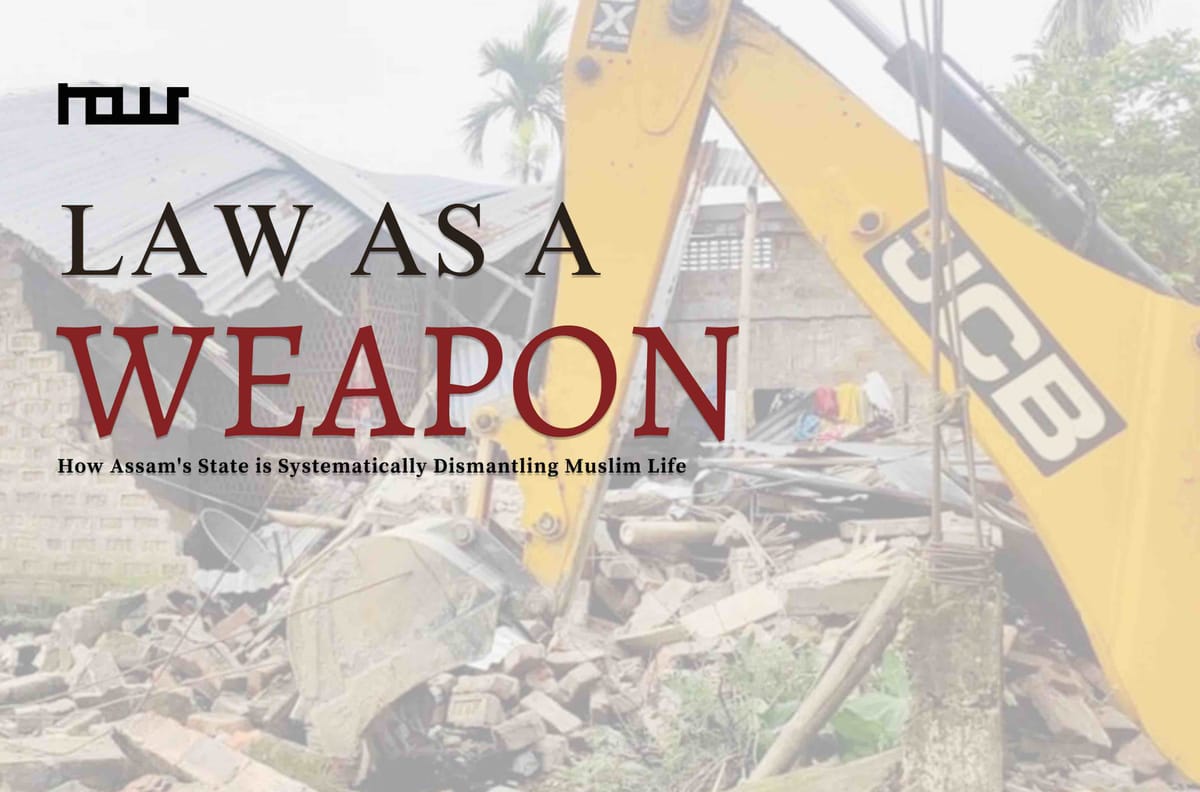
Eviction and demolition drives have been the most visible mechanism of this new governance regime. Officially framed as routine anti-encroachment or land-recovery operations, they have in practice operated as punitive, selective, and procedurally unlawful interventions targeting Muslim communities with striking consistency.
Al Jazeera documented how Assam authorities demolished homes and evicted thousands of families - the overwhelming majority Bengali-speaking Muslims - with critics describing the operations as politically motivated rather than neutral land-administration measures. Amnesty International's investigation into what it termed "bulldozer injustice" verified the targeted demolition of at least 128 properties across five Indian states between April and June 2022, with the majority belonging to Muslims. In Assam specifically, Amnesty recorded a disturbing pattern: demolitions frequently followed episodes of protest involving Muslims, raising serious concerns about retaliatory state action.
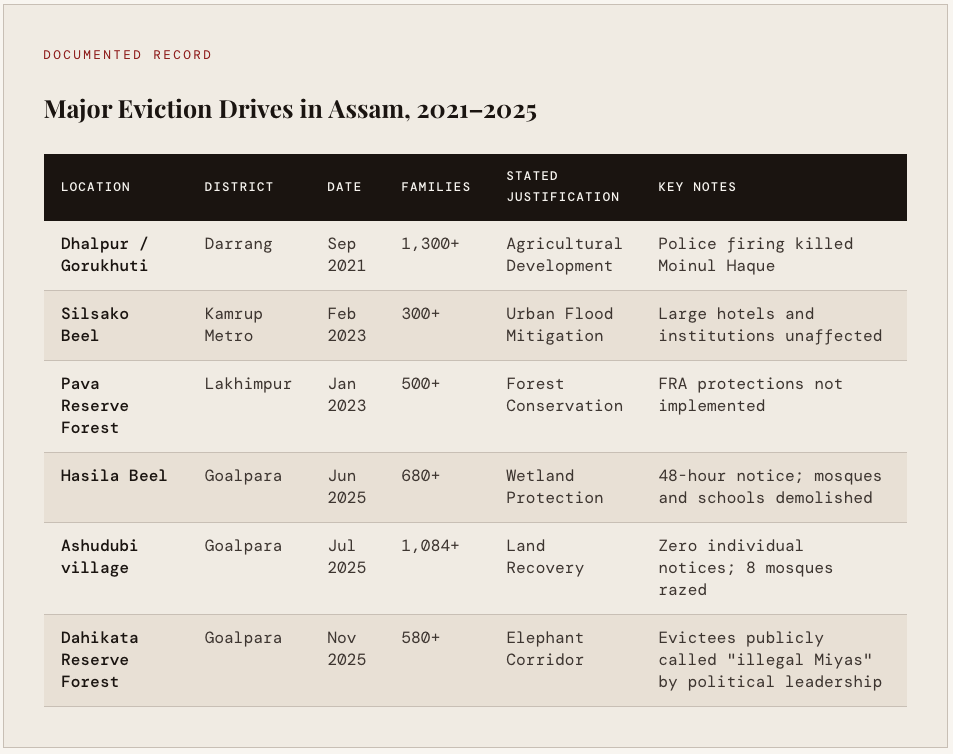
The primary legal tool for these evictions is the Assam Land and Revenue Regulation, 1886 - specifically Rule 18(2), which empowers the Deputy Commissioner to summarily eject persons from land where no proprietary rights have been established. The procedural safeguard under Rule 18(3), which mandates prior notice, is routinely violated or compressed. In the Hasila Beel eviction (June 2025), announcements were made barely 48 hours before demolition, with no individual notices served - making it practically impossible for residents to seek judicial relief before bulldozers arrived.
Critically, the government has simultaneously refused to implement the Forest Rights Act, 2006, which prohibits evictions of long-term forest dwellers until rights recognition processes are complete. Many eviction sites - including Pava Reserve Forest in Lakhimpur and Dahikata Reserve Forest in Goalpara — fall squarely within the Act's protections. Instead of recognising rights, the state relies on colonial-era land laws to manufacture illegality: communities are rendered "encroachers" not because they lack rights, but because the state refuses to recognise those rights.
The watershed moment was the September 2021 eviction in Dhalpur, Darrang district, carried out for the so-called Gorukhuti Agricultural Project. Approximately 1,300 families - many of whom had paid land revenue for 50 to 70 years and held names in the National Register of Citizens - were displaced. During the operation, 33-year-old Moinul Haque was shot and killed at close range by police while carrying a bamboo stick. Video footage corroborated eyewitness accounts. The state subsequently framed the Dhalpur residents as "illegal encroachers," a characterisation that conveniently erased the reality that many had been displaced by Brahmaputra river erosion - climate-displaced people rendered criminal by administrative fiat.
The Gorukhuti Project explicitly aimed to replace existing cultivators with "indigenous" farmers and promoted the introduction of Gir cattle - symbolically reconstituting the landscape in ways aligned with ethno-nationalist imaginaries.
By 2024 and 2025, the drives had intensified dramatically. In July 2025, Ashudubi village in Goalpara saw the displacement of over 1,084 families, with 8 mosques, 2 madrasas, and 5 Anganwadi centres razed - what observers described as a "scorched earth" policy aimed at erasing the community's entire social footprint. Not a single resident had received an individual eviction notice. Demolitions in Sonitpur razed 1,200 homes in January 2026; Hailakandi saw 516 more demolished in February 2026.
The Bulldozer and the Madrasa
Parallel to eviction drives, the state has pursued a coercive approach towards Islamic educational institutions. Between 2022 and 2024, several madrasas across Assam were demolished following the arrest of individual clerics on allegations of links to extremist organisations. In each case, the demolitions were not carried out pursuant to convictions or judicial orders - they relied instead on administrative pretexts such as alleged structural instability or violations of building codes.
The cases of the Jamatul Madrasa in Morigaon and the Markazul Ma-Arif Quariayana Madrasa in Bongaigaon are illustrative. Neither institution was declared a terrorist organisation; no court finding established that the buildings themselves were involved in unlawful activity. Yet both were demolished. This approach collapses a fundamental legal distinction: individual criminal liability versus institutional guilt. By treating a school as punishable for the alleged actions of one of its teachers, the state imposes collective punishment on children and families who had no role in the alleged offence.
While district officials framed demolitions as regulatory enforcement, Chief Minister Sarma publicly linked each one to his broader "anti-jihadi campaign" - transforming administrative action into securitised governance where suspicion replaces proof, and identity substitutes for evidence.
Academic research directly contradicts the premise underlying these actions. Studies by scholars including Yoginder Sikand, Arshad Alam, and Hilal Ahmed consistently demonstrate that Indian madrasas are locally embedded institutions focused on religious instruction, literacy, and community welfare - structurally and ideologically distinct from the militant training camps referenced in counter-terrorism discourse. Analyses from the Institute for Defence Studies and Analyses further show that pathways into extremist violence in India are more closely linked to online networks, transnational propaganda, and political grievance than to traditional religious schooling.
Legislating the Private Sphere: Marriage, Family, and the Law
The state's interventions have increasingly extended into the most intimate domains of Muslim life - marriage and family. In February 2023, Assam police initiated a large-scale arrest drive under the POCSO Act and the Prohibition of Child Marriage Act, detaining more than 3,000 men.
A key concern was the retrospective application of criminal law. Men were arrested for marriages that had taken place several years earlier, often in circumstances where the couples had children and were living as established households. This approach transformed what were historically unaddressed social practices into criminal offences overnight, without accompanying social support mechanisms. Although the Chief Minister publicly claimed that arrests reflected a "55:45" ratio between Muslims and Hindus, reports from Muslim-majority districts such as Dhubri, South Salmara, Barpeta, and Nagaon indicated a disproportionate concentration of arrests among Muslim families.
The Gauhati High Court criticised the drive severely, noting it caused "havoc in the private lives of people" and questioned the necessity of custodial interrogation for historic cases. Contrary to official claims of empowering women, the crackdown left many young wives destitute — their husbands and primary breadwinners incarcerated. Civil society and media reports documented cases of suicides among women fearing the arrest of their spouses.
Following the child marriage crackdown, the government moved to ban polygamy. The Assam Prohibition of Polygamy Act, 2025 criminalises polygamy with imprisonment of up to 10 years - and extends liability to clerics and family members who participate in such ceremonies.
Its most revealing feature is its exemption of Scheduled Tribes and Sixth Schedule areas. This is significant because NFHS-5 data shows that polygamy is more prevalent among indigenous tribal communities in Assam than among Muslims. By exempting tribal groups - key BJP electoral constituencies in Bodoland and Karbi Anglong - while criminalising the same practice among Muslims in Dhubri, Barpeta, and Nagaon, the law reveals its true character: not social reform, but identity-targeted governance.
The proposed "Love Jihad" legislation (tabled late 2025) goes further still, extending criminal liability to the parents of any man accused of deceptive interfaith marriage or conversion. It effectively criminalises entire family units for personal relationships - a provision with no precedent in Indian law.
Economic Strangulation: Cattle, Livelihoods, and "Jihad" Rhetoric
The Assam Cattle Preservation Act, 2021 was among the first legislative actions of the Sarma administration. It introduced a prohibition on beef sales within a 5-kilometre radius of any temple or Vaishnavite Satra - which, given the density of temples across Assam's urban and semi-urban landscape, functions as a near-blanket ban in commercially viable areas. Heavy transit restrictions further empowered police and vigilante groups to harass traders and seize vehicles.
For Bengali Muslim households in the char regions, cattle trading had historically been a critical source of liquidity — income used for medical emergencies, education, and seasonal consumption. The collapse of this trade has driven households into debt, distress migration, and precarious daily wage labour. Since Muslims are disproportionately concentrated in cattle-related occupations, the law has functioned as a group-differentiated economic restriction, compounding existing inequalities.
This economic assault has been accompanied by a rhetorical strategy that frames ordinary livelihood as communal threat. The Chief Minister coined "fertiliser jihad" in 2023 - accusing Bengali Muslim farmers of deliberately using excessive fertilisers to "ruin the soil" and harm the indigenous population, inverting a century of history in which char-dwelling Muslims transformed riverine wastelands into productive agricultural land.
In August 2024, flooding in Guwahati was attributed by the Chief Minister to a Muslim-founded university in Meghalaya - the term "flood jihad" implying conspiracy and intent, while obscuring the city's well-documented drainage failures, wetland encroachment, and bowl-shaped topography.
The War on Culture: Erasure of the Miya Identity
Beyond dispossession of land and livelihood, the Sarma administration has pursued what can only be described as cultural erasure — the denial of any legitimate cultural presence to the Miya community within the imagination of "Assamese" identity. Miya Muslims are tolerated as a source of agricultural and urban labour; they are not permitted to exist as a cultural or historical subject.
In October 2022, a small community-run Miya Museum was inaugurated in Goalpara, documenting the everyday material culture of char-dwelling Muslims: ploughs, fishing equipment, household artefacts. Within days, the district administration sealed it. Chief Minister Sarma argued that the plough was a symbol of "Assamese" culture and could not be claimed by the "Miya" community - creating a paradox that lays bare the logic of exclusion: Bengali Muslims are denied "Assamese" identity through the NRC and CAA discourse, yet when they attempt to archive their own distinct heritage as "Miya," they are accused of cultural appropriation. There is no permitted identity. There is only the condition of having none.
The state's response to Miya poetry — a literary movement that emerged to narrate experiences of documentation anxiety, detention, and displacement - has been equally revealing. FIRs were filed against several Miya poets on charges of promoting enmity. Hafiz Ahmed's poem "Write Down, I Am a Miya," which asserts dignity through an unapologetic account of labour and exclusion, was treated as a law-and-order issue. The fact that the dominant political narrative is threatened by poetry — by aesthetic expressions that merely document suffering — speaks to the fragility of that narrative and the conditions of silencing it requires to survive.
The Consolidation of an Ethno-Nationalist Governance Regime
What makes the current phase of state action in Assam so consequential is precisely its legal character. Unlike earlier episodes of mass violence, this regime does not require a pogrom or a riot. It requires only the sustained, selective, and disproportionate application of laws that appear neutral on their face. Land regulation becomes demographic engineering. Building codes become a pretext for the destruction of religious institutions. Criminal law becomes a tool for regulating domestic life. Economic regulation becomes group-targeted impoverishment. And cultural policy becomes enforced invisibility.
The cumulative effect is the institutionalisation of a hierarchy of belonging in which Bengali Muslim communities occupy a permanently provisional status — tolerated residents without full citizenship, conditional participants in the economy, suspects in the legal order. This is not an accident of enforcement. It is, as the evidence presented in this analysis shows, a governance architecture. One that retains democratic and constitutional forms while systematically emptying them of substantive equality.
The three men lynched in Nagaon on the eve of Assam's 2026 elections did not die in isolation. They died in a state where the Chief Minister has threatened to "break the backbone of Miyas," where the official BJP Assam social media handle posted videos simulating executions of Muslim individuals, and where years of administrative dehumanisation have created the conditions in which mob violence is not a rupture but a continuation — the informal enforcement of a formal agenda.
The question before those who study, report, and adjudicate on constitutional democracy is not whether this constitutes a pattern. The documentation is now extensive. The question is what the institutions of constitutional accountability intend to do about it - and how much longer they can sustain the fiction that what is happening in Assam is routine law enforcement.
Support Independent Media That Matters
nous is committed to producing bold, research-driven content that challenges dominant narratives and sparks critical thinking. Our work is powered by a small, dedicated team — and by people like you.
If you value independent storytelling and fresh perspectives, consider supporting us.
Contribute monthly or make a one-time donation.
Your support makes this work possible.