Is a New Global Order Emerging From This War? | Ghazala Wahab
Bushra Khanum speaks with Ghazala Wahab on the geopolitical impact of the US–Israeli war on Iran, examining shifting global power dynamics, the role of regional actors like Hezbollah and Hamas, and how the conflict may reshape American influence in the Middle East and India’s strategic position.
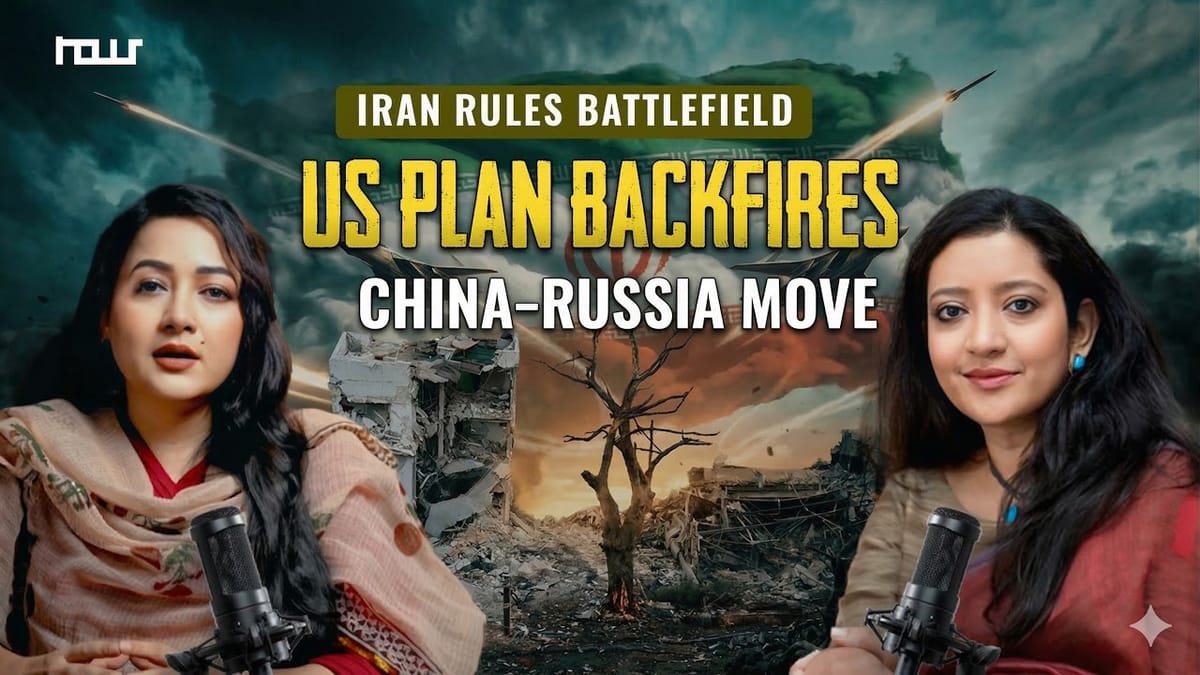
In this podcast, senior journalist Bushra Khanum speaks with Ghazala Wahab, Editor of Force magazine, about the geopolitical implications of the ongoing US–Israeli war on Iran. The conversation examines how the conflict reflects a broader shift in global power dynamics, with Russia and China appearing more willing to support Iran than in the past. It also discusses the role of regional actors such as Hezbollah and Hamas, and whether the conflict could challenge long-standing American dominance in the Middle East. As tensions raise concerns about possible military escalation and strategic realignments, the discussion also asks an important question: what role could India play in this evolving global order?
The Changing Geopolitics of West Asia: Conflict, Power Transitions, and the Possibility of a Multipolar Order
Understanding the Strategic Implications of the Iran–Israel–US Confrontation
West Asia has long been one of the most strategically sensitive regions in the world. It sits at the intersection of global energy routes, historical rivalries, ideological conflicts, and great-power competition. Any escalation in the region inevitably reverberates far beyond its borders, shaping global markets, diplomatic alignments, and the architecture of international power.
Recent tensions involving Iran, Israel, and the United States have once again placed the region at the centre of international attention. In a detailed conversation on the Nous Network, senior journalist Bushra Khanum spoke with defence analyst and Force magazine editor Ghazala Wahab about the implications of the current conflict and whether it reflects a deeper transformation in global geopolitics.
Their discussion moves beyond immediate battlefield developments to address a larger question: Are we witnessing the gradual erosion of the unipolar world order dominated by the United States, and the emergence of a more complex multipolar system?
A Conflict With Regional and Global Consequences
The confrontation between Iran and Israel has historically unfolded through indirect channels—proxy groups, intelligence operations, cyber warfare, and limited strikes across Syria, Lebanon, and Iraq. What distinguishes the current phase is the growing visibility and intensity of direct military and strategic engagement.
Although the conflict remains geographically concentrated within West Asia, its implications extend globally. Energy markets react instantly to instability around the Strait of Hormuz. Financial markets respond to uncertainty in Gulf economies. Diplomatic alignments shift as states weigh their long-term strategic interests.
For global powers, the region remains both a security theatre and an economic lifeline.
This layered complexity explains why developments in West Asia often serve as a barometer for broader shifts in international power.
Strategic Expectations and the Question of Miscalculation
In many Western strategic circles, the expectation has long been that sustained economic sanctions, technological pressure, and occasional military strikes would eventually weaken Iran to the point of political capitulation or internal transformation.
However, as Wahab notes in the conversation, such assumptions often underestimate the resilience of states that have spent decades preparing for confrontation.
Since the Iranian Revolution in 1979, Iran has operated under various forms of external pressure—from sanctions and diplomatic isolation to covert and overt military threats. Over time, this environment forced Tehran to adapt its strategic doctrine.
Rather than competing symmetrically with technologically superior militaries, Iran invested in alternative methods of warfare designed to offset that imbalance.
Asymmetric Warfare and Strategic Adaptation
Iran’s military doctrine is widely understood as an example of asymmetric warfare—a strategy adopted by states that cannot match the technological or financial capabilities of their adversaries.
Instead of relying on large conventional forces, Iran developed a network-based military structure involving missile capabilities, decentralized command systems, regional alliances, and layered defensive strategies.
One element discussed in the conversation is the concept sometimes described as “mosaic defence.” Under this model, military command is decentralized across multiple operational units, allowing the system to continue functioning even if senior leadership structures are disrupted.
Such strategies are not unique to Iran; they have been used historically by states facing technologically superior opponents. But they highlight an important point about modern warfare: military power is not determined solely by advanced hardware, but also by organizational adaptability and strategic planning.
The Role of Russia and China
One of the most significant geopolitical questions surrounding the conflict is the role of major powers outside the region—particularly Russia and China.
Both countries have maintained diplomatic and economic relations with Iran for decades. However, their engagement has traditionally been cautious, calibrated to avoid direct confrontation with Western powers.
Today, the situation appears more complex. Russia and China have expanded their diplomatic and economic coordination with Iran through forums such as the Shanghai Cooperation Organisation (SCO) and the BRICS grouping, which seek to promote alternative frameworks of international cooperation beyond Western-dominated institutions.
However, this does not necessarily translate into military alignment. Both Moscow and Beijing have historically avoided direct military entanglement in West Asian conflicts.
Their broader strategic objective appears less about confrontation and more about reshaping global governance structures in ways that reduce Western dominance.
In that sense, the conflict becomes part of a larger geopolitical transition rather than an isolated regional war.
Gulf States and Strategic Vulnerability
The war has also highlighted the delicate position of the Gulf monarchies.
Countries such as Saudi Arabia, the United Arab Emirates, Qatar, and Bahrain have invested enormous resources into building globally connected economies based on finance, tourism, logistics, and energy exports. Their prosperity depends on the perception of stability.
Yet geography places them within range of regional conflicts.
This vulnerability explains their long-standing security partnerships with the United States. American military presence in the Gulf has historically been viewed as a stabilizing force that deters external threats and reassures global investors.
However, shifting geopolitical dynamics mean that Gulf states increasingly pursue diversified diplomatic relationships—including economic engagement with China and cautious dialogue with Iran.
The region is therefore witnessing a subtle but significant shift from rigid alliance blocs toward more flexible diplomacy.
The Economic Dimension of Conflict
Beyond military calculations, economic warfare has become a central feature of modern geopolitical confrontation.
Sanctions regimes, restrictions on financial transactions, and attempts to control energy flows all form part of the strategic toolkit. In the case of Iran, economic pressure has been a defining element of Western policy for decades.
At the same time, energy infrastructure and maritime routes such as the Strait of Hormuz remain critical chokepoints in global trade. Any disruption—real or anticipated—affects global oil prices and supply chains.
Thus, the conflict operates simultaneously on military, diplomatic, and economic fronts.
India and the Challenge of Strategic Balance
Another theme discussed in the conversation concerns the position of emerging powers such as India.
India maintains historically important relationships with both Iran and Israel. Iran has long been an important partner in energy cooperation and regional connectivity projects such as the Chabahar Port initiative. Israel, meanwhile, is one of India’s key defence and technology partners.
Balancing these relationships has always required diplomatic nuance.
As the global order evolves toward a more multipolar configuration, countries like India face the challenge of navigating multiple strategic partnerships without becoming overly dependent on any single power bloc.
The choices made by such states may significantly influence the shape of future global alliances.
Is a Multipolar World Emerging?
For much of the post–Cold War period, the international system was widely described as unipolar, with the United States exercising unmatched military and economic influence.
Over the past decade, however, several trends have begun to challenge that structure. The economic rise of China, Russia’s assertive foreign policy, and the growing institutional presence of coalitions such as BRICS have introduced new centres of power.
Conflicts in regions like West Asia often act as testing grounds for these shifting dynamics.
Yet it would be premature to declare the end of American influence. The United States remains the world’s most powerful military actor and continues to play a central role in global security alliances.
What appears to be emerging is not a sudden replacement of one order by another, but a gradual transition toward a more complex distribution of power.
The Human Cost of Strategic Rivalries
Amid discussions of geopolitics and military strategy, it is easy to overlook the human consequences of prolonged conflict.
Civilian populations bear the greatest burden when wars escalate. Economic disruptions, displacement, and social instability affect millions of people whose lives are far removed from strategic calculations made in distant capitals.
Ultimately, the long-term stability of West Asia will depend not only on military deterrence or diplomatic manoeuvres, but also on the ability of regional actors to address underlying political and social tensions.
Conclusion: A Region at a Crossroads
The current tensions in West Asia are more than another episode in a long history of regional conflict. They reflect broader shifts taking place in the global political landscape.
Iran’s strategic resilience, Israel’s military capabilities, the United States’ enduring influence, and the expanding diplomatic roles of Russia and China all interact within a rapidly changing international system.
Whether these developments lead to prolonged instability or to a recalibrated balance of power remains uncertain.
What is clear, however, is that the geopolitical centre of gravity is gradually shifting. The world is moving toward a more contested and interconnected order—one in which regional conflicts increasingly intersect with global strategic transformations.
Understanding this transition will be essential for interpreting the future of West Asia and the international system as a whole.
Support Independent Media That Matters
Nous is committed to producing bold, research-driven content that challenges dominant narratives and sparks critical thinking. Our work is powered by a small, dedicated team — and by people like you.
If you value independent storytelling and fresh perspectives, consider supporting us.
Contribute monthly or make a one-time donation.
Your support makes this work possible.