How Architecture Marginalizes Muslims in India?
In this conversation, Fahad Zuberi, PhD Scholar at MIT, explores the politics of demolition and space in contemporary India. Using the concept of “punitive domicide,” he explains how law, architecture, and state power intersect to produce exclusion and reshape citizenship and public space.
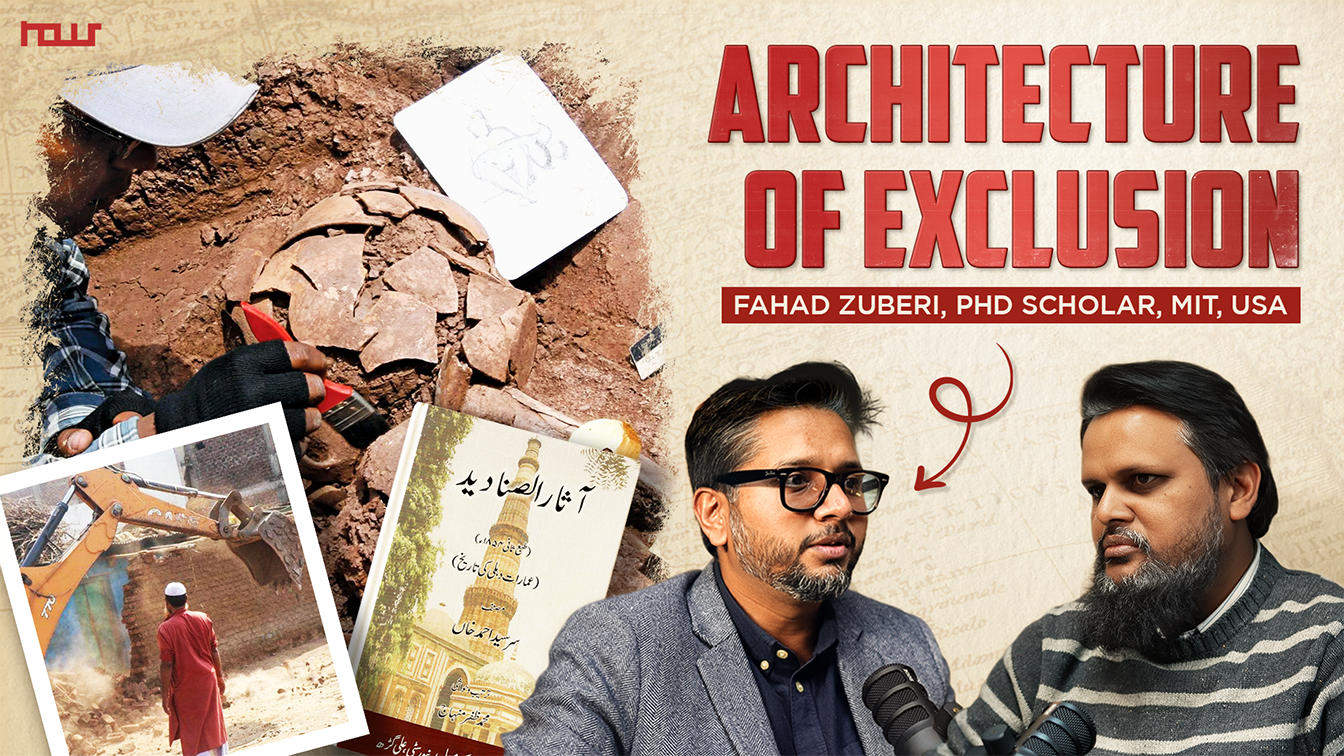
In this thought-provoking conversation, Fahad Zuberi, PhD Scholar at MIT, USA, discusses the growing politics of demolition, marginalisation, and space in contemporary India. He explains why the term “punitive domicide” better captures the bulldozer demolitions targeting specific communities, describing them not as administrative actions but as forms of political violence. The discussion moves beyond isolated incidents to examine the legal, historical, and philosophical structures enabling such practices. Drawing on thinkers like Hannah Arendt, Fahad reflects on how public spaces are shrinking for minorities and how law, politics, and architecture intersect to shape power. The podcast also explores deeper questions of archaeology, history, and identity—from Sir Syed’s intellectual legacy to Ambedkar’s experiences of space and caste. Fahad argues that architecture is never neutral; it reflects political imagination and social control. This conversation unpacks how time, space, and law come together to produce exclusion—and what resistance might look like in such a landscape.
The Architecture of Exclusion: Domicide, Law, and the Politics of Space in Contemporary India
Architecture is often understood as the art of constructing buildings. Yet, at its most fundamental level, architecture is not about buildings—it is about power. It is about deciding who belongs, who is excluded, who is protected, and who is made vulnerable. Every wall, every road, every demolition, and every preservation decision reflects not merely technical necessity, but political imagination.
In a recent episode of the Nous podcast, architect and scholar Fahad Zuberi—currently pursuing his doctoral research at the Massachusetts Institute of Technology (MIT)—offered a profound reframing of architecture as a political and ethical project. Drawing from his academic training at Aligarh Muslim University, CEPT University, and Oxford, Zuberi argued that architecture is fundamentally the act of imagining the world—and in imagining it, determining its moral structure.
“The first line drawn on a blank sheet,” he observed, “is already a political decision.” It can become a bridge that connects communities, or a boundary that separates them. This insight forms the foundation for understanding one of the most urgent questions confronting India today: how law, urban planning, and state power are reshaping space in ways that systematically marginalize certain communities.
Architecture as Political Imagination
Modern societies often treat architecture as a technical discipline—concerned with materials, engineering, and aesthetics. But historically, architecture has always been inseparable from political power. The design of cities determines how people interact, how resources are distributed, and how dignity is either enabled or denied.
Zuberi invokes the example of Dr. B.R. Ambedkar, widely known as the “Architect of the Indian Constitution.” This title, he suggests, is not merely metaphorical. Ambedkar quite literally designed the framework through which citizens would coexist, embedding principles of equality, justice, and dignity into the spatial and legal architecture of the republic.
This perspective forces us to reconsider architecture not simply as construction, but as governance.
Cities are not neutral environments. They are structured systems of inclusion and exclusion. Decisions about zoning, housing, infrastructure, and demolition are never purely administrative; they are exercises of political authority that shape whose lives are protected and whose are made precarious.
Segregation by Design: Law and the Geography of Separation
One of the clearest manifestations of architecture as political power in India is the institutionalization of residential segregation through legal mechanisms.
The Gujarat Disturbed Areas Act, originally introduced to prevent distress sales during communal violence, prohibits property transactions between communities in designated areas without explicit state approval. While framed as a protective measure, its long-term effect has been to freeze communities into segregated enclaves.
Instead of enabling recovery and reconciliation, the law has entrenched separation.
In practice, it has prevented Muslims and Hindus from living as neighbors in many areas, transforming temporary measures into permanent spatial divisions. Entire neighborhoods have become legally insulated from integration, reinforcing suspicion, fear, and social fragmentation.
Segregation is not only maintained through housing laws but also through infrastructure design. Modern urban infrastructure increasingly enables physical avoidance. Elevated highways, gated communities, and bypass roads allow affluent populations to move through cities without encountering poorer or minority neighborhoods.
This creates what urban scholars call “invisible segregation”—a system in which communities exist in proximity but remain socially and psychologically isolated.
Such separation has profound consequences. When people do not encounter each other in everyday life, empathy diminishes. Segregation enables prejudice to flourish because it eliminates the human familiarity that undermines stereotypes.
Bulldozers and the Emergence of “Punitive Domicide”
Perhaps the most visible and alarming manifestation of architecture as an instrument of state power in recent years has been the rise of what is popularly called “bulldozer justice.”
Officially, these demolitions are justified as administrative actions against illegal construction. But as Zuberi argues, the term “demolition” fails to capture the true nature of what is taking place.
Demolition, in its neutral sense, can be constructive. It may involve removing unsafe structures or making way for new development. What is occurring today, however, is something fundamentally different.
Zuberi introduces the concept of domicide—the deliberate destruction of homes as a form of violence.
More specifically, he identifies a phenomenon he calls punitive domicide, in which the state destroys residential homes not as part of neutral urban planning, but as a form of punishment.
This practice exploits a legal contradiction.
Under criminal law, punishment must follow due process. Guilt must be established through investigation, trial, and judicial determination. Collective punishment is explicitly prohibited.
However, municipal laws governing building regulations provide a workaround. Minor technical violations—such as deviations in building setbacks or floor area ratios—are widespread across Indian cities. These violations, often tolerated for decades, can suddenly be invoked selectively.
By using municipal law rather than criminal law, authorities can demolish homes immediately—without trial, without conviction, and without the procedural safeguards that criminal law requires.
This transforms urban planning into an instrument of punishment.
The destruction of a home is not merely the removal of a structure. A home is the site of memory, security, and identity. Its destruction is the destruction of stability itself.
From State Policy to Social Desire: The Normalization of Spatial Punishment
One of the most disturbing developments highlighted in the discussion is the growing normalization of domicide—not only as state policy, but as a social demand.
In some instances, demolition is no longer merely imposed from above; it is demanded from below. Citizens themselves call for bulldozers as instruments of justice, equating destruction with accountability.
This marks a dangerous transformation in democratic consciousness.
When destruction becomes a publicly celebrated form of punishment, the rule of law is replaced by the spectacle of power. Legal due process becomes secondary to visual displays of authority.
The bulldozer, in this sense, becomes not just a machine, but a political symbol—representing the state’s ability to bypass legal restraint and exercise immediate force.
Archaeology, History, and the Politics of Ownership
The podcast also explored the increasingly contentious use of archaeology in contemporary legal disputes.
Archaeology, by its nature, is interpretive. It reconstructs the past through fragments, offering narratives rather than definitive proof. Yet in recent years, archaeological findings have been invoked as evidence in property and religious disputes.
This raises a fundamental constitutional question.
Modern legal systems determine ownership based on documented rights, not historical succession. If property claims are determined by what lies beneath the soil, then no ownership can ever be secure—because every place contains layers of past occupation.
India’s cities, particularly in the Gangetic plains, have been continuously inhabited for thousands of years. Excavation anywhere will reveal remnants of earlier structures. This does not establish rightful ownership in the present; it merely reflects the layered nature of history.
Using archaeology as legal evidence risks replacing constitutional principles with historical claims, undermining the legal stability essential to democratic governance.
Sir Syed Ahmed Khan and Architecture as Resistance
The discussion also reclaimed the legacy of Sir Syed Ahmed Khan, founder of Aligarh Muslim University, as a pioneering architectural thinker.
His seminal work, Asar-us-Sanadid, documented the architectural heritage of Delhi at a time when colonial narratives sought to reduce Indian civilization to a relic of the past.
Unlike colonial historians, who treated monuments as lifeless ruins, Sir Syed documented them as living spaces—embedded in social life and collective memory.
This was an act of intellectual resistance.
By preserving architectural memory, Sir Syed preserved cultural dignity. His later establishment of Aligarh Muslim University represented an effort to design not only buildings, but a future—creating institutional space for a community navigating profound political transformation.
The Politics of Space in a Finite Republic
At its core, the struggle over architecture is a struggle over belonging.
Space is finite. Every allocation of space—to housing, infrastructure, heritage, or development—is a decision about priorities.
When homes are demolished, when neighborhoods are segregated, when communities are erased from public space, the issue is not merely urban planning. It is citizenship itself.
Political philosopher Hannah Arendt described public space as the space of appearance—the space where individuals exist as visible members of society.
To be excluded from space is to be excluded from political existence.
Domicide, segregation, and spatial exclusion are therefore not simply urban phenomena. They are mechanisms that reshape the moral architecture of the republic.
Conclusion: Reclaiming the Moral Imagination of Architecture
The question facing India today is not merely how cities are built, but how justice is built.
Architecture can create inclusion or exclusion. It can protect dignity or enable dispossession. It can embody constitutional morality or undermine it.
The rise of punitive domicide, legal segregation, and spatial exclusion signals a deeper transformation—one in which law and urban planning increasingly operate as instruments of political control rather than democratic protection.
Yet architecture also remains a site of possibility.
If architecture is the act of imagining the world, then the future depends on reclaiming the moral imagination necessary to design cities that reflect constitutional values rather than political expediency.
The true test of a democracy is not only how it conducts elections, but how it organizes space—who it allows to belong, and who it renders invisible.
In the end, architecture is not about buildings. It is about justice.
Support Independent Media That Matters
Nous is committed to producing bold, research-driven content that challenges dominant narratives and sparks critical thinking. Our work is powered by a small, dedicated team — and by people like you.
If you value independent storytelling and fresh perspectives, consider supporting us.
Contribute monthly or make a one-time donation.
Your support makes this work possible.