History of Muslims in Assam and the Politics of Erasing It
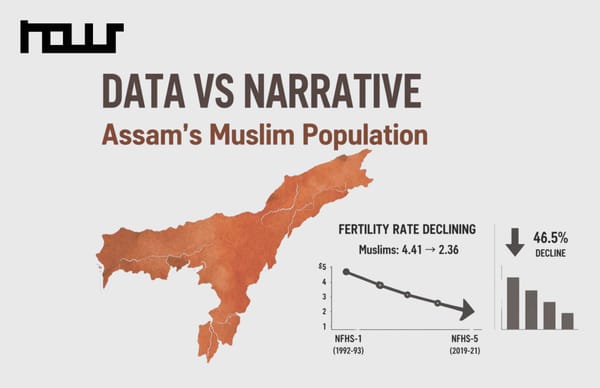
The targeting of Bengali-origin Muslims in Assam is rooted not just in present politics, but in a distorted reading of history. Complex processes of migration and integration are reduced to a single “outsider” narrative - used to justify exclusion, dispossession, and dehumanisation.

Introduction
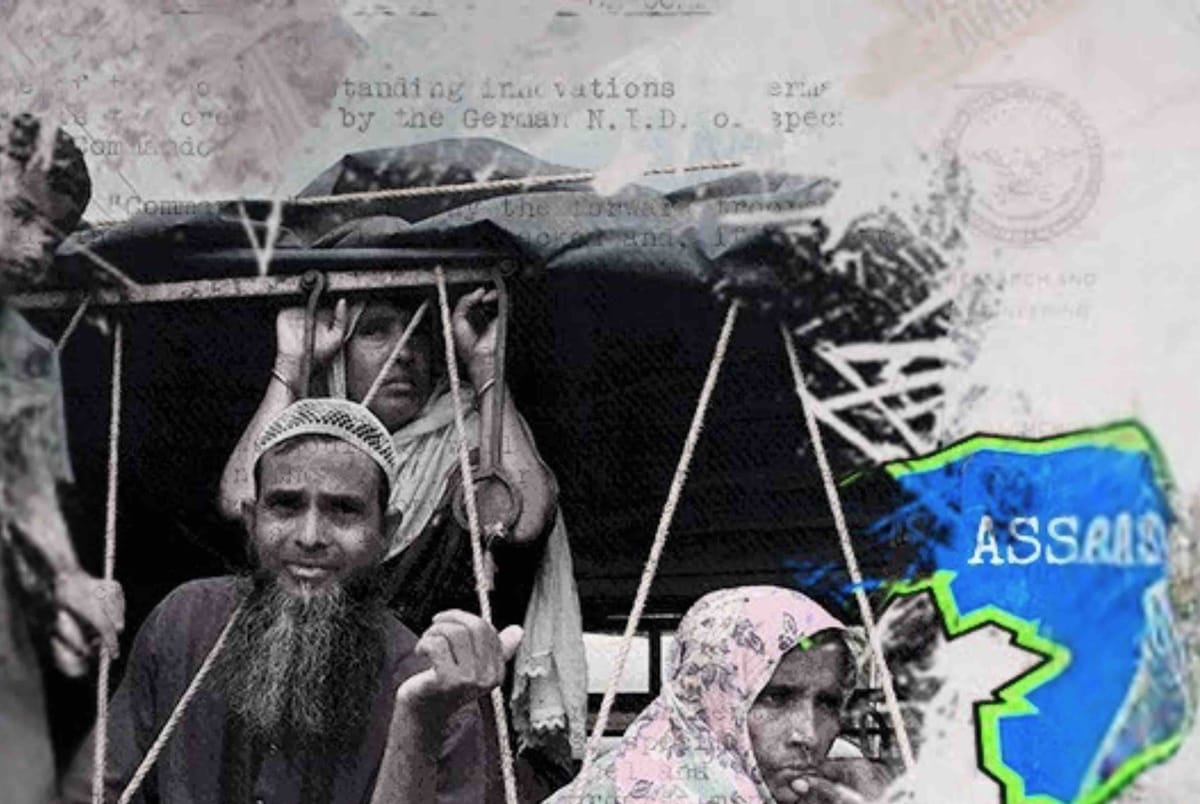
Ahead of Assam's assembly elections, Chief Minister Himanta Biswa Sarma has intensified his rhetoric targeting Bengali-origin Muslims, a community progressively reframed in official discourse as illegal immigrants requiring expulsion.
This hate has gone beyond rhetoric. Over the past few years, evictions and demolitions targeting Bengali-origin Muslim-majority areas have become routine. The National Register of Citizens has forced families who have lived in Assam for generations to prove their citizenship. Those unable to prove their status before Foreigners Tribunals are pushed into detention centres. Reports have shown these tribunals function less as impartial judicial bodies and more as a systematic architecture of exclusion, together forming an apparatus in which citizenship is kept perpetually in question. Together, they form a system where not just citizenship itself is constantly questioned but justifies persecution of a community.
This cannot be understood in isolation. It is part of a broader moment in which anti-Muslim rhetoric has become central to the rise of the BJP and Hindutva politics across India.
Union Home Minister Amit Shah declared in Assam's Kaliabor that the BJP's fight is against "Bangladesh-origin Muslim immigrants," not the state's "indigenous Muslims." This is the same tactical distinction Sarma deploys targeting the "Miya" community while making selective appeals to indigenous Muslim groups. But earlier this year, Sarma instructed the Education Department to revise high school textbooks questioning the portrayal of Bagh Hazarika, a Muslim Ahom-era warrior who fought alongside Lachit Barphukan at the Battle of Saraighat, one of Assam's most celebrated moments of resistance against Mughal expansion.
So the question is: if this is only about “Bangladesh-origin” Muslims, why revisit and erase the place of Muslims in Assam’s past?
What emerges is not merely exclusion in the present, but a wider discomfort with Muslim presence altogether. A layered history is reduced to a simple story: Bengali-origin Muslims become "outsiders," "indigenous" Muslims are selectively acknowledged when convenient, and the genuine diversity within Assam's Muslim communities is flattened into a single disposable category. This demands that we understand who Muslims in Assam actually are and how they came to be here.
The Archive Problem
History doesn’t simply exist in a complete form. It is reconstructed from archives, manuscripts, and records that survive over time. And in Assam, that process is uneven.
Many archives are poorly preserved, incomplete, or difficult to access. As a result, large parts of the past cannot be traced directly through primary material. Historians often have to rely on secondary sources, that is, accounts written later, which themselves depend on earlier interpretations.
As historian Yasmin Saikia points out, this creates a particular kind of limitation. When later histories rely on earlier ones, they can end up carrying forward the same frameworks and assumptions, even when new evidence is limited.
One of the most influential texts here is Edward Gait’s History of Assam (1906). It remains a foundational reference for writing about the region. In Gait’s account, Muslims largely appear in the context of conflict, especially Mughal invasions and political encounters. Other aspects, such as trade, migration, or everyday settlement, receive far less attention.
This framing continues in later works. Assamese historian S.K. Bhuyan, for instance, does acknowledge early Muslim settlements in western Assam. But these are still positioned within the larger narrative shaped by invasion. In eastern Assam, Muslim communities are often described as descendants of war captives who were later absorbed into Assamese society.
Saikia’s point is not simply that these accounts are incorrect, but that they narrow the way Muslim presence is understood. Histories of conflict become central, while other forms of belonging like economic, cultural, and social remain less visible.
Over time, these interpretations are repeated across texts, classrooms, and public discourse. As they circulate, they begin to feel less like interpretations and more like settled historical fact.
The problem with accepting them as they are is twofold. First, they reduce the origins of an entire community to defeat and dependency. Second, they sideline agency, continuity, and independent social formation, narrowing the scope of belonging.
This means the task is not simply to accept what is available, but to read these histories more carefully to ask what is missing, whose experiences remain less visible, and how different kinds of evidence might allow for a fuller account.
The Earliest Presence: Western Assam and the Frontier
Assam did not develop as a single, uniform region. Western Assam, particularly Kamrup and Goalpara, where the Brahmaputra valley opens toward Bengal functioned as a frontier zone marked by movement, trade, and periodic military incursions. It is here that the earliest traces of Muslim presence appear.
In 1206 CE, Muhammad Bakhtiyar Khilji led a military campaign into Kamarupa on his way to Tibet. The Tabaqat-i-Nasiri by Minhaj-i-Siraj records this incursion, and the Kanai Barashil inscription near present-day Guwahati records the defeat of "Turuksha" forces, most likely referring to the same expedition. Central to this moment is Ali Mech, a local chieftain who guided Khilji's forces and later embraced Islam. His descendants form the Deshi Muslims of the region.
By the mid-thirteenth century, Ibn Battuta passed through Kamarupa and described meeting Shah Jalal Mujarrad, a Sufi pir, along with a small community of followers. As Saikia notes, between the thirteenth and seventeenth centuries, new Muslim communities gradually took shape across the western Brahmaputra valley through processes of movement, settlement, conversion, and exchange.
Taken together, these accounts point to a processes of movement, settlement, conversion, and exchange unfolding over time through which communities were gradually taking shape. Muslim presence here thereby appears to be a part of a history shaped by local interactions and evolving social worlds.
The Ahom Period: Integration and Cultural Synthesis
In eastern Assam, the story follows a different path, one that cuts directly against the BJP's current historical revisionism.
The Ahom dynasty, founded in 1228 CE, had by the sixteenth century consolidated power across the Brahmaputra valley. In 1530 CE, an army led by Afghan general Turbak invaded Ahom territory. King Suhungmung defeated the invasion decisively, and a substantial number of captured Muslim soldiers were settled across upper Assam. Their descendants became known as the Mariyas, or Moriyas.
Now, here is what becomes crucial to understand. These communities did not remain isolated or alien enclaves within Ahom society. Over time, they were absorbed, linguistically, culturally, and materially.
As historian R. Das notes, skilled Muslim artisans and educated men were incorporated into the Ahom kingdom through the Khanikar khel system, a guild-like structure organising specialist labour within the state.
By the seventeenth century, this integration was fully visible. The Battle of Saraighat in 1671, in which Ahom forces led by Lachit Barphukan included among the Ahom ranks Ismail Siddique, known as Bagh Hazarika against the Mughals.
The BJP's recent effort to recast Barphukan as a "Hindu" warrior and the battle as Hindu resistance against Muslim invasion erases precisely this: how Assamese society was built through state formation, cultural synthesis, and the incorporation of diverse communities.
Around the same period, the mystic poet Azan Fakir composed zikir and zari in Assamese, drawing on local language and musical forms. These devotional compositions remain part of living Assamese folk culture today. What emerges from this period is not a fixed order of insiders and outsiders, but a dynamic process in which identities and belonging were continuously shaped through interaction.
Colonial Reordering of the Assamese Society
By the late eighteenth century, the Ahom kingdom was fracturing under succession crises and Burmese invasions. The Treaty of Yandabo in 1826 transferred Assam to the East India Company, and the colonial administration reorganised the region around tea plantations, oil extraction, and revenue generation.
Central to this restructuring was land. Historian Amalendu Guha, in Planter Raj to Swaraj, shows how large portions of Assam were formally declared "waste land." Floodplains, char islands, and seasonal grazing areas were already embedded in local use but under colonial law, customary patterns did not constitute ownership. Once reclassified as "waste," these lands were brought under state control and actively repopulated.
For the tea plantations, indentured labour was brought in from regions like Jharkhand, Chhattisgarh, and Odisha. For agriculture, the colonial state having already consolidated its control over Bengal after the Battle of Plassey, encouraged migration from East of Bengal.
Bengali-speaking Muslim cultivators from were settled across the riverine plains and char lands. This was not any kind of encroachment, on contrary, it was directed by colonial state policy to expand cultivation and increase revenue.
By the early twentieth century, these cultivators had transformed the landscape, extending wet rice cultivation across floodplains. But this disrupted existing patterns of use. Assamese communities who had relied on seasonal access to the same lands lost that access, as colonial revenue systems privileged permanent cultivation over customary seasonal use. Tension emerged not between an indigenous population and an intruder, but between two groups both reshaped by colonial policy, competing over resources the colonial state had simultaneously reorganised and destabilised.
The colonial state responded not by addressing this structural cause but through the Line System, which drew boundaries restricting where Bengali Muslim cultivators could settle, reframing an economic conflict as an ethnic divide. Presented as a regulatory measure, it divided land into distinct categories: areas where migrant cultivators could settle freely, areas where they were prohibited from settling, and zones where a physical “line” marked which side they could occupy. Entire villages were classified accordingly, some reserved for Assamese populations, some for migrants, and others divided between the two. Even as the state claimed to regulate migration, it continued to encourage settlement through schemes that expanded cultivation and increased land revenue.
In this contradiction lies its significance: the same colonial system that produced migration and competition also institutionalised division, transforming a question of land and labour into a question of identity.
From Nellie to the NRC: The Long Machinery of Exclusion
After 1947, this division intensified. As India approached independence amid the violence of Partition, a referendum was held in Sylhet, a Muslim-majority district, to decide whether it would join India or Pakistan. While often framed as a communal vote, historian J.B. Bhattacharjee argue that the referendum was shaped as much by administrative manipulation and regional politics as by religious identity.
The result transferred most of Sylhet to East Pakistan, redrawing borders that had previously not existed in this form.
Patterns of movement that had long been internal to a single region were suddenly filtered through the lens of international migration. People who had never crossed a national boundary began to be treated as if they had. The category of the "illegal" or “foreigner” was constructed, applied to populations whose presence predated the frameworks now being used to question it.
By 1979, this logic had organised itself into mass politics through the Assam Movement, demanding the detection and deletion of "illegal voters", a category that fell overwhelmingly on Bengali Muslims regardless of how long their families had been in the region.
In 1983, this logic reached its most violent expression. In Nellie, somewhere between 1,800 and 3,000 people, the majority Bengali Muslim villagers, many from families settled there for generations were massacred within a few hours. No one was ever convicted.
The Assam Accord that followed in 1985 formalised the demand to detect and deport "illegal migrants". Decades later, the same logic reappeared in legal form. The 2019 National Register of Citizens excluded nearly two million people, disproportionately Bengali Muslims. The process demanded that people prove through formal documentation that they or their ancestors were in India before a fixed date in a region where floods regularly destroy records, where many people never interacted with formal documentation systems. Clearly, the burden was not equal between state and people. It made the absence of paperwork into a presumption of foreignness.
The Trap of Indigeneity
The "indigenous versus outsider" framing has a deeper flaw that goes beyond showing Bengali Muslims have long been present in Assam. The very category of indigeneity here is far more unstable than the current political narrative allows.
Consider the Ahoms themselves, the dynasty around whom Assamese identity is most powerfully organised, whose resistance to the Mughals is today claimed as the heart of Assamese civilisation. The Ahoms are descendants of Tai peoples who reached the Brahmaputra valley in 1228, along with indigenous peoples who joined them over the course of history. Sukaphaa, the leader of the Tai group and his 9,000 followers, established the Ahom kingdom. They came from outside: Sukaphaa led a migration from the Mong Mao region, moving through northern Myanmar as part of a broader movement of Tai peoples from southern China and mainland Southeast Asia. The modern Ahom people and their culture are a syncretism of Tai and local Tibeto-Burman traditions, many local ethnic groups were completely subsumed into the Ahom community.
In other words, the very identity now used to define who counts as authentically Assamese was itself forged through migration, intermarriage, and the absorption of communities who preceded the Ahoms in the valley. This is not an argument to delegitimise the Ahoms or anyone else. It is a recognition that history does not produce the clean categories ethnonationalist politics requires. Every community arrived somewhere, at some point, through some process of movement. The question of who counts as "indigenous" and who as "outsider" is always, to some degree, a political question: a decision about where to draw the line in time, and whose arrival counts as the founding moment and whose as an intrusion.
When that question is answered in ways that systematically target one religious community, constructing their presence as uniquely illegitimate across both past and present.
Conclusion: What Is at Stake
What we see today is not just rewriting of history but weaponisation of particular historical moments to serve particular ends. Those ends have real consequences.
Recently, a panel of three eminent international law and human rights experts, examining evidence from Assam and Uttar Pradesh between 2022 and 2025, concluded that crimes against Muslims in both states may amount to apartheid as a crime against humanity, involving inhumane acts committed within an institutionalised regime of systematic oppression and domination over a racialised group. In Assam specifically, the panel documented at least 2,450 unilateral expulsions of Bengali-speaking Muslims since May 2025, carried out under procedures allowing deportation within 24 hours without judicial oversight, with 17,600 families displaced since the BJP came to power. The panel found that multiple statements by Chief Minister Himanta Biswa Sarma portraying Bengali-speaking Muslims as infiltrators and existential threats appear to be preparing the ground for ethnic cleansing, and called on the UN Human Rights Council to mandate an independent fact-finding body to preserve evidence for future accountability.
This is where distorted history leads. When the past is simplified enough, repeated insistently enough, it stops functioning as history and becomes a tool used to justify demolitions, statelessness, detention, and expulsion. And a tool to normalise exclusion, to enable dehumanisation, and to strip people of their dignity. Therefore, understanding the actual complexity of Muslim presence in Assam is not an academic exercise alone. It is a precondition for seeing the human beings beyond the binaries and for recognising what is being done to them in the name of history.
Support Independent Media That Matters
nous is committed to producing bold, research-driven content that challenges dominant narratives and sparks critical thinking. Our work is powered by a small, dedicated team — and by people like you.
If you value independent storytelling and fresh perspectives, consider supporting us.
Contribute monthly or make a one-time donation.
Your support makes this work possible.