Exporting the Sacred: How Hindutva Politics and the Global Beef Trade Coexist
While cow protection fuels domestic fire, a $4B buffalo trade thrives in the shadows. The Allana Group’s Rs 30cr donation to the BJP marks a new era of state-backed halal diplomacy. In India’s "beef" corridor, ideology ends where the global bottom line begins.

Beef has long been one of Hindutva’s most potent political weapons. From colonial-era mobilisation around the “Gaumata” plank to its revival in propaganda spectacles like The Kerala Story and the grim normalisation of lynchings over alleged beef consumption, the issue has repeatedly been deployed to consolidate Hindu sentiment and vilify Muslims.
But a recent report by Scroll journalist Ayush Tewari exposes a sharp contradiction: even as beef is weaponised at home, the Modi government facilitated the export expansion of one of India’s largest buffalo meat companies to foreign countries — amid rising electoral bond donations.
At the centre of this story is the 160-year-old Allana Group, India’s largest exporter of buffalo meat. In 2024–25, the group, led by Irfan Allana, donated an unprecedented Rs 30 crore to the Bharatiya Janata Party, according to disclosures filed with the Election Commission of India — a fifteen-fold increase from previous years.
The same year, India’s beef exports crossed $4 billion for the first time since 2018, while Allanasons Private Limited recorded revenues exceeding Rs 10,000 crore, also a first since 2018.
The relationship has not always been smooth. After 2014, vigilante attacks disrupted meat supply chains in states like Uttar Pradesh, where the group operates.
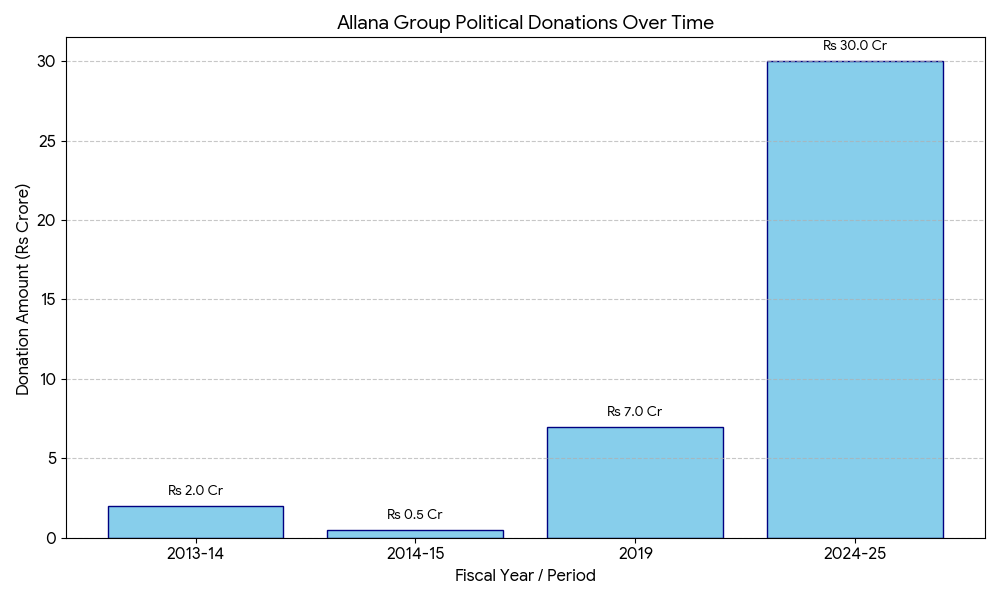
In 2019, the Income Tax Department raided over 100 premises linked to the company, alleging tax evasion of nearly Rs 2,000 crore. Soon after, the group began purchasing electoral bonds — buying Rs 7 crore worth in 2019, donating Rs 5 crore to the Shiv Sena and Rs 2 crore to the BJP — adding to earlier donations of Rs 2 crore in 2013–14 and Rs 50 lakh in 2014–15. Contributions surged 15 times by 2024–25.
Global trade shifts also reshaped the industry. China’s 2019 crackdown on Indian beef citing diseases, made the exporters shift to new markets like Egypt and Malaysia, where shipments have since doubled compared to 2017–18.
Despite anti-beef rhetoric at home, the Modi government facilitated this push. In January 2023, it urged Indonesia to increase imports and introduced halal certification guidelines, effective October 2024, targeting West Asia, Turkey and Singapore. Egypt, now India’s second-largest market, plans an India office to oversee halal standards.
As Ayush Tewari’s reporting shows, the story of India’s beef industry is not one of decline under Hindutva politics — but of expansion into new horizons, effectively setting up a distinct “Made in India” buffalo meat corridor to Egypt, Malaysia and other international markets.