
Electoral Power, Developmental Marginality: Muslims in West Bengal
Muslims in West Bengal are electorally decisive yet structurally marginalized. Despite shaping political outcomes, their access to education, jobs, healthcare, and political representation remains limited, alongside rising concerns over voting rights through SIR.

West Bengal is heading toward elections scheduled for 23 and 29 April. As in previous elections, Muslims in the state are largely framed through two dominant and reductive lenses. They are viewed either as a consolidated “vote bank” or through stigmatising labels like “infiltrators.” Even powerful political leaders routinely invoke such language in their public language. This leads us - perhaps dangerously - to the question that among these competing narratives, where is the issue of development?
Muslims make up about 27% of West Bengal's population, making them a demographically significant group. In several assembly constituencies, their voting patterns play a decisive role in shaping electoral outcomes, underscoring their political importance. But when we look at the very community through development indicators and institutional representation, a markedly different picture emerges.
This article argues that Muslims in West Bengal occupy a structurally paradoxical position - one of electoral indispensability and institutional marginalisation. It examines three interrelated dimensions: the developmental profile of the community, the political economy of Muslim voting behaviour, and emerging threats to voting rights through the Special Intensive Revision (SIR) process.
Political Significance of Muslims in West Bengal
To begin with, it is necessary to understand the political importance of Muslims in the state. Approximately 125 assembly constituencies in West Bengal are such that Muslim votes directly influence electoral outcomes. Victories in these constituencies have historically determined which party forms the government, making it impossible for any political formation to ignore this community. Victories in these constituencies have historically determined which party forms the government, so any political formation can’t ignore this community.
We can see this in brief from a timeline. In 2006, when the Left Front was at its peak, the CPI(M)-led alliance won 102 out of these 125 seats. In 2011, the TMC–Congress alliance secured 95 seats, bringing an end to 34 years of Left rule. In this major political shift, Muslim voters played a decisive role.
Additionally, analyses by the SABAR Institute and Alt News suggest that, during the Special Intensive Revision (SIR) process, higher rates of voter deletion were observed in areas with larger Muslim populations. This is worrisome - it suggests that such patterns may grant direct electoral advantages to a specific party. But underneath these electoral dynamics - which I’ll discuss later in the article - is a more complex structural reality.
While Muslims are one of the key determiners of what happens in the elections in West Bengal, their presence at institutional power structures, particularly higher administrative levels, employment in government, and key decision-making institutions, tends to be marginal (Sachar Committee, 2006; Association SNAP & Guidance Guild, 2016). This touches on an underlying democratic question: whether it is enough for a community to be electorally important only on polling day, or is equitable participation within institutional structures equally necessary?
Developmental Profile
a) Rural Concentration and Structural Disadvantage
Only about 19 per cent of Muslims in West Bengal live in urban areas, compared to the state average of 32. This disparity is significant. Rural dwelling, in the Indian context, is not just a condition associated with geography, but a significant factor defining opportunity. Areas having much more rural concentration also tend to have less schools, less medical care and often fewer employment opportunities, all of which influence development.
The SNAP report indicates that nearly 47% of Muslims in rural areas are engaged in agricultural labour or daily wage work. In contrast, representation in regular employment remains extremely limited: approximately 1.5% in the public sector and around 1% in the private sector (Association SNAP & Guidance Guild, 2016).
b) Income and Poverty
Income is another indicator of economic vulnerability. An estimated 80% of rural Muslim families earn monthly incomes of ₹5000 or less, and 38% earn below ₹2500 (Association SNAP & Guidance Guild, 2016). This translates into daily incomes of roughly ₹167 or less, with a significant proportion surviving on approximately ₹83 per day - comfortably low compared to the poverty line considered around the world. Under such conditions, it becomes extremely difficult for households to sustain basic needs, let alone ensure savings, access to healthcare, or educational opportunities for children.
c) Education
West Bengal is often regarded as a state with a strong educational tradition. However, data from Census 2011 reveal significant disparities. The overall literacy rate in the state stands at 76.3%, whereas among Muslims it is 68.7%. In districts such as Uttar Dinajpur, which have a high Muslim population, literacy rates fall to approximately 60%.
Low literacy is not a coincidence, but a result of the inequitable distribution of educational infrastructure. Based on the SNAP report, only 4.6 government-managed primary schools per 10,000 people were in regions with more than 50% Muslim population, whereas there were 7.7 schools in regions where the Muslim population is less than 15% (Association SNAP & Guidance Guild, 2016). It goes on to say that the current scenario at the tertiary level is even graver. By comparison, in Kolkata, one college caters to about 11,000 students — as much as 56,000 in Muslim-majority districts, and 76,000 students per college in Uttar Dinajpur. The result is that only ~2.7% of Muslims attain graduate education (Association SNAP & Guidance Guild, 2016).
The SNAP survey also found that 14.4% of Muslim children in the 6–14 age group were out of school - of whom 5.4 percentage points had dropped out and 9.1 percentage points had never enrolled at all. Official records show that Uttar Dinajpur, Malda, and Murshidabad trail far behind the state average in secondary and higher secondary school density.
d) Health
The disparity across the health sector is also similar. According to the SNAP report, regions with larger Muslim populations also tend to have weaker health infrastructures. Most health facilities are 6 to 20 kilometers away. District-level data further indicate that among the six worst-performing districts in terms of hospital availability per lakh population, all have Muslim populations exceeding 25%. In districts such as Murshidabad, Malda, and Uttar Dinajpur - where Muslims form a majority - their representation in government medical colleges is around 3% (Association SNAP & Guidance Guild, 2016).
Health outcomes reflect this structural gap. As per NFHS, the under-five mortality rates for Muslim communities in West Bengal are around 31 per 1000 live births while the Hindu population is around 22. This becomes even more impactful in view of the fact that at the national level, Muslim child mortality is very often lower than the Hindu average — making West Bengal's reversal of this pattern a significant outlier that demands explanation.
Voting Rights and the SIR Process
The issue extends beyond narratives to institutional processes. The Special Intensive Revision (SIR) in West Bengal reportedly led to the deletion of approximately 9 million voter names from electoral rolls. The distribution of these deletions raises serious concerns about democratic integrity. Murshidabad recorded approximately 460,000 deletions; North 24 Parganas, 330,000; and Malda, 240,000 - all districts with large Muslim electorates. In Nandigram, where Muslims constitute about 25% of the population, approximately 95% of deleted names reportedly belonged to Muslim voters. In Manikchak, where Hindu and Muslim populations are nearly equal, over 97% of names in discrepancy lists were Muslim. Similar patterns are observed in Samserganj and Mothabari.
These patterns raise serious concerns. Are they the result of technical errors, or do they indicate deeper issues related to electoral neutrality?
To justify this process, a parallel narrative has emerged in public discourse. Through memes, political statements, and media amplification, it has been suggested that many of the deleted voters were “Bangladeshi Muslims.” This framing has been echoed by prominent political leaders, including at the highest levels of government. However, when examined in the context of administrative procedures and available data, such claims do not hold up to scrutiny.
First, it is important to clarify that the SIR is not a test of citizenship. It is an administrative exercise aimed at updating electoral rolls by matching and verifying records. Inclusion in a “logical discrepancy” list does not imply that an individual is a foreign national. Such discrepancies often arise from routine issues such as spelling mismatches, errors in record linkage, or digitization-related inconsistencies. These are common administrative challenges and cannot, in themselves, be used to infer questions of nationality. Notably, reports indicate that the scale of mismatches increased in this round of SIR due to reliance on software systems whose accuracy has itself been questioned, and that such discrepancies affected not only Muslims but also a significant number of Hindu voters.
Second, documented cases further complicate the story. Instances have been reported where individuals with verifiable credentials, including a Wing Commander who served in the Indian Air Force for 17 years and even a former High Court judge, found their names excluded from electoral rolls. These cases highlight that the issue is not merely about individual identity but about systemic reliability. If such well-documented individuals can be affected by administrative discrepancies, the implications for ordinary citizens - particularly those with limited documentation or resources - are far more serious.
Political Context and Historical Trajectory
To situate these developments, it is necessary to examine the broader political context. In the post-independence period, West Bengal was governed by the Indian National Congress, with a focus on rehabilitation, industrialization, and institution-building. However, by the 1960s, economic slowdown, unemployment, food shortages, and labour unrest led to new forms of political mobilization.
In contrast to places like Uttar Pradesh and Bihar, where caste emerged as the main political axis after Mandal politics came to power, West Bengal’s political structure morphed very differently. Refugees, the dominance of the bhadralok and a strong Left tradition influenced the politics on class rather than caste. Within this milieu, the Communist Party of India (Marxist)-led Left Front took power in 1977. Land reforms, most notably Operation Barga, created legal certainty for sharecroppers and the power relations in the countryside were altered. Yet these rewards were not distributed equitably.
Muslims, despite being largely rural and landless, did not proportionately benefit. Local party structures dominated by the bhadralok limited equitable access to land redistribution, education, and employment. Thus, while Muslims remained electorally important, their structural inclusion remained limited. The Sachar Committee Report (2006) formally documented the socio-economic deprivation of Muslims, contributing to political change. In 2011, the TMC–Congress alliance ended Left rule, with Muslim voters playing a crucial role.
Initially, representation improved. The number of Muslim MLAs increased from 44 in 2006 to 61 in 2011, and cabinet representation also rose. However, by 2016 and 2021, this momentum had declined, with representation reverting to earlier levels.
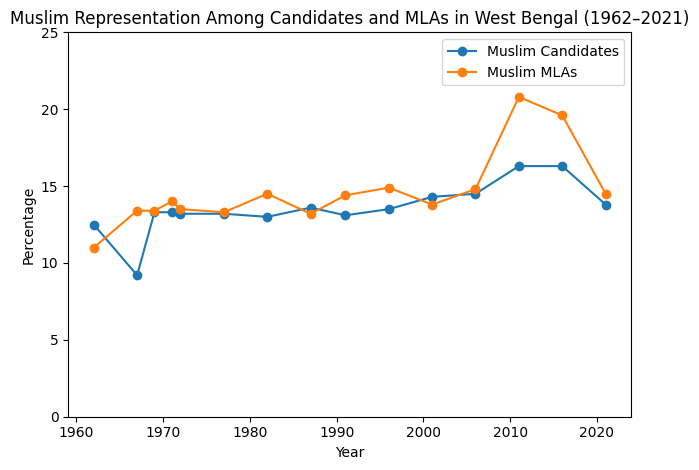
This trend can be explained by several structural factors. First, the TMC’s focus changed after it amassed power, diminishing the imperative to accommodate Muslim presence. Second, the BJP reshaped Hindu consolidation dynamics, prompting the TMC to embrace a balancing strategy - drawing on Muslim support, whilst curbing overt association. Third, because “viable” political alternatives are scarce, there was this “captive voting” - electoral support persisted, even as representation fell away. The result has been consistent: Muslims remain electorally indispensable but politically underrepresented.
Una comparación útil de camisetas de fútbol por equipo comienza por la talla, el material y el uso previsto. Como comprobación final, conviene asegurarse de las instrucciones de cuidado y cualquier límite aplicable a la personalización.
Conclusion
The evidence and data we’ve looked at so far illustrates a trend: Muslims in West Bengal are electorally central but structurally marginalized. They are key players in elections yet underrepresented in governance and disadvantaged across key development indicators. Political inclusion has been episodic rather than structural. As growing concerns for voting rights rise alongside persistent developmental gaps, the question rises beyond electoral politics to a democratic equality question. As you might read, however, what is at stake for communities now in a democracy: Should this community only matter in an election for which it is valued - or should it share the same rights in the political system?
Sources: Sachar Committee Report (2006); SNAP/Association Guidance Guild Report (2016); NFHS (various rounds); Census of India (2011); Ministry of Minority Affairs Implementation Report (2018); Lokniti-CSDS Post-Poll Survey (2021). Baji official payments page