Economic Fundamentalism and the Commercialization of Human Vulnerability
Dr. Javed Jamil examines how modern economics—from the Industrial Revolution to today’s “Billionaire Raj”—has deepened inequality. Discussing inflation, taxation, banking, and Zakat, he questions whether economic systems should serve profit alone or promote health, justice, and social peace.


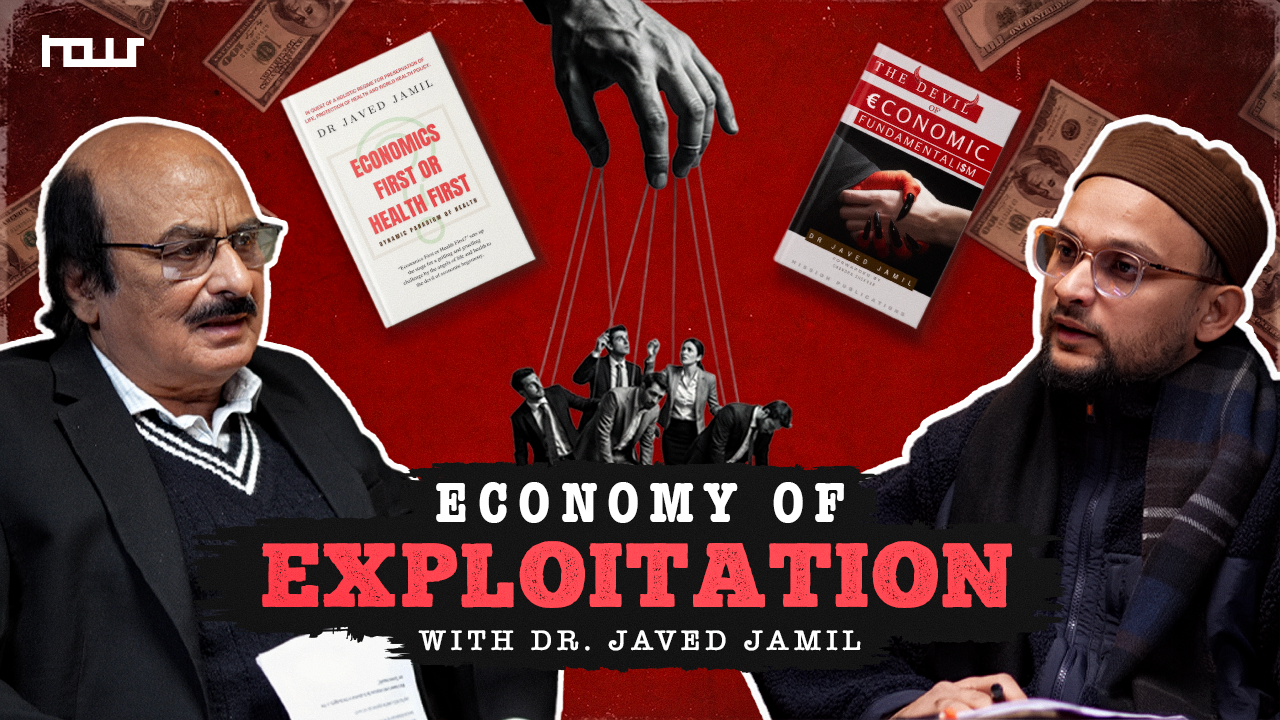
In this important conversation, Dr. Javed Jamil explains how economics has shaped the world since the Industrial Revolution—and why inequality keeps growing. Referring to studies like those of Thomas Piketty, we discuss the shift from “British Raj” to “Billionaire Raj” and what real economic growth actually means after accounting for inflation.
The episode explores how wealth accumulation affects markets, why the poor still pay taxes through everyday purchases, and how modern banking can trap people in cycles of debt. Dr. Jamil also explains Zakat as a form of wealth balance and compares Islamic economic principles like Musharaka and Mudaraba with capitalism.
Most importantly, we ask: Should economics promote health, social security, and peace—or profit at any cost? A clear and thought-provoking discussion on inequality, exploitation, and the moral purpose of economic systems.
Rethinking Growth, Wealth, and the Moral Purpose of the Economy
A deep analysis of “Economic Fundamentalism” based on Dr. Javed Jamil’s insights—examining corporate power, inequality, taxation, inflation, and the role of Zakat in building a health-centred economic model.
For centuries, economics functioned as a means to an end — a framework designed to ensure survival, stability, and social welfare. In the modern age, however, economics has evolved into something far more dominant and far more intrusive. It no longer merely supports civilization; it defines it. Growth, profit, and market expansion have become supreme objectives, often pursued without regard for human health, social balance, or moral limits.
In a compelling and far-reaching discussion, Dr. Javed Jamil describes this transformation as the rise of Economic Fundamentalism — an ideology that elevates economic growth above all other human values. In this system, economics is not a tool serving society; society becomes a tool serving the economy.
The result is a global order that monetises vulnerability, institutionalises inequality, and normalises exploitation under the language of freedom and development.
From Democracy to Corporatocracy
Modern political systems continue to call themselves democracies. Yet, in practice, power has increasingly shifted from citizens to corporations. According to Dr. Jamil, we are witnessing the consolidation of what may be described as a Corporatocracy — a system in which policies are shaped by corporate priorities, political actors operate within corporate influence, and public institutions often facilitate private capital accumulation.
This shift is not accidental. Since the Industrial Revolution, economic growth has become the central organizing principle of governance. Over time, corporations have acquired unprecedented leverage over legislation, media narratives, and public policy. Economic expansion is treated as synonymous with national success, regardless of its social consequences.
In such an environment, health, education, housing, justice, and even human relationships are commodified. The value of a policy is judged less by its moral or social impact and more by its contribution to measurable economic output.
The Commercialization of Human Weakness
Historically, commerce focused on fulfilling human needs. Today, it increasingly thrives on manufacturing desires — and more disturbingly, exploiting vulnerabilities.
Entire industries profit from addiction, impulse, insecurity, and psychological frailty. Alcohol, tobacco, ultra-processed food, gambling platforms, and addictive digital technologies generate immense revenues precisely because they cultivate dependency. Their profitability often depends on excess consumption.
The system functions through a cyclical logic: first, it commercialises the problem; then, it commercialises the solution.
Substances and products generate illness, addiction, and social breakdown. Subsequently, pharmaceutical companies, rehabilitation centres, legal systems, insurance providers, and private healthcare institutions profit from managing these consequences. The same economic framework benefits from both the cause and the cure.
Under Economic Fundamentalism, suffering becomes economically productive.
This cycle does not merely reflect market dynamics — it reveals a structural moral inversion, where reducing harm becomes less profitable than sustaining it.
GDP Growth and the Illusion of Prosperity
Gross Domestic Product (GDP) is frequently presented as the definitive measure of progress. Yet GDP measures economic activity, not human wellbeing.
A rise in disease increases healthcare spending and boosts GDP. An increase in litigation expands the legal industry and raises GDP. Environmental degradation followed by reconstruction stimulates economic output.
Growth figures can rise even as social trust declines, inequality widens, and public health deteriorates.
In India, this paradox is evident. The country ranks among the world’s largest economies in aggregate size. Yet per capita income remains comparatively low, and wealth concentration has intensified dramatically. Asset ownership is increasingly concentrated among a small elite, while millions struggle with precarious livelihoods.
Economic expansion has not translated into proportional social security.
Inflation: The Silent Transfer of Wealth
Inflation plays a subtle but powerful role in deepening inequality.
For wage earners and small savers, inflation erodes purchasing power. Essential goods become more expensive while incomes fail to keep pace. For asset holders, however, inflation often increases the value of real estate, equities, and commodities.
Thus, inflation functions as an invisible transfer of wealth from labour to capital.
While nominal GDP may rise, real economic growth — once adjusted for inflation — is often far more modest. Yet policy narratives continue to celebrate gross growth without acknowledging this distortion.
The Banking Structure and Upward Redistribution
The modern banking system appears inclusive: millions deposit savings into banks. But structurally, these deposits are aggregated into large capital pools that primarily finance corporate ventures.
Small depositors receive minimal returns, frequently below inflation rates. Corporations, however, access substantial loans and generate amplified returns. When large corporations default, state mechanisms often intervene to restructure or absorb losses. When individuals default, consequences are severe and personal.
This asymmetry reflects a systemic bias — capital is stabilised, labour is exposed.
Taxation: Rewarding Accumulation, Penalising Survival
Contemporary taxation models rely heavily on income tax and indirect taxes such as GST or VAT. These mechanisms disproportionately affect those who earn through labour and spend on necessities.
Indirect taxes are regressive: a daily wage worker pays the same tax rate on essential goods as a billionaire. Meanwhile, accumulated wealth in assets often faces minimal recurring taxation.
This structure discourages productive effort while permitting intergenerational wealth concentration. Over time, wealth consolidates into dynastic holdings, reducing economic mobility and reinforcing structural hierarchy.
Zakat: A Structural Alternative to Wealth Concentration
One of the most significant contributions of Dr. Jamil’s analysis is his emphasis on Zakat as a structural economic instrument rather than merely a religious obligation.
Zakat, in its classical formulation, is a recurring wealth tax — typically around 2.5% annually — imposed on accumulated, idle assets such as savings, gold, and trade goods. Its function is not punitive; it is circulatory.
Unlike income tax, which taxes production, Zakat taxes hoarding. It encourages wealth to remain in economic circulation rather than stagnate in concentrated holdings.
If wealth is subject to recurring levy, individuals are incentivised to invest it productively. Idle accumulation becomes economically inefficient. Capital flows more dynamically into enterprises, social welfare, and productive ventures.
Moreover, Zakat is directly redistributive. It is earmarked for vulnerable segments of society — the poor, the indebted, and those deprived of opportunity. It embeds social responsibility within the architecture of wealth itself.
In contrast to modern systems that permit indefinite accumulation, Zakat structurally moderates inequality.
It represents a model where economic circulation is tied to moral obligation, and wealth is understood as a trust rather than an absolute entitlement.
Economics as the Stomach, Not the Soul
Dr. Jamil offers a striking metaphor: economics is like the stomach of the human body. It is essential for survival, but it is not the purpose of existence.
When the stomach dominates life, health deteriorates. Similarly, when economics becomes the supreme objective, social balance collapses.
A healthy civilization must subordinate economic expansion to broader human goals — dignity, justice, health, peace, and moral equilibrium.
Redefining Success: A Holistic Measure of Peace
What would an alternative metric of progress look like?
Dr. Jamil proposes a simple yet profound standard: a successful system is one that minimises disease and minimises violence.
If economic growth coincides with rising mental health crises, lifestyle diseases, domestic conflict, addiction, and social fragmentation, it cannot be considered progress.
True prosperity must reflect improvements in public health, reductions in exploitation, equitable access to opportunity, and preservation of social harmony.
The Choice Before Us
Economic systems are not natural laws; they are human constructions. They can be redesigned.
The critical question is whether societies will continue to organise themselves around profit maximisation — even when it erodes social wellbeing — or whether they will reclaim economics as a servant of humanity.
Economic Fundamentalism has normalised the monetisation of vulnerability. But alternative frameworks — rooted in ethical circulation, distributive justice, and human-centred priorities — remain available.
The future of democracy, equality, and social peace may depend on which path we choose.
Support Independent Media That Matters
Nous is committed to producing bold, research-driven content that challenges dominant narratives and sparks critical thinking. Our work is powered by a small, dedicated team — and by people like you.
If you value independent storytelling and fresh perspectives, consider supporting us.
Contribute monthly or make a one-time donation.
Your support makes this work possible.